
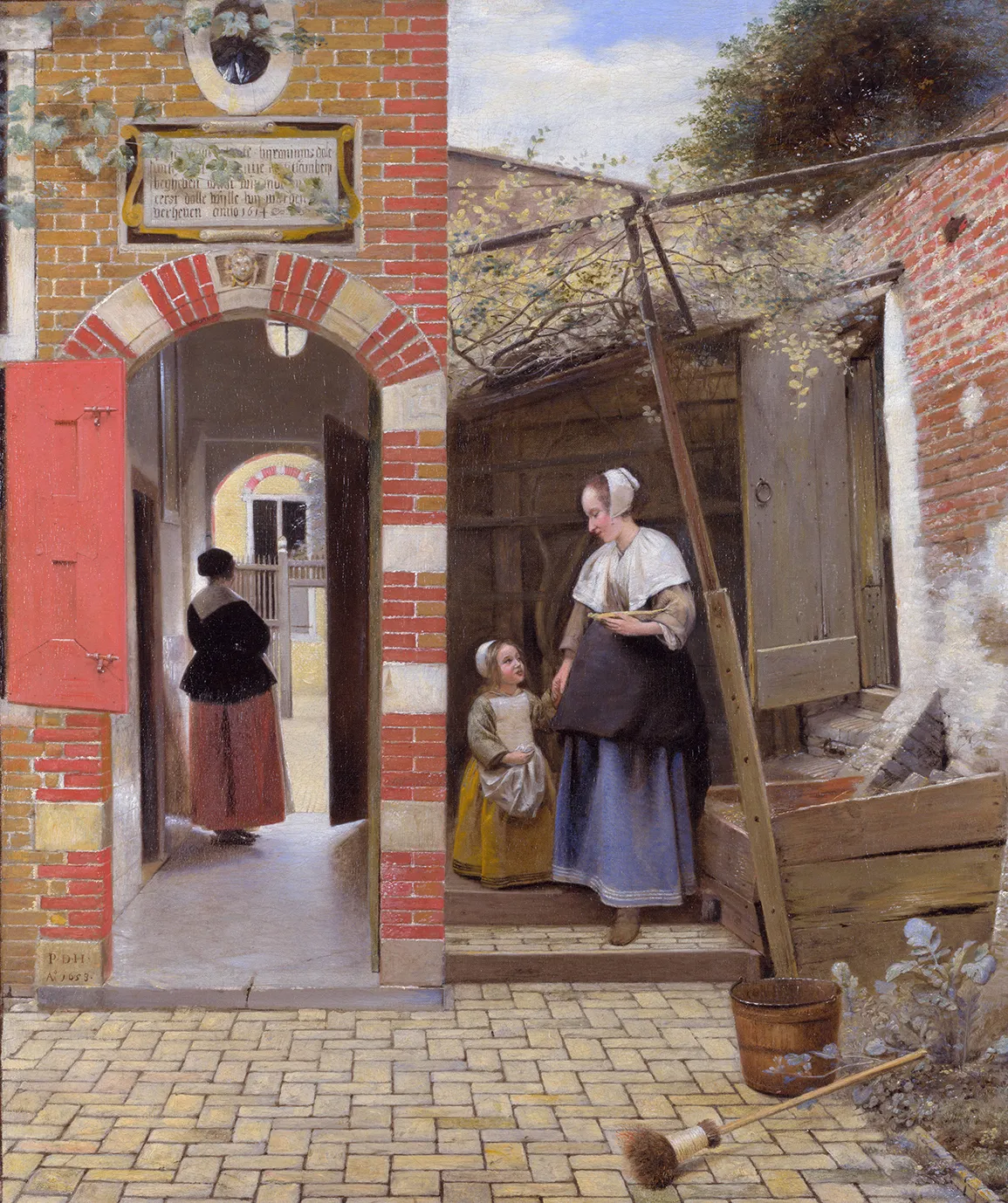
The Courtyard of a House in Delft
1658
- Dimensions
- 縦 73.5 cm × 横 60.0 cm
- Medium
- 油彩・カンヴァス
- Collection
- ロンドン・ナショナル・ギャラリー
日常の地道な家事労働の中にある「謙遜」と「忍耐」という美徳を、光と影の緻密な計算によって永遠の理想空間として描き出したかった。
✦ Highlights (technique & color)
画面右下の草地やツタは、黄色い絵の具が退色したため現在は青みがかって見えるが、当初は鮮やかな緑色だった。また、アーチ通路の右側の柱に向けて「ピンホール技法」による厳密な遠近法が用いられ、明るい前庭、暗い通路、明るい通りという光と影の層が圧倒的な奥行きを生んでいる。
✦ The setting of this painting
17世紀半ばのオランダ・デルフト。実在するヒエロニムスダール修道院の石碑(1614年銘)などの要素と、画家の想像を組み合わせた「合成的景観」の中庭。
✦ Historical context
17世紀ネーデルラント連邦共和国(オランダ黄金期)。カルヴァン主義の道徳観に基づき、家内空間が神聖視され、清掃や家事労働を通じた「整然とした家庭」が市民の理想とされた時代。
Soft afternoon sunlight gently illuminates red brick walls and cobblestones. In a quiet courtyard in the Dutch city of Delft, a young maid in a blue apron tenderly clasps the hand of a little girl in a yellow dress. A shallow dish rests in her hand, and an air of quiet serenity flows between them. Shifting one's gaze to the left, deep within a dim, arched passageway, a woman in elegant red and black attire stands quietly, looking out toward the street beyond. In the silence of his studio, the painter Pieter de Hooch faced his canvas, determined to render this fleeting, ordinary moment into an enduring scene. With every brushstroke, he may well have woven a prayer of his own into this world of interwoven light and shadow.
Family Whispers in a Quiet Courtyard
Standing before this painting, anyone might feel enveloped by its warm, domestic atmosphere. Indeed, from the nineteenth through the early twentieth century, a romantic theory circulated regarding the figures depicted here. Rumor had it that the woman in the distant passageway was De Hooch's wife, Jannetje, and the little girl holding the maid's hand in the foreground was their own daughter. People took it for granted that the painter had simply transcribed the daily life of his beloved family onto canvas.
Later research, however, revealed that no contemporary records or letters exist to support this heartwarming tale. Rather than portraits of specific individuals, the figures represent an idealized vision of home. Even more remarkably, the picturesque courtyard itself was not painted directly from life. In truth, this view was a composite landscape, artfully combining real architecture with the painter's imagination. Rather than merely recording the scene before him like a camera, De Hooch was constructing an idealized vision of domestic life from the ground up upon his canvas.
Days Spent Sketching a Neighborhood Tablet
In composing this picture, De Hooch did not invent everything out of whole cloth. He walked the streets of Delft, gathering fine fragments from the scenery around him. The heraldic stone tablet set above the archway on the left is a very real historic relic. Originally, it had been mounted over the entrance to the Hieronymusdale convent along a Delft canal. After the convent was dissolved during the Reformation, the tablet was removed and relocated to the garden wall of a private residence.
Records show that in 1652, De Hooch lived right near the residence where this tablet had been installed. He regularly observed the neighborhood buildings, keenly sketching their architectural details to amass material for his work. Familiar sights from his surroundings and an ancient tablet steeped in history—he brought these fragments of reality back to his studio, transforming them through the magic of imagination into an entirely new, unified world.
Lost Colors Revealed by Scientific Analysis
The painting we see in the museum today differs subtly from the appearance De Hooch originally created. The ivy clinging to the wall on the right and the patch of grass underfoot have taken on a somber, distinctly bluish hue. For many years, this was assumed to be an intentional, somber touch by the artist. Yet advanced analysis carried out by the Scientific Department of the National Gallery in London brought a remarkable fact to light.
Microscopic examination and chemical analysis revealed that the organic yellow pigment used to produce the lush green of the foliage had faded completely over centuries of light exposure. Painters of the era created green by blending blue pigment with yellow dye. Over time, however, the light-sensitive yellow vanished, leaving only the durable blue behind on the canvas. Consequently, the ivy and grass in De Hooch's day were not the dark blue we see now, but a warm, vibrant green. What the artist truly intended to depict was a luminous garden glowing with life and sunlight.
About 644 more words
Read the rest of this commentary —
and step into a secret gallery
opened just for you
An "art letter" delivered to you every Saturday morning
Works, music and words chosen for your sensibility, from your artist-type result and the paintings you love
A library of masterpieces and music you can enjoy "in your own words", not just look at
A "digital art notebook" (unlimited) where your impressions build into your own taste
Unlimited likes and notes
¥980 / month¥0 today
¥980/month (tax incl.) from day 8. Cancel anytime.
Already have an account? Log in
Your Note
Write down what this painting made you feel in your art notebook.
Please sign up to write notes.
Sign up for freeRecommended Artworks
Sources & references
More artists



If you find an error in this content, please let us know here
This site is protected by reCAPTCHA, and the Google Privacy Policy and Terms of Service apply.