
 日本語 (JA)
 English (EN)
- Dimensions
- 62.0 × 46.4 cm
- Medium
- 油彩、カンヴァス
- Collection
- 個人蔵

An English painter deeply influenced by the spirit of the Pre-Raphaelite Brother…
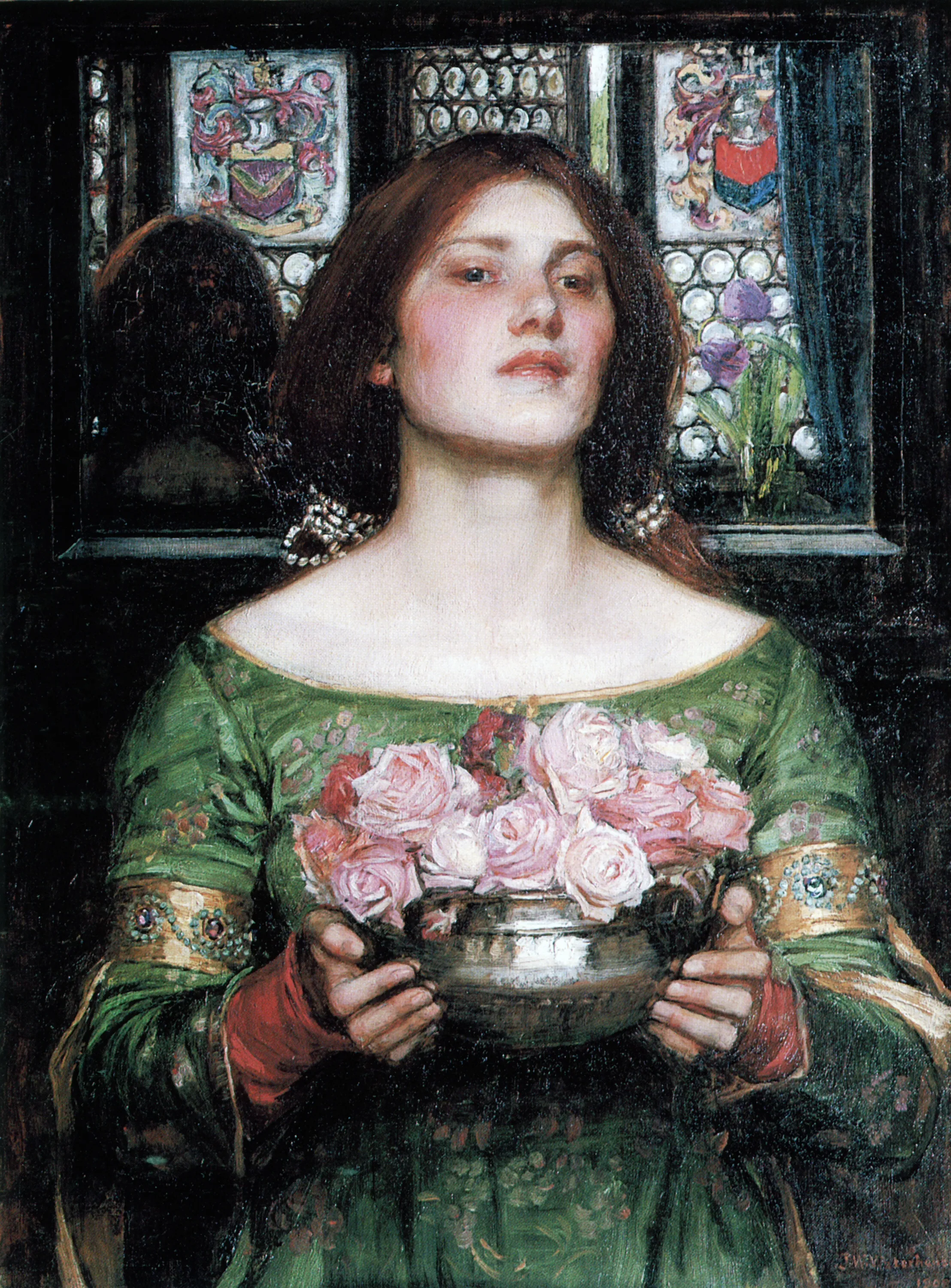
女性と花を「いずれ衰えゆく美」であると同時に「新たな成長の種子を宿す存在」と重ね合わせ、避けることのできない時の経過と美の頂点を描いた生命の探求。
✦ Highlights (technique & color)
明るい光と影の対比、そして計算された色づかいです。左側の窓から差し込む光が、女性の顔立ちや手元の金属碗を印象的に浮かび上がらせています。研磨された鉢の表面には周囲の光やドレスの緑が映り込み、繊細な輝きを放ちます。色彩の最大の特徴は、衣装や背景の「緑」と、女性の赤髪や薔薇の「赤・ピンク」による補色の組み合わせです。この対比が画面に重厚さと華やかさをもたらし、観客の視線を女性の表情から手元の薔薇へと滑らかに導きます。
✦ The setting of this painting
描かれている室内は、実在する部屋の写生ではなく、画家が構想した歴史主義的なインテリアです。画面奥には円形の底型ガラスを用いたボトルグラス窓があり、手前にはV字型の紋章入りの窓が映り込む大きな鏡が配置されています。これらは、画家ウォーターハウスがロンドンのスタジオに用意した小道具でした。室内には窓から光が注ぎ、真鍮の鉢に生けられたピンクや赤の薔薇を照らし出しています。画家の頭の中にあった中世ロマン主義の世界が、スタジオ内で再現された舞台です。
✦ Historical context
本作が制作された1908年は、イギリスのエドワーディアン時代の渦中にあたる。産業革命による急速な都市化の反動として、中世の田園生活や古代神話へのノスタルジーが富裕層の間で高まっていた。また、1897年に創設されたテイト・ギャラリーなどの存在により、ラファエル前派の美学は国民的芸術として定着していた。前衛芸術運動が台頭し始めた時代において、59歳のウォーターハウスは伝統的な美意識と具象技術を守り抜き、イギリス歴史主義絵画の最終的な成熟を示した。
Why a Barrister Stopped in His Tracks in the Summer of 1908
The summer of 1908.
The exhibition galleries in London were bustling with crowds.
It was the Summer Exhibition of the Royal Academy.
Sir Frederick M. Fry, a barrister, was walking quietly through the rooms.
Then, he stopped in his tracks.
An oil painting hanging on the wall caught his eye and refused to let go.
Within the frame stood a red-haired woman.
She was clad in a heavy, medieval-style green dress.
With both hands, she tenderly cradled a shallow metal bowl.
The brass bowl was filled with freshly gathered pink and red roses.
Light from a window before her cast a strong radiance upon her neck and shoulders.
In the shadows of the background hung a large rectangular mirror.
Reflected clearly upon its surface were round bottle-glass panes and a chevron coat of arms.
It was a scene bathed in quietude and imbued with an undeniable nobility.
The artist was John William Waterhouse, then fifty-nine years old.
He was celebrated as one of the preeminent figures of the British art world.
Waterhouse had composed this canvas in his London studio.
Arranging historic garments and vessels, he meticulously calculated every play of light.
Right then and there, Fry decided to purchase the painting.
The work was titled "Gather Ye Rosebuds While Ye May."
It drew its name from the verse of the seventeenth-century poet Robert Herrick.
The poem spoke of the transience of youth and beauty.
It offered the timeless counsel: "Gather ye rosebuds while ye may."
A Deep Bond Formed Beside the Canvas
This purchase marked the beginning of a profound friendship between the two men.
Fry became an ardent collector of the artist's works.
He acquired six oil paintings alone.
Numerous drawings were also added to his collection.
Among his acquisitions was Waterhouse's 1909 painting "Lamia."
Their relationship soon went far beyond that of patron and painter.
In 1917, Waterhouse succumbed to cancer and departed this life.
He was sixty-seven years old.
Among those gathered at the somber funeral was Fry.
Fry continued to cherish "Gather Ye Rosebuds While Ye May."
He hung it upon the wall of his home and never parted with it for the rest of his days.
Long after the painter had passed away, the canvas remained at Fry's side.
Yet the tides of the era were shifting inexorably.
Toward the middle of the twentieth century, public taste underwent a profound transformation.
Victorian and Pre-Raphaelite art came to be regarded as hopelessly out of fashion.
The acclaim of yesteryear vanished, and Waterhouse's name slowly slipped from memory.
Many decades passed following the artist's death.
Yet the story was far from over.
About 377 more words
Read the rest of this commentary —
and step into a secret gallery
opened just for you
An "art letter" delivered to you every Saturday morning
Works, music and words chosen for your sensibility, from your artist-type result and the paintings you love
A library of masterpieces and music you can enjoy "in your own words", not just look at
A "digital art notebook" (unlimited) where your impressions build into your own taste
Unlimited likes and notes
¥980 / month¥0 today
¥980/month (tax incl.) from day 8. Cancel anytime.
Already have an account? Log in
Stories featuring this painting
Your Note
Write down what this painting made you feel in your art notebook.
Please sign up to write notes.
Sign up for freeRecommended Artworks
More art movements
Pre-Baroque
1 artworks
Victorian era
10 artworks
Impressionism
48 artworks
Late Pre-Raphaelite
10 artworks
Baroque
2 artworks
American Impressionism
5 artworks
Realism
4 artworks
Pre-Raphaelite
3 artworks
Barbizon School
5 artworks
Academic art
5 artworks
Luminism
3 artworks
Rococo
2 artworks
Symbolism
22 artworks
Neo-Impressionism
3 artworks
Ukiyo-e
1 artworks
Japonism
4 artworks
Edo period
1 artworks
Fauvism
1 artworks
Naturalism
9 artworks
Russian Realism
1 artworks
Post-Impressionism
13 artworks
Genre painting
9 artworks
Neoclassicism
3 artworks
ウィーン分離派
7 artworks
自然主義
1 artworks
ナショナル・ロマンティシズム
1 artworks
未来派
1 artworks
More artists




If you find an error in this content, please let us know here
This site is protected by reCAPTCHA, and the Google Privacy Policy and Terms of Service apply.