
Death of Ellenai
1907
- Dimensions
- 縦 147 cm × 横 116 cm
- Medium
- 油彩・カンヴァス
- Collection
- ワルシャワ国立博物館
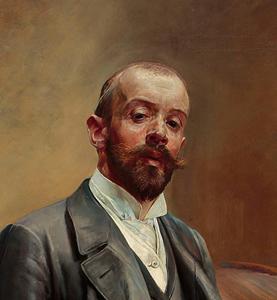
A leading figure of Polish modernism in the late 19th century, this painter inte…
1905年革命による祖国独立への期待の再燃を受け、民族の苦難と救済の象徴である物語を自らの成熟した象徴主義で再構築し、殉教の先にある民族復興のメッセージを提示した。
✦ Highlights (technique & color)
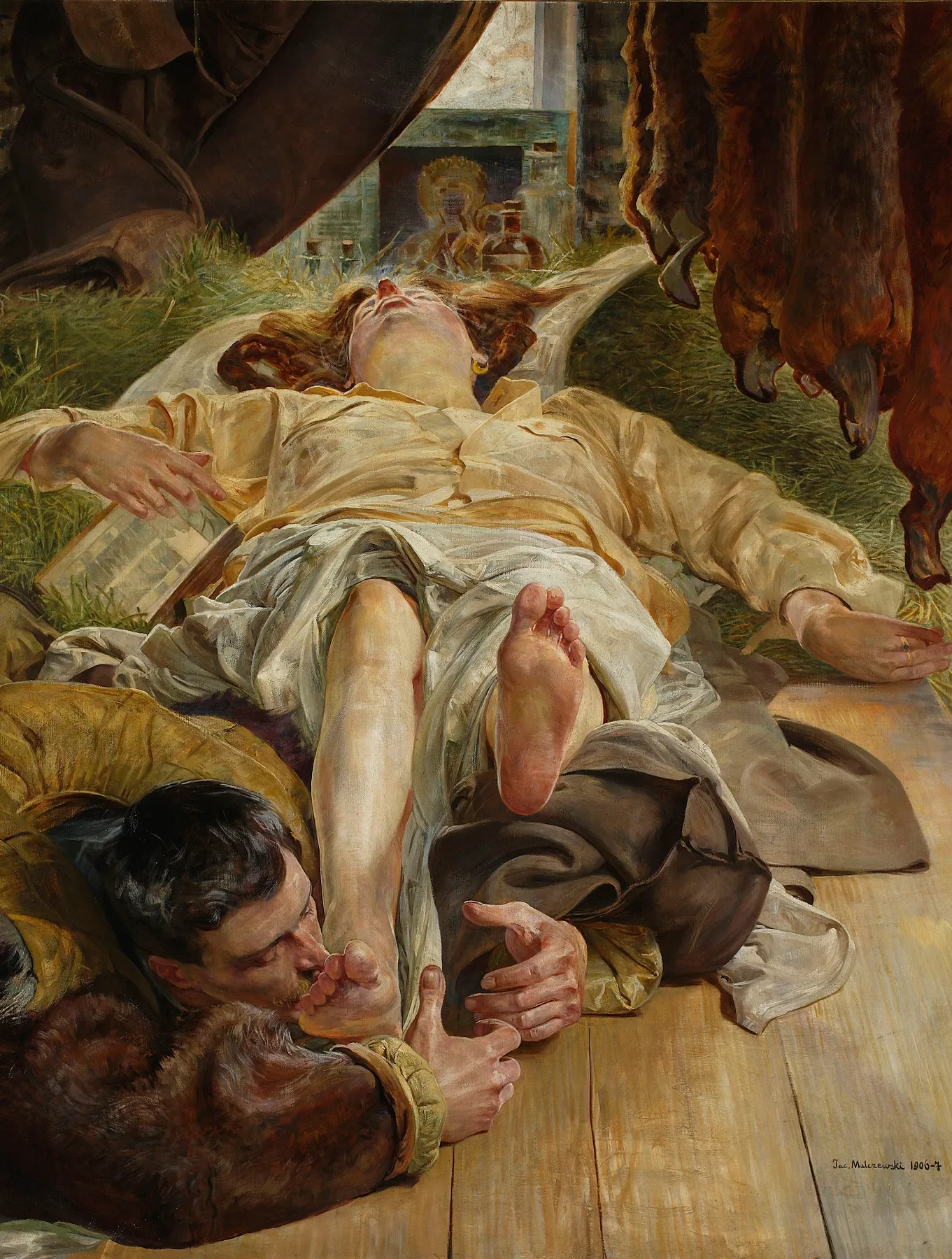
画面手前から奥へと至る極端な短縮法により、視線がアンヘッリの身体とエレナイの裸足から、彼女の体躯、頭部へと誘導される。暗褐色や金茶色のトーンの中で、エレナイの遺体と白い衣服、金髪に柔らかな散乱光が当てられ、明暗の強いコントラストを生んでいる。
✦ The setting of this painting
ユリウシュ・スウォヴァツキの散文詩『アンヘッリ』に着想を得た文学的・象徴的空間。1830〜1831年の11月蜂起後、ロシア当局によってシベリアへ流刑となったポーランド人愛国者たちが身を寄せる極寒地の粗末な丸太小屋の内部。
✦ Historical context
1906〜1907年前後、ロシア帝国支配下のポーランド王国において政治的波乱が極まった時期。1905年革命に伴い、国家独立の回復に対する強い予感が広がっていた。「若いポーランド」運動が展開され、象徴主義が追求された時代。
In a dim space enveloped in silence, a woman lies peacefully. Dressed in simple, pure white garments, her head tilts back, lips parted ever so slightly. Her limp, frail hand seems to barely hold the book she likely clasped until her final moments. Her golden hair catches a soft light against the dark background, bestowing a sacred aura upon the scene. And at her feet, a man is bowed, overcome with profound grief.
A Tragedy in a Frigid Chamber
This painting depicts the final moments of Ellenai, who has drawn her last breath upon a bed of straw inside a humble wooden hut. At her feet, overcome by despair and helplessness, a man named Anhelli collapses to his knees, pressing his head against her lifeless, bare feet to kiss them with fervent devotion.
Throughout his life, the painter Jacek Malczewski was deeply captivated by the world of Anhelli, a prose poem by the Polish Romantic poet Juliusz Słowacki. This work recounts the tribulations of Polish patriots exiled to the vast wilderness of Siberia by the Russian Empire. Cut off from the brutal frozen wasteland outside, the dark interior of the cabin—though a sealed chamber heavy with silence and the unsettling presence of death—is elevated into a solemn sanctuary for mourning a departed martyr.
Malczewski brought this tragedy of a frigid chamber to life on canvas not merely as a narrative illustration, but with an intensity that bared his very soul. Evoking the supreme act of love in the New Testament, where a repentant woman kissed the feet of Jesus, Anhelli's kiss embodies spiritual redemption and the ultimate form of human devotion amidst a land of suffering. The warmth of his breath touching her cold feet feels almost palpable from the canvas.
An Intriguing Composition Drawing the Viewer from the Feet
Standing before this painting, the viewer's gaze is captured first by Anhelli's body at the lower foreground and Ellenai's vulnerable bare feet. From there, one's eyes are smoothly guided along the diagonal across her reclining form to her head tilted back in the distance.
Here, Malczewski employs the technique of extreme foreshortening, receding from the foreground into the depth of the space. According to scholarly commentary from institutions such as the National Museum in Poznan, this dramatic composition framing the figure from feet to head clearly references the compositional solution found in Andrea Mantegna's Renaissance masterpiece, Lamentation over the Dead Christ.
The artist superimposed the sacred composition used by the Renaissance master for Christ's death onto the figure of a woman who perished in Siberian exile. Within a unified palette of subdued dark browns and golden russets, Ellenai's reclining body, white garments, and golden hair are illuminated by a gentle, warm light that contrasts sharply with the surrounding gloom. This powerful chiaroscuro creates a sense of sacred transcendence, as if the soul of the departed is rising beyond the physical body from within the harsh confines of the room.
The Artist's Secret Love Hidden in the Canvas
What Malczewski wove into this painting was not merely literary empathy or religious sublimity. Behind the two figures portrayed on the canvas lies the artist's own deeply private passion and secret romance.
The features of the deceased Ellenai distinctly reflect the visage of Maria Balowa, an aristocratic woman who was his cherished muse and lover. Meanwhile, the frame and head of the kneeling, grieving Anhelli unmistakably incorporate elements of Malczewski's own self-portrait.
At the time of its creation, Malczewski was in his early fifties and held an unshakeable position as a leading master of Polish art, serving as a professor at the academy of fine arts. In his private life, however, he was entangled in an impassioned love affair with Maria Balowa, a married woman in her mid-twenties. In 1906, the two traveled together to Italy, amid a swirling storm of artistic inspiration and personal turmoil.
By casting himself as the despairing Anhelli and his beloved as the lifeless Ellenai, the artist may have etched onto the canvas the impending tragedy of their parting and the crushing weight of an inescapable fate. Personal fervor and deep sorrow breathe vivid, poignant life into this work.
About 585 more words
Read the rest of this commentary —
and step into a secret gallery
opened just for you
An "art letter" delivered to you every Saturday morning
Works, music and words chosen for your sensibility, from your artist-type result and the paintings you love
A library of masterpieces and music you can enjoy "in your own words", not just look at
A "digital art notebook" (unlimited) where your impressions build into your own taste
Unlimited likes and notes
¥980 / month¥0 today
¥980/month (tax incl.) from day 8. Cancel anytime.
Already have an account? Log in
Your Note
Write down what this painting made you feel in your art notebook.
Please sign up to write notes.
Sign up for freeRecommended Artworks
Sources & references
More artists
If you find an error in this content, please let us know here
This site is protected by reCAPTCHA, and the Google Privacy Policy and Terms of Service apply.