
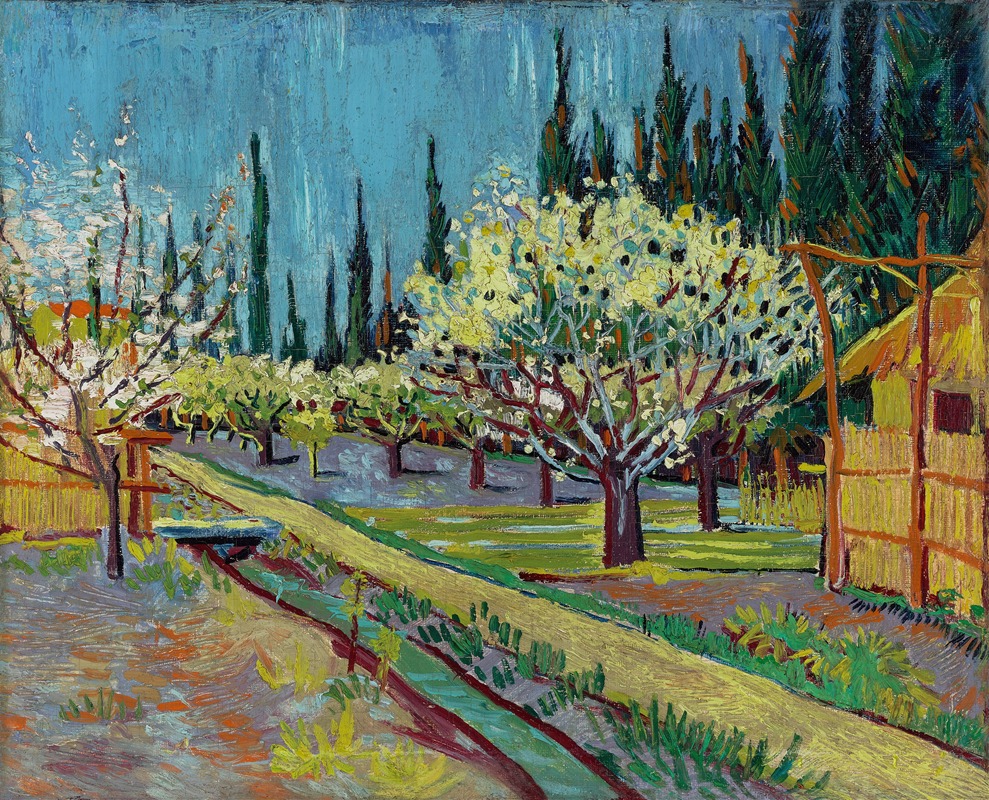
Orchard Bordered by Cypresses
1888
- Dimensions
- 64.9 × 81.2 cm
- Medium
- 油彩・カンヴァス
- Collection
- クレラー=ミュラー美術館
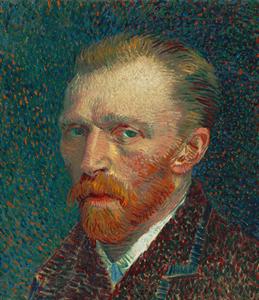
A Post-Impressionist painter who fundamentally revolutionized the visual languag…
日本の浮世絵に描かれたような光と明るい色彩に満ちた土地を南仏に見出し、自らの芸術的探求と将来の芸術家コミュニティのための大装飾計画を実現しようとした。
✦ Highlights (technique & color)
画面右下から左奥へと急勾配で上昇する対角線(小道と畝)が視線を誘導し、背景にそびえる糸杉の垂直線と交差することで画面に構造的な安定をもたらしている。上空の青と地表の黄色、高明度のパステルカラーと極めて深い緑黒色の糸杉など、補色と明暗の対比が極限まで活用されている。
✦ The setting of this painting
南フランスのアルル旧市街を囲む城壁の外縁部に広がっていた実在の果樹園。春のプロヴァンス地方に吹き荒れる冷たい局地風「ミストラル」からデリケートな果樹の花や野菜を守るため、農家の敷地の北西側に糸杉の防風林と葦の囲いが設置されている。
✦ Historical context
1880年代後半、フランス全国鉄道網の整備によりパリから南仏へのアクセスが容易になり、多くの画家が陽光を求めて移動した。また、金属製チューブ入り油絵具の普及が野外制作を後押しした。印象派からポスト印象派への過渡期であり、ジャポニスム(日本趣味)が流行していた時代である。
The clear light of a spring day illuminates an orderly plot of farmland. Beyond a woven fence of yellow reeds, fruit trees stand in full bloom with tiny white and pale pink blossoms, while dark green cypresses rise vertically toward the sky in the background. A wooden ladder lies on the ground in the lower right, subtly evoking the rhythm of human labor. Standing before this vivid, light-filled landscape, we witness the earnest hopes of a painter and his impassioned quest for a new form of art.
Escaping Paris for the Sun-Drenched South
In the late 1880s, Vincent van Gogh was living an intense urban life in Paris, the capital of the art world. Engaging with Impressionist and Neo-Impressionist painters and absorbing cutting-edge techniques made for an exhilarating existence, but the intricate relationships of the art scene and the clamor of the city gradually exhausted him, body and mind. Beneath cold, grey skies, Van Gogh's spirit began to yearn for somewhere else.
He dreamed of a land filled with light and brilliant color, much like the Japanese ukiyo-e woodblock prints he so deeply admired. The crystal-clear atmosphere and vibrant chromatic contrasts found in the prints of artists such as Utagawa Hiroshige had captivated him. For Van Gogh, the South of France was to serve as a visual surrogate for that longed-for "Japan."
On February 20, 1888, Van Gogh finally left Paris and arrived in the southern town of Arles. Rather than the warm sunshine he had anticipated, however, he was greeted by a harsh winter landscape blanketed in heavy snow. Even so, his heart burned with anticipation for the coming spring and a fierce determination to pioneer a new artistic vision. Though he relied entirely on allowances from his brother Theo, an art dealer, for his living and material expenses, being in close touch with the nature of the South lifted his health and creative drive to unprecedented heights.
An Orchard Painted Amid Violent Winds
As the harsh winter drew to a close and April arrived, the orchards around Arles burst into bloom all at once. Peach, pear, and apricot trees flowered in shades of white and pink, filling the earth with the joy of life. Witnessing this dramatic transformation of nature, Van Gogh carried his easel and heavy painting gear day after day to the orchards just outside the old ramparts of Arles.
Yet spring in Provence was hardly a tranquil affair. The region was frequently lashed by the mistral, an intensely powerful, chilly wind sweeping down the Rhône valley from the north. Even as violent gusts threatened to blow his canvas away, Van Gogh threw himself into outdoor painting with relentless fervor.
To shield the delicate blossoms and emerging vegetables, local farmers planted dense rows of cypresses to the northwest as sturdy windbreaks and erected woven enclosures of yellow reeds. Van Gogh devised his own means to counter nature's fury as well. As his letters clearly document, he drove wooden stakes into the ground and lashed his easel securely with rope before setting to work. Amid the howling winds, wrestling with the elements, he captured the landscape unfolding before him onto the canvas.
Not Madness, but Meticulous Calculation
A widespread myth portrays Van Gogh as an artist who lost his reason, frantically slinging paint across the canvas in bouts of uncontrolled passion. Drawing on episodes from his later life, people often view his art as the product of madness. Yet modern scholarship has demonstrated that, at least during this period, the notion of him painting haphazardly under the sway of raw emotion is completely unfounded.
Around April 12, 1888, Van Gogh sent a letter to his painter friend Émile Bernard. Included with it was an invaluable pen-and-ink sketch illustrating the composition of this very painting. Even more remarkably, in the margins of the sketch he had jotted down detailed color annotations, such as "great blue sky," "pink peach trees," and "cypresses." Rather than relying solely on raw sensation in the field, he was thoughtfully theorizing the colors he observed, calculating with composure how they would harmonize across the picture plane.
Modern scientific examinations have corroborated this intellectual approach. Infrared reflectography has revealed that before applying thick layers of paint, Van Gogh laid down precise guidelines for the foreground path, tree trunks, and hedges using carbon-based drawing material. Beneath the swirling, vigorous brushwork and the impasto that looks as though it were squeezed straight from the tube lay an exceptionally rigorous structural framework. He was by no means driven by madness; rather, he commanded advanced technique and keen intellect to bring his artistic vision into being.
Were Cypresses a Symbol of Death?
The dark green cypresses towering in the background of this painting would later become a defining motif for Van Gogh. Historically in Western painting, the cypress was planted in cemeteries and served as a symbol of death, mourning, and eternal life. For this reason, scholars have sometimes interpreted Van Gogh's cypresses as reflections of his inner dread of death or a somber state of mind.
However, research by scholars such as Susan Alyson Stein, a curator at the Metropolitan Museum of Art, has revealed that the cypresses in this painting do not carry that somber, Mediterranean symbolism of death. The cypresses Van Gogh chose here served a practical purpose: they were sturdy protectors shielding the orchard's fragile life from the biting cold of the mistral.
From a formal perspective, placing extremely deep, greenish-black cypresses within a sun-drenched southern landscape introduced a forceful "dark note" of contrast. Setting an absorbent, dark color alongside luminous pastels paradoxically accentuates the searing intensity of the Provençal sun. Life and death, movement and stillness, light and dark—Van Gogh depicted the cypress not as an omen of mortality, but affirmatively, as an essential element that made the living landscape shine all the more brightly.
About 560 more words
Read the rest of this commentary —
and step into a secret gallery
opened just for you
An "art letter" delivered to you every Saturday morning
Works, music and words chosen for your sensibility, from your artist-type result and the paintings you love
A library of masterpieces and music you can enjoy "in your own words", not just look at
A "digital art notebook" (unlimited) where your impressions build into your own taste
Unlimited likes and notes
¥980 / month¥0 today
¥980/month (tax incl.) from day 8. Cancel anytime.
Already have an account? Log in
Your Note
Write down what this painting made you feel in your art notebook.
Please sign up to write notes.
Sign up for freeRecommended Artworks
Sources & references
More artists
If you find an error in this content, please let us know here
This site is protected by reCAPTCHA, and the Google Privacy Policy and Terms of Service apply.