
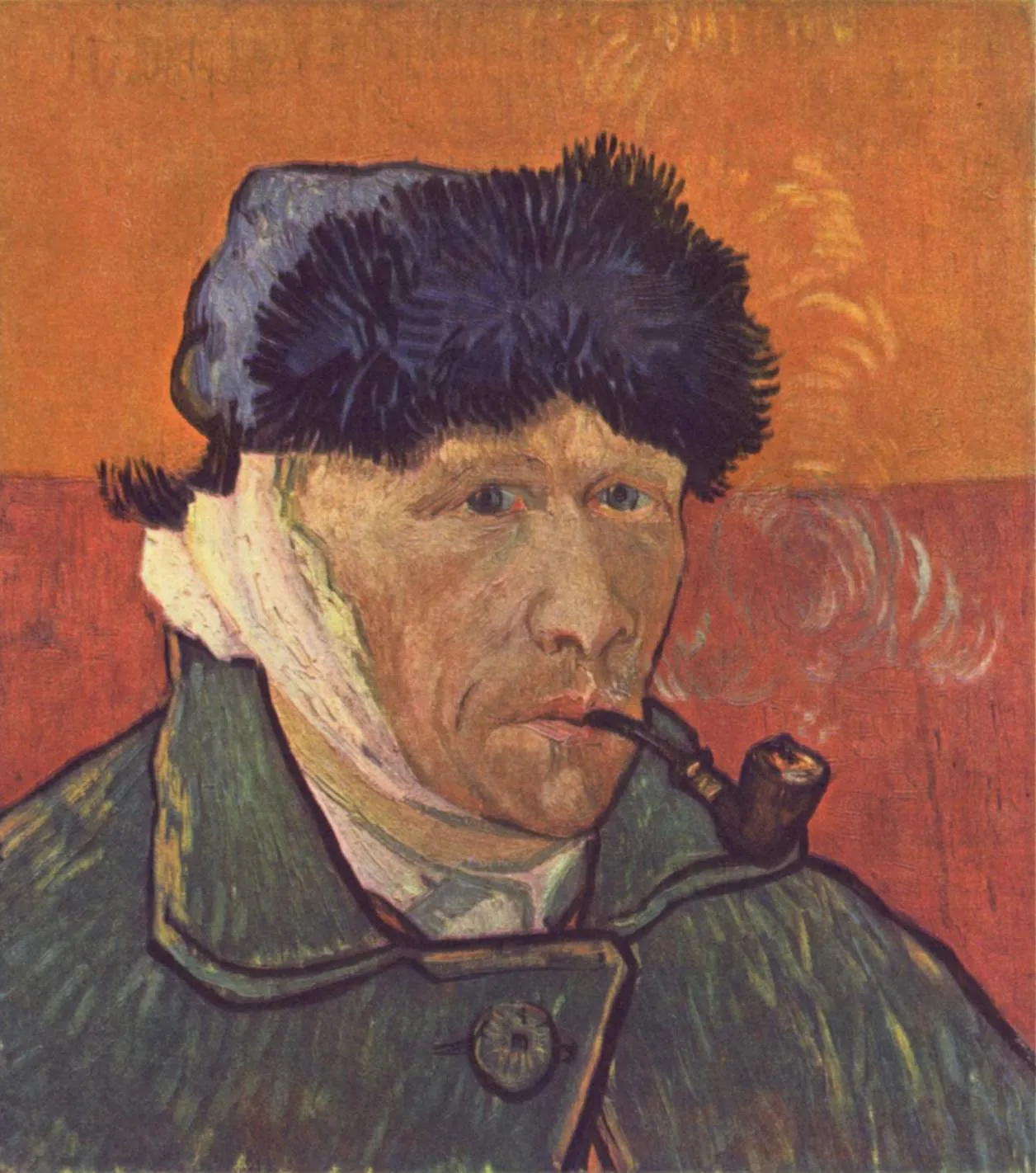
Self-Portrait with Bandaged Ear and Pipe
1889
- Dimensions
- 51.0 × 45.0 cm
- Medium
- Oil on canvas
- Collection
- Private collection (on loan to the Kunsthaus Zürich)
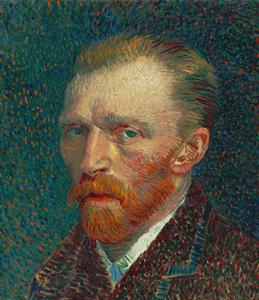
A Post-Impressionist painter who fundamentally revolutionized the visual languag…
Refusing to turn away from the grim reality of his self-harm, he fixes an unflinching gaze upon his wounded reflection in the mirror. Holding his fragile psyche together through the paintbrush, this is a testament of the soul that asserts his resurgence as an artist and the unyielding strength of his reason.
✦ Highlights (technique & color)
A standout feature is the meticulously calculated complementary contrast between the intense red background and the green coat. The boundary dividing the upper and lower halves of the composition aligns with the artist's eyes, drawing the viewer's gaze into his piercing look. Bold, rhythmic parallel brushstrokes and heavy impasto create a substantial texture, while the white bandage serves as a visual neutral zone, quietly tempering the clash between red and green.
✦ The setting of this painting
The second-floor studio of the Yellow House in Arles, southern France. In the bitter cold of mid-January 1889, inadequate heating made a heavy coat and winter cap necessary even indoors. This was the scene of Van Gogh's tragic self-harm—a place to which he returned with trepidation after leaving the hospital, determined to forge his resurgence as a painter.
✦ Historical context
In the late 19th century, the spread of photography challenged the traditional role of painting as a faithful record of reality. Post-Impressionists like Van Gogh turned away from merely reproducing visible reality, pioneering a new form of portraiture that expressed subjective emotion and psychological tension through color and brushwork. This era was also profoundly shaped by Cloisonnism, with its bold outlines and flat planes of color, as well as the influence of Japanese ukiyo-e prints.
A heavy dark green coat and a winter cap trimmed with fur.
From the center of the canvas, Vincent van Gogh gazes directly at us.
A stark white bandage is wrapped around the right side of his face, while pale blue smoke quietly rises from a modest wooden pipe clenched between his lips.
For many years, this painting has been celebrated as an emblem of the tragically mad genius.
Driven by an uncontrollable impulse, he was said to have severed his own earlobe and handed it to a familiar courtesan.
And then, lost in a feverish frenzy, he supposedly dashed off this self-portrait in a single breath.
Yet in recent years, scholarly research has overturned much of that tale.
In 2016, an extraordinary sketch was discovered.
It was a drawing made by Dr. Félix Rey, the attending physician who treated Van Gogh in 1888.
What it depicted was not a mere clipping of an earlobe.
It showed a harrowing incision indicating that almost the entire left ear had been cleanly severed from its base.
The bandage appears on the right side of his face in the painting simply because he was depicting his reflection in a mirror.
And the person who received the severed ear?
She was no glamorous courtesan.
Her name was Gabrielle Berlatier.
She was a young woman of rural origins who bore painful scars on her arm from a rabid dog bite, working as a maid at the brothel to pay for her medical treatment.
In the throes of severe psychological distress, Van Gogh may have offered a part of his own body out of deep compassion for her wounded state.
The night of December 23, 1888.
Collapsing from massive blood loss, he was admitted to the hospital in Arles.
Although Dr. Rey's care saved his life, his body was gravely weakened, and he was tormented by the terror of another episode.
With the dawn of the new year, on January 7, 1889,
discharged from the hospital, Van Gogh returned through the bitter chill of Arles to his studio at the Yellow House—the very site of the tragedy.
Confronting his profound fear.
About 235 more words
Read the rest of this commentary —
and step into a secret gallery
opened just for you
An "art letter" delivered to you every Saturday morning
Works, music and words chosen for your sensibility, from your artist-type result and the paintings you love
A library of masterpieces and music you can enjoy "in your own words", not just look at
A "digital art notebook" (unlimited) where your impressions build into your own taste
Unlimited likes and notes
¥980 / month¥0 today
¥980/month (tax incl.) from day 8. Cancel anytime.
Already have an account? Log in
Your Note
Write down what this painting made you feel in your art notebook.
Please sign up to write notes.
Sign up for freeRecommended Artworks
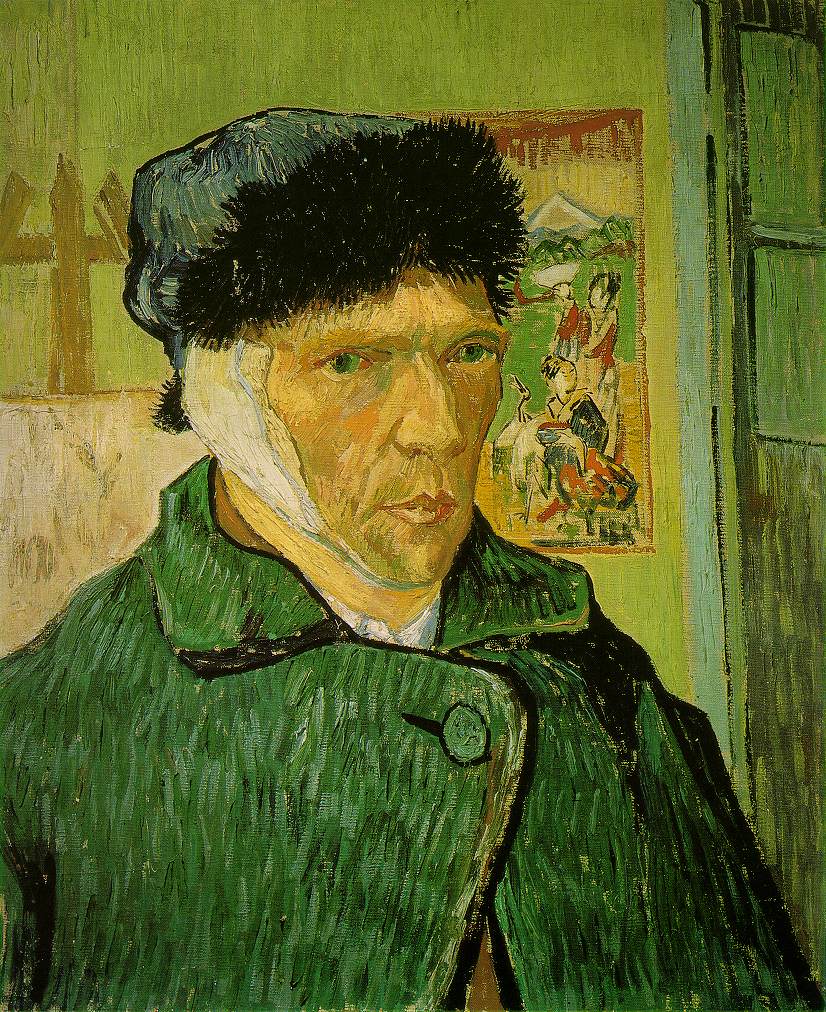
Sources & references
More artists




If you find an error in this content, please let us know here
This site is protected by reCAPTCHA, and the Google Privacy Policy and Terms of Service apply.