
Ville-d'Avray
1867
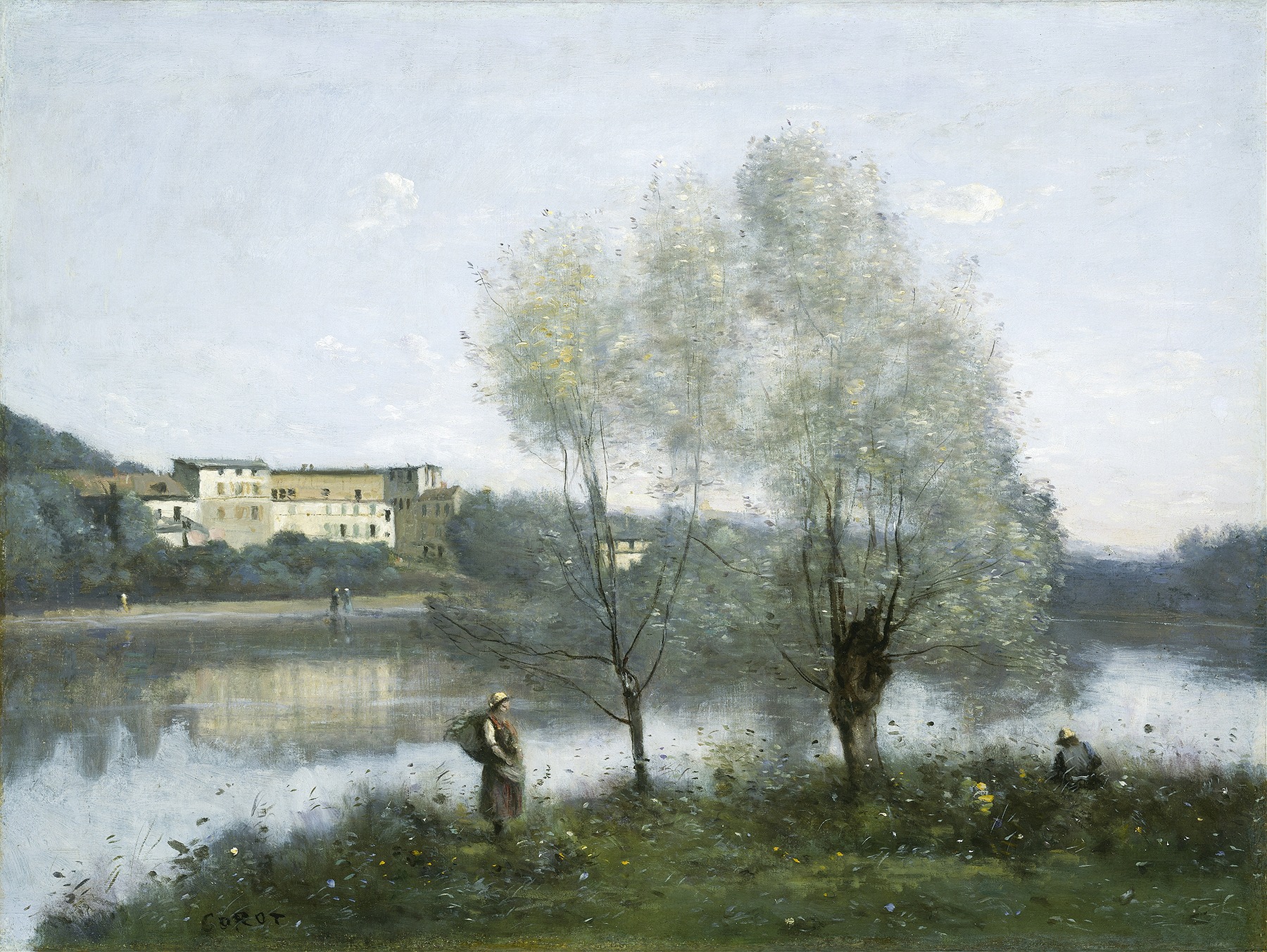
Image: Artvee / Public Domain
- Dimensions
- 縦 49.3 cm × 横 65.5 cm
- Medium
- Oil on canvas
- Collection
- National Gallery of Art, Washington
19世紀フランスを代表する画家であり、バルビゾン派の中心的な存在である。
Faced with an ever-changing landscape, I wished to poetically reconstruct the home of my artistic beginnings within memory (souvenir)—transforming it into an eternal, idyllic sanctuary.
✦ Highlights (technique & color)
A low horizon line, set about one-third from the bottom of the canvas, accentuates the expansive sky. Two willows slightly to the left of center serve as a visual anchor, gently guiding the eye from the foreground wildflowers to the figures, the serene water, and the cluster of buildings across the pond. Note the soft, feathery texture of the foliage created by scumbling with a semi-dry brush, as well as the luminous transparency of the water achieved through delicate layers of glaze.
✦ The setting of this painting
The northern shore of the pond at Ville-d'Avray (commonly known as Corot's Pond), situated in a small town about twelve kilometers west of Paris. The buildings on the opposite shore reflect the distinctive architecture of real local villas.
✦ Historical context
The 1860s, during the French Second Empire. Rapid urbanization under Baron Georges-Eugène Haussmann's renovation of Paris fostered a growing longing among city dwellers for untouched nature and the tranquil countryside.
A calm expanse of water mirrors the pale blue sky and the white walls of the opposite shore. On the grassy bank, a peasant woman carrying a bundle stands quietly, while beside her, slender willows sway their pale green leaves in the gentle breeze. Time flows with such tranquil grace that one can almost hear the distant chirping of birds and the rustle of the wind brushing across the water.
Leaving the Bustle of Paris for a Haven of the Heart
In the mid-1860s, as he approached the age of seventy, Jean-Baptiste-Camille Corot was at the height of his career as an undisputed master of the French art world. His paintings sold briskly through art dealers, and honors such as the Legion of Honour cemented his enduring fame and financial security. Wealthy and deeply respected, he was affectionately known as "Père Corot," earning widespread admiration for his generous support of struggling young artists.
Yet the world around him was far from tranquil. Paris at the time was in the midst of the vast urban transformation spearheaded by Napoleon III and Baron Georges-Eugène Haussmann. The labyrinth of medieval streets was systematically torn down, rapidly giving way to a modern metropolis of broad boulevards and towering iron-framed buildings.
Amidst this relentless upheaval, urban clamor, and dust-choked air, people endured tremendous strain and longed for untouched nature and the peace of the countryside. Behind his brilliant acclaim, Corot also harbored a quiet sanctuary in his heart: the small town of Ville-d'Avray, situated about twelve kilometers west of Paris.
Ville-d'Avray held a significance for Corot that went far beyond mere scenery. In 1817, when he was a young man of twenty-one, his father, a draper, bought a house and property there. The aspiring young painter was given a small studio on the grounds, taking his first steps in studying nature and painting outdoors.
Even after studying under the sun of Italy and traveling widely across France, he always returned to this family retreat. For Corot, the ponds and woods of Ville-d'Avray were the wellspring of his art—a spiritual home to which he would inevitably return, no matter how far he journeyed.
Yet, with the passage of time, this peaceful rural village was also changing. With the arrival of the railway, making it readily accessible from Paris, it quickly developed into a resort and country retreat for the bourgeoisie seeking escape from city life. The light, cream-colored buildings with shallow-pitched roofs on the opposite bank are precisely such modern villas. Faced with this landscape where pristine nature mingled with an encroaching suburban modernity, Corot quietly set to work at his canvas, contemplating his changing home.
About 408 more words
- ・The secrets behind landscapes reconstructed from memory in the studio
- ・A distinctive technique pursuing the harmony of light and shadow over color
- ・The profound influence on Monet and other Impressionist masters
Read the rest of this commentary —
and step into a secret gallery
opened just for you
An "art letter" delivered to you every Saturday morning
Works, music and words chosen for your sensibility, from your artist-type result and the paintings you love
A library of masterpieces and music you can enjoy "in your own words", not just look at
A "digital art notebook" (unlimited) where your impressions build into your own taste
Unlimited likes and notes
¥980 / month¥0 today
¥980/month (tax incl.) from day 8. Cancel anytime.
Already have an account? Log in
Your Note
Write down what this painting made you feel in your art notebook.
Please sign up to write notes.
Sign up for freeRecommended Artworks
.webp)
Sources & references
More artists
If you find an error in this content, please let us know here
This site is protected by reCAPTCHA, and the Google Privacy Policy and Terms of Service apply.