
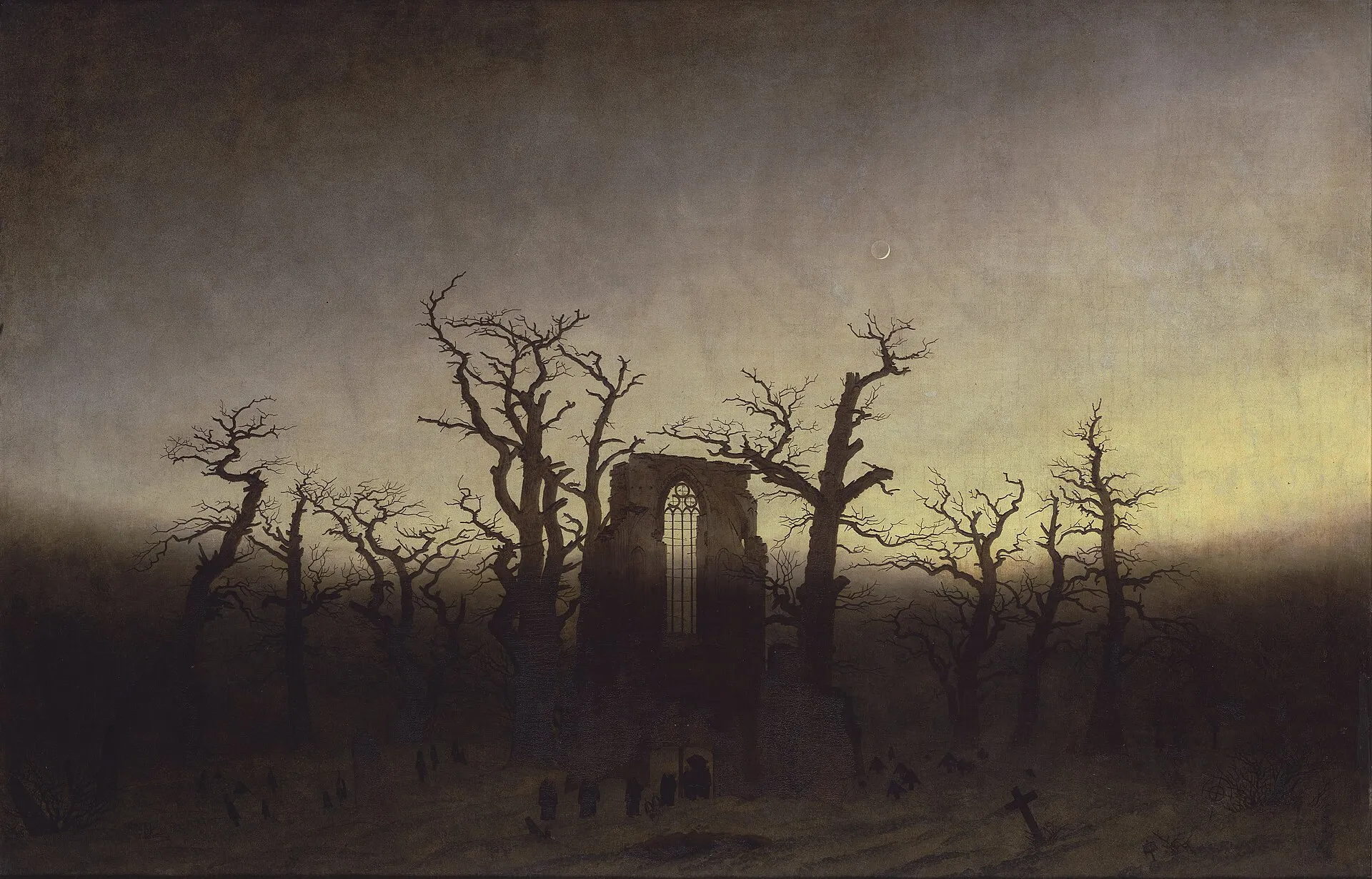
The Abbey in the Oakwood
1810
- Dimensions
- 110.4 × 171.0 cm
- Medium
- Oil on canvas
- Collection
- Alte Nationalgalerie, Berlin
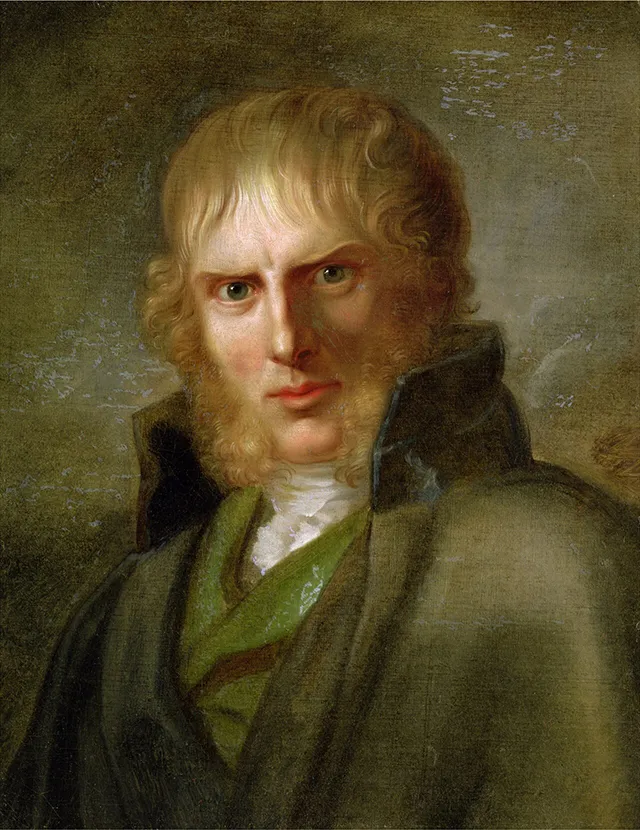
Active from the late eighteenth to the early nineteenth century, this German pai…
A profound yearning for eternal mystery and true faith beyond the limits of human reason—a landscape of the soul that inscribes a steadfast light of salvation beyond crumbling history and the darkness of death.
✦ Highlights (technique & color)
Using exceptionally fine brushes, Friedrich achieved the atmospheric sky through multiple gossamer-thin layers of glaze, avoiding any trace of impasto. A defining characteristic of the composition is its strict geometric and mathematical precision: the central vertical axis aligns with the apex of the abbey's window tracery, while the monumental oaks flanking the scene are positioned along the lines of the golden ratio.
✦ The setting of this painting
The setting of this work is not an actual landscape, but a topographical composite created in Friedrich's studio, combining the ruins of Eldena Abbey near his native Greifswald with oak trees sketched in Neubrandenburg. By uniting these historical remains with nature, he established an enduring, sacred space that transcends reality.
✦ Historical context
The years of its creation, 1808 to 1810, marked a humiliating era for Prussia, following crushing defeats by Napoleon's French forces and the subsequent military occupation. In Germany at the time, the Gothic ruins and oak trees symbolized a glorious medieval past and an indomitable Germanic spirit, serving as a coded political allegory for national resurgence.
Under a wintry twilight sky, a funeral procession of monks moves across a snow-covered cemetery.
Bearing a coffin, they make their way toward the ruins of a crumbling Gothic abbey.
Barren oak trees twist their branches as if in agony, creating an eerie, haunting scene.
For generations, this painting was clouded by a persistent myth:
that Friedrich painted it as a funeral of utter despair, foreseeing his own demise.
The canvas, long darkened with age, only seemed to deepen this chill of mortality.
Yet in truth, this work was never an ode to despair.
The notion that he stood on the brink of death was merely dramatic embellishment by later commentators.
Dresden, 1809.
Then in his mid-thirties, Friedrich was entering the absolute zenith of his artistic career.
Amid the hardships of society under Napoleonic rule, and without a commission, he retreated into his studio to confront this monumental canvas.
In fact, this work was conceived as a pair alongside another piece:
The Monk by the Sea.
That canvas portrays a solitary monk standing upon a desolate shore,
facing the overwhelming loneliness and earthly limits of humanity before the boundless sea and sky.
Created as its spiritual counterpart was The Abbey in the Oakwood.
What he sought to portray was not an end, but what lies beyond.
In a letter to his friend Johannes Schulze, Friedrich wrote of depicting
"that which can only be seen and recognized through faith."
He strove to paint what must forever remain an eternal mystery to the finite human mind.
He brought together sketches of the ruins of Eldena Abbey from his native Greifswald and the ancient oaks of Neubrandenburg.
It is a spiritual landscape that exists nowhere in reality.
Though man-made churches crumble and mortal bodies return to dust,
he sought to capture a light that can never be extinguished.
At the 1810 exhibition in Berlin,
the two paintings were displayed together, creating an immense sensation.
The Crown Prince of Prussia, then just fifteen years old, was so deeply moved that he implored his father, the king, to acquire them.
About 163 more words
Read stories of masterpieces for free
Your Note
Write down what this painting made you feel in your art notebook.
Please sign up to write notes.
Sign up for freeRecommended Artworks

Sources & references
More artists

If you find an error in this content, please let us know here
This site is protected by reCAPTCHA, and the Google Privacy Policy and Terms of Service apply.