
De Forest Phonofilm
1927
- Dimensions
- 115.6 × 73.7 cm
- Medium
- Color lithograph poster on paper (linen-backed)
- Collection
- Private collection
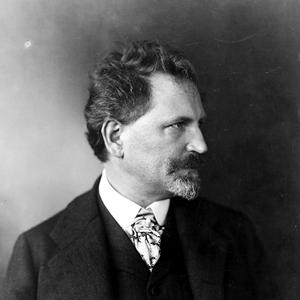
Alfons Maria Mucha, known internationally as Alphonse Mucha, was a Czech painter…
✦ Highlights (technique & color)
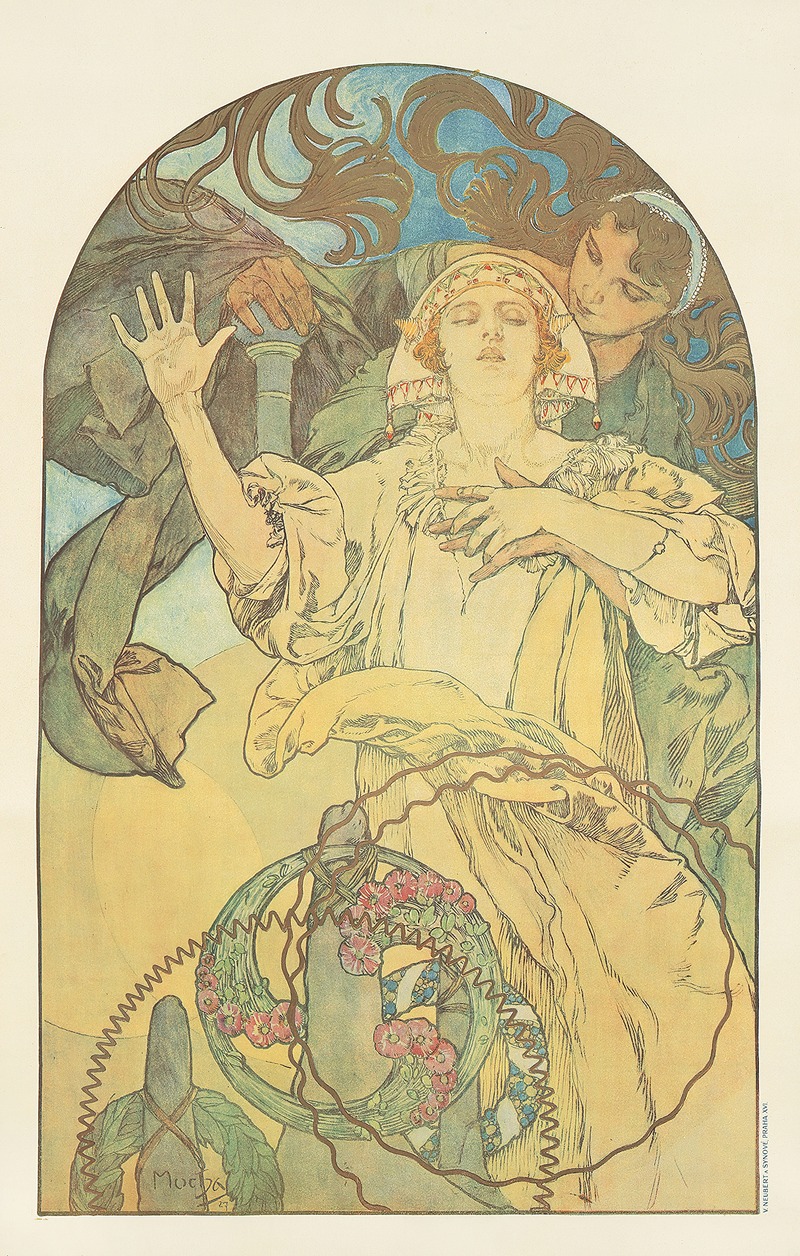
Soft, muted colors characteristic of Art Nouveau, such as creamy yellows and subdued greens, envelop the composition. Red berries tucked into the woman's hair and around her hands provide vibrant accents. It is a masterful composition where flowing organic curves intersect with circular film patterns that foreshadow modern Art Deco.
✦ The setting of this painting
An allegorical space symbolizing the fusion of music and scientific technology. In the background, dynamic concentric circles representing sound waves overlap with a geometrically stylized reel of motion picture film. The scene creates an acoustic world that illustrates how invisible sound is materialized through the luminous medium of cinema.
✦ Historical context
In the mid-1920s, the film industry was transitioning from silent movies to "talkies" with synchronized sound. The American inventor Lee de Forest developed Phonofilm, a technology that recorded sound directly onto film. The Czech tenor Otakar Mařák brought this new technology to his homeland, presenting the first screening in Prague in 1927.
Concentric sound waves and the geometric circles of a film reel.
At the center, a pale-skinned woman presses one hand to her chest,
as if listening intently to the invisible world of sound.
In the mid-1920s,
the world of cinema was in the midst of a monumental revolution:
the transition from silent movies to synchronized "talkies."
Phonofilm, developed by the American inventor Lee de Forest,
was a groundbreaking technology that recorded sound directly onto motion picture film.
One man worked tirelessly to bring this cutting-edge invention to his homeland of Czechoslovakia:
the international tenor Otakar Mařák.
He entrusted his close friend Alphonse Mucha with designing a poster to announce a historic screening—
a vital commission meant to herald the 1927 presentation at Prague's Adria Cinema.
Accepting the request, Mucha began his preparations at Zbiroh Castle in western Bohemia, where he resided at the time.
To explore the composition, he took test photographs himself.
He had his beloved daughter, Jaroslava, pose as the female artist in front of the lens.
And for the enigmatic man peering from behind her,
Mucha himself donned a costume to pose in the shadows.
About 113 more words
Read stories of masterpieces for free
Your Note
Write down what this painting made you feel in your art notebook.
Please sign up to write notes.
Sign up for freeRecommended Artworks
Sources & references
More artists

If you find an error in this content, please let us know here
This site is protected by reCAPTCHA, and the Google Privacy Policy and Terms of Service apply.