
 日本語 (JA)
 English (EN)
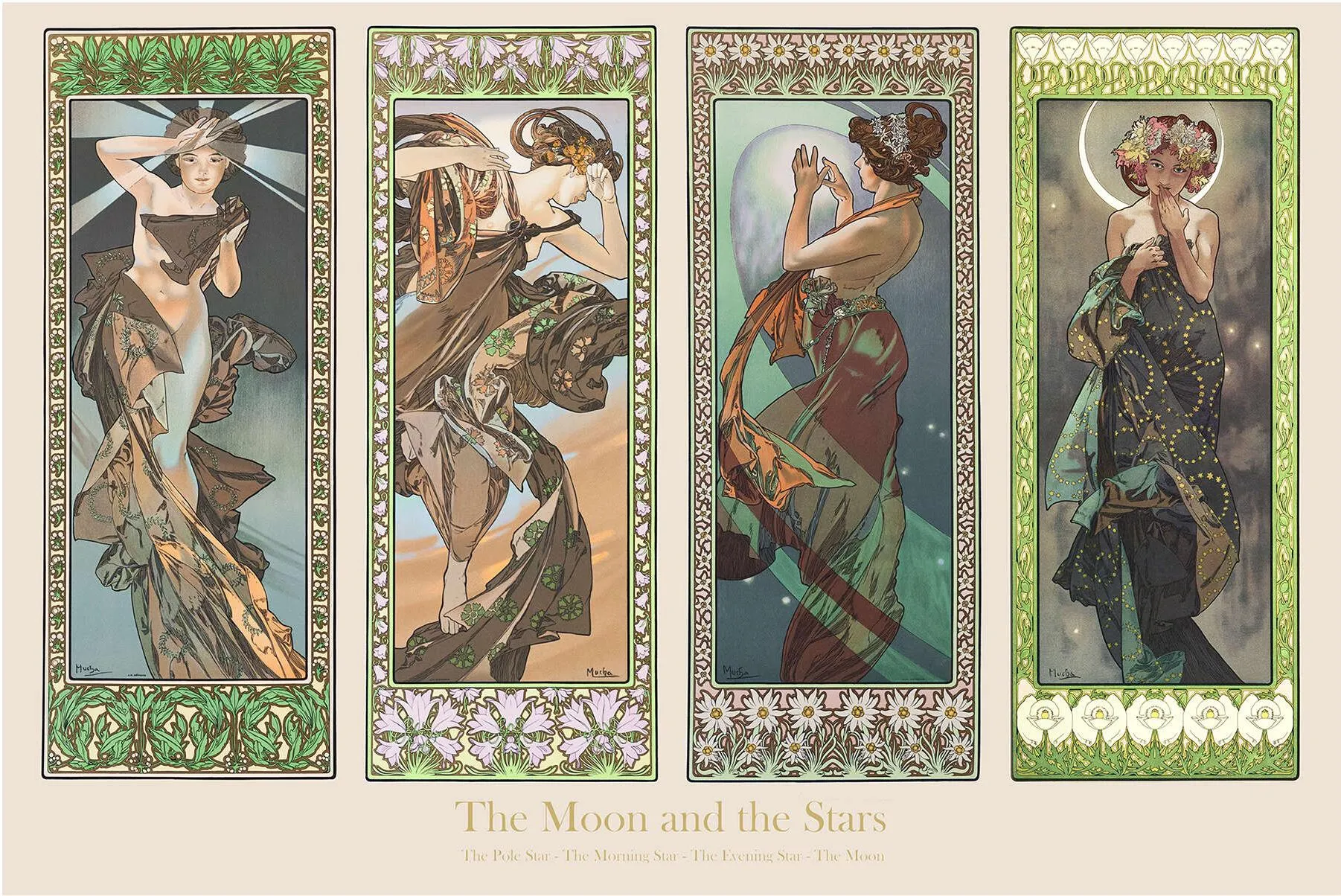
The Moon and the Stars
1902
- Dimensions
- 出版リトグラフ(単体):約 80.5 cm × 30.5 cm
- Medium
- Color lithograph; Studies (preliminary sketches): ink and watercolor on paper
- Collection
- Mucha Foundation (Mucha Trust Collection); Sakai Alphonse Mucha Museum (Sakai, Osaka, Japan); Mucha Museum (Prague, Czech Republic); Bibliothèque nationale de France (Paris); Czech Center Museum Houston
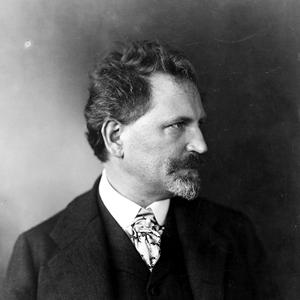
Alfons Maria Mucha, known internationally as Alphonse Mucha, was a Czech painter…
✦ Highlights (technique & color)
The most striking aspect of the compositions is that the celestial bodies are not depicted directly; instead, they are evoked through the reflection of light playing across the figures' skin and drapery. Employing a color lithography technique with eight to twelve separate printing runs, Mucha masterfully rendered the subtle gradations of nocturnal air and the smooth textures of fabric. In The Evening Star, for instance, the deep red drifting at the figure's feet, or in The Moon, the striking contrast between the dark blue drapery and milky-white skin, visually convey the passage of time and the stillness of the night. Furthermore, the hems and tresses of hair spilling beyond the frames bring a remarkable sense of depth to the flat surface.
✦ The setting of this painting
Rather than depicting real-world locations, the setting is a mystical cosmos born of Mucha's imagination. Dispensing with the heavy arches and framing elements seen in his earlier commercial posters, the artist set these figures against the boundless night sky itself. This series was conceived and created in Mucha’s spacious studio on the Rue du Val-de-Grâce in Paris’s 5th arrondissement. At the time, his studio was filled with exotic antiques, oriental textiles, and occult literature, serving as a salon where artists and intellectuals gathered. Working from photographs he took of professional models posing in this interior, Mucha built his vision of the infinite universe.
✦ Historical context
Published in 1902, this series reflects a transitional period when Art Nouveau was reaching its maturity and shifting toward more spiritual modes of expression. Following the sensational success of his 1895 poster Gismonda, Mucha had established himself as a leading commercial artist, under contract with printer F. Champenois and enjoying immense acclaim. From around 1899, however, he became deeply immersed in mystical philosophies, including Freemasonry and Theosophy. After his work for the 1900 Paris Exposition Universelle, he moved beyond mere commercial advertising, increasingly dedicating himself to fine art that explored cosmic mysteries and human spirituality.
In the Darkness, Only the Women’s Skin Softly Glowed
Four vertical panels stand in a row. The women within them are bathed in a gentle, quiet light.
In the night sky, not a single star is drawn. Only their luminous skin and flowing drapery reveal the presence of celestial bodies.
At first glance, they might seem like fashionable decorative art depicting beautiful women. Many would mistake them for graceful posters of Greek goddesses, or perhaps a romantic story modeled on the artist's beloved wife.
Yet that is not the case.
The women depicted here are neither mythological deities nor portraits of a beloved wife.
They are the quiet prayers of an artist who, having navigated the frenzy of commercial art, turned inward to confront his own soul.
At the Zenith of Success, the Artist Began Pursuing an Invisible Light
Alphonse Mucha: a Czech-born artist born in 1860.
In late 1894, a poster he designed, Gismonda, covered the streets of Paris. An obscure illustrator was transformed overnight into the darling of the era.
A regular contract with the printer F. Champenois brought him guaranteed wealth. He established a vast studio on Rue du Val-de-Grâce in Paris’s 5th arrondissement, surrounded by exotic antiques and sumptuous fabrics. There began days of hiring professional models and photographing their poses.
What the world demanded was glamorous design meant to sell products. Sell, sell—society urged ceaseless consumption.
Yet Mucha remained unfulfilled. In the shadow of his glory, his soul was yearning for something else entirely.
Around 1899, he was drawn deeply into mysticism, including Freemasonry and Theosophy. In his illustrated book Le Pater (The Lord's Prayer), published that same year, he etched the profound spiritual faith of his inner world. Amid a city swirling with desire, he had begun to search for an unseen, spiritual light.
Rumors suggest the model was his future wife, Maruška. Yet the two did not meet until 1903, after the work was completed, and no supporting records exist. What he painted was not a specific person, but celestial ideals sublimated within the artist's inner realm.
About 422 more words
Read the rest of this commentary —
and step into a secret gallery
opened just for you
An "art letter" delivered to you every Saturday morning
Works, music and words chosen for your sensibility, from your artist-type result and the paintings you love
A library of masterpieces and music you can enjoy "in your own words", not just look at
A "digital art notebook" (unlimited) where your impressions build into your own taste
Unlimited likes and notes
¥980 / month¥0 today
¥980/month (tax incl.) from day 8. Cancel anytime.
Already have an account? Log in
Your Note
Write down what this painting made you feel in your art notebook.
Please sign up to write notes.
Sign up for freeRecommended Artworks
Sources & references
- www.muchafoundation.org
- www.posterauctions.com
- www.mucha.jp
- mymodernmet.com
- www.alamy.com
- www.thehistoryofart.org
- note.com
- www.atelier-blanca.com
- www.muchafoundation.org
- koubo.jp
- www.muchafoundation.org
- abennett1985.wordpress.com
- www.thehistoryofart.org
- www.muchafoundation.org
- www.muchafoundation.org
- www.mucha.jp
- www.thehistoryofart.org
- www.invaluable.com
- www.muchafoundation.org
- www.wga.hu
More art movements
Pre-Baroque
1 artworks
Victorian era
10 artworks
Impressionism
48 artworks
Late Pre-Raphaelite
10 artworks
Baroque
2 artworks
American Impressionism
5 artworks
Realism
4 artworks
Pre-Raphaelite
3 artworks
Barbizon School
5 artworks
Academic art
5 artworks
Luminism
3 artworks
Rococo
2 artworks
Symbolism
22 artworks
Neo-Impressionism
3 artworks
Ukiyo-e
1 artworks
Japonism
4 artworks
Edo period
1 artworks
Fauvism
1 artworks
Naturalism
9 artworks
Russian Realism
1 artworks
Post-Impressionism
13 artworks
Genre painting
9 artworks
Neoclassicism
3 artworks
ウィーン分離派
7 artworks
自然主義
1 artworks
ナショナル・ロマンティシズム
1 artworks
未来派
1 artworks
More artists
If you find an error in this content, please let us know here
This site is protected by reCAPTCHA, and the Google Privacy Policy and Terms of Service apply.