
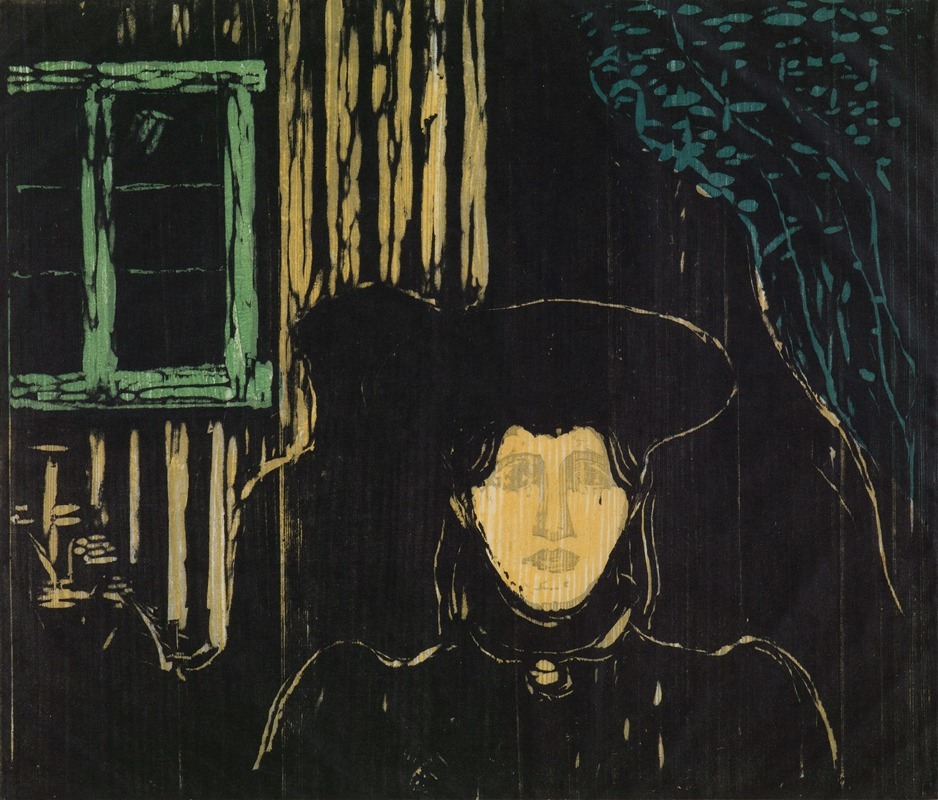
Moonlight
1896
- Dimensions
- 40.0 × 47.0 cm
- Medium
- Color woodcut on thin Japanese paper
- Collection
- Munch Museum
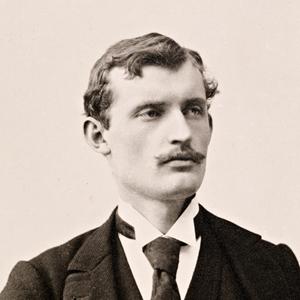
A celebrated Norwegian painter active from the late nineteenth century to the fi…
✦ Highlights (technique & color)
This work employs a technique in which both sides of a single woodblock were carved and pressed. In addition, the color block, emphasizing the wood grain, was cut into three sections with a fretsaw, inked individually, and reassembled for layered printing. The use of highly absorbent, thin Japanese paper allowed the ink to sink in softly, producing a ghostly, luminous effect.
✦ The setting of this painting
The setting features a real yellow clapboard house and a white picket fence in Åsgårdstrand. While the 1893 oil painting depicted a full-length figure with spatial distance, this work narrows the focus around the woman's face, creating a suffocatingly tight, close-up space framed by the window and trees.
✦ Historical context
In 1896, while residing in Paris, Munch was inspired by the city's sophisticated print culture and shifted toward innovating his printmaking techniques. Paris was then at the height of a printmaking revival, and Munch experimented extensively with color woodcuts as a means to recreate his inner landscapes in an ever more ethereal and refined manner.
A woman's face, pale and luminous, emerges from the dark night.
To the left, a small window reflects the moonlight.
To the right, trees with eerily spreading branches loom close.
Moonlight.
From this quiet night scene, one might imagine a romantic and mysterious female figure.
Some might feel it depicts a tranquil moment of contemplation in silence.
However, what is actually embedded in this painting is the memory of a desperate first love that instilled in the artist a lifelong sense of distrust and fear.
In 1885, Edvard Munch met a woman named Milly Thaulow.
Referred to as 'Mrs. Heiberg' in his private notes, she was the wife of a Norwegian army medical captain.
This illicit, brief affair was Munch's first secret love.
However, it simultaneously brought him deep despair.
The fear of intimate relationships would continue to torment him for a long time thereafter.
In 1896, while staying in Paris, Munch created this memory as a woodcut.
The setting is Åsgårdstrand, where he spent his summers.
It depicts a real yellow clapboard house and a white picket fence.
In an oil painting of the same theme from 1893, almost the entire female figure was depicted.
There was a rich spatial distance between the dark night background and the moonlight.
However, in this woodcut, the view is narrowed down to the extreme, focusing on the area around the woman's face.
Munch adopted an extremely complex experimental approach for this work.
He carved different elements on both the front and back sides of a single woodblock and pressed them sequentially from both sides of the paper.
Furthermore, he cut another woodblock into three pieces with a fretsaw.
He colored each piece differently and then reassembled them to print in layers.
By using thin, highly absorbent Japanese paper, the ink particles softly permeated the fibers.
The woman's face, illuminated by moonlight, appears to glow white like a ghost in the darkness of the night.
About 159 more words
Read stories of masterpieces for free
Your Note
Write down what this painting made you feel in your art notebook.
Please sign up to write notes.
Sign up for freeRecommended Artworks
Sources & references
More artists

If you find an error in this content, please let us know here
This site is protected by reCAPTCHA, and the Google Privacy Policy and Terms of Service apply.