
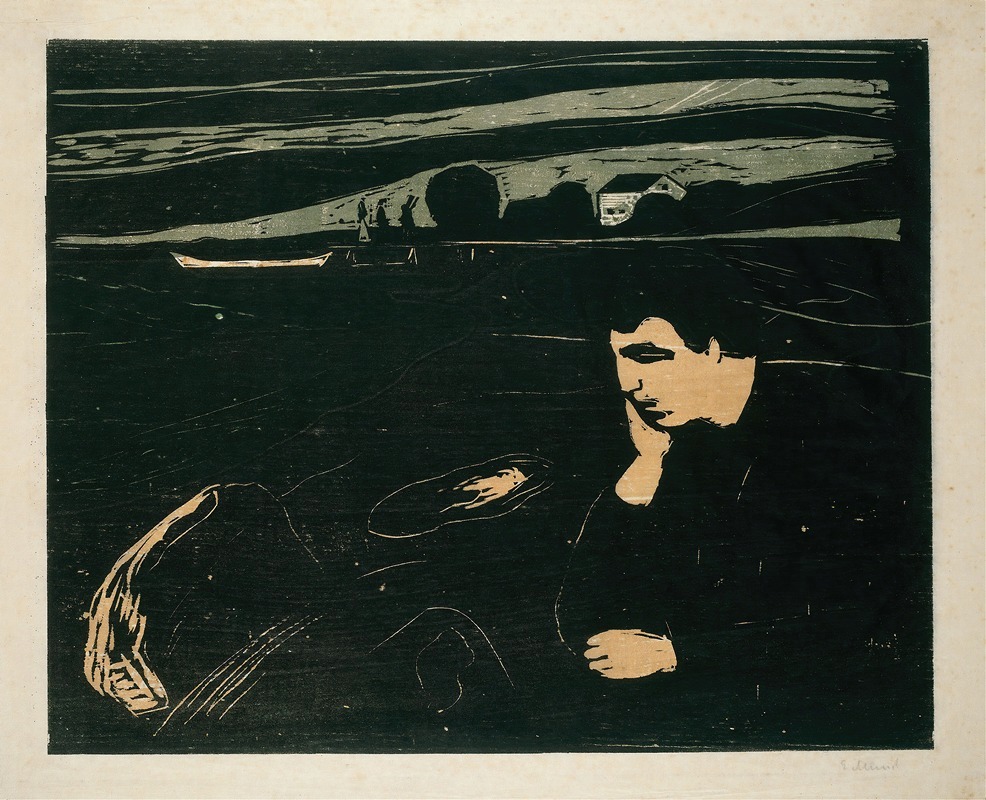
Melancholy III
1915
- Dimensions
- 版画ブロック:37.6 × 46.7 cm / シート:47.3 × 65.5 cm(個体差あり)
- Medium
- Color woodcut
- Collection
- National Gallery of Art (Washington, D.C.), The Museum of Modern Art (New York), The Art Institute of Chicago, Munch Museum
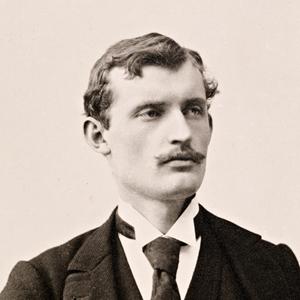
A celebrated Norwegian painter active from the late nineteenth century to the fi…
✦ Highlights (technique & color)
This print employs Munch's distinctive 'puzzle-cut' woodcut technique. Using a fretsaw, he divided the woodblock into three sections—the sky and houses, the sea, and the man with the rocky shore. After inking each piece with a different color, he reassembled them like a puzzle and printed them in a single pass. This allowed distinct colors and rich textures to transfer cleanly onto the paper without blending together.
✦ The setting of this painting
The setting is the coastline of Åsgårdstrand, a small village along Norway's Oslofjord. Munch was deeply attached to this place, spending his summers there from the 1890s onward. The gentle curves of the shoreline and the sharp, straight lines of the pier serve as a visual device that accentuates the man's sense of isolation in the foreground.
✦ Historical context
Between the late 19th and early 20th centuries, as rapid urbanization transformed Europe, Expressionism emerged to depict human inner conflict and anxiety. Munch likewise broke away from Realism, pursuing a 'painting of the soul' that gave direct form to emotions such as personal trauma, jealousy, and solitude.
A man sits, head bowed, supporting his head with his hand.
In the distance, on a pier, a man and a woman are heading towards a boat, and another figure carries an oar.
The scene is the coast of Åsgårdstrand, a small village in Norway.
In the summer of 1891, Jappe Nilssen, a Danish critic and close friend of Munch, was in deep despair.
He was consumed by an intense love for Oda Lasson, the wife of painter Christian Krohg.
Munch saw his past self reflected in his friend's plight.
He himself had experienced an unhealing jealousy and sense of loss during his first love with a woman named Millie Thaulow.
His friend's tragic love affair.
For Munch, it was an event that reopened his own emotional wounds.
This poignant theme evolved through oil paintings and other mediums, eventually leading to woodcuts.
However, an unexpected problem arose.
In 1901, Munch, aiming for success in Berlin, attempted to send a wooden crate containing his works to Berlin.
But due to a mix-up, the crate was mistakenly sent back to his villa in Åsgårdstrand.
He didn't have the woodblocks with him.
Forced to recreate the prints in Berlin, Munch decided in 1902 to carve new woodblocks.
And thus, this 'Melancholy III' was born.
About 106 more words
Read stories of masterpieces for free
Your Note
Write down what this painting made you feel in your art notebook.
Please sign up to write notes.
Sign up for freeRecommended Artworks
.webp)
![Untitled [Rescue boat]](https://musicstory-assets-682855971161-ap-northeast-1-an.s3.ap-northeast-1.amazonaws.com/artworks/paintings/untitled-rescue-boat.jpg)
Sources & references
More artists
If you find an error in this content, please let us know here
This site is protected by reCAPTCHA, and the Google Privacy Policy and Terms of Service apply.