
Study for Schwarz und Weiss
1909
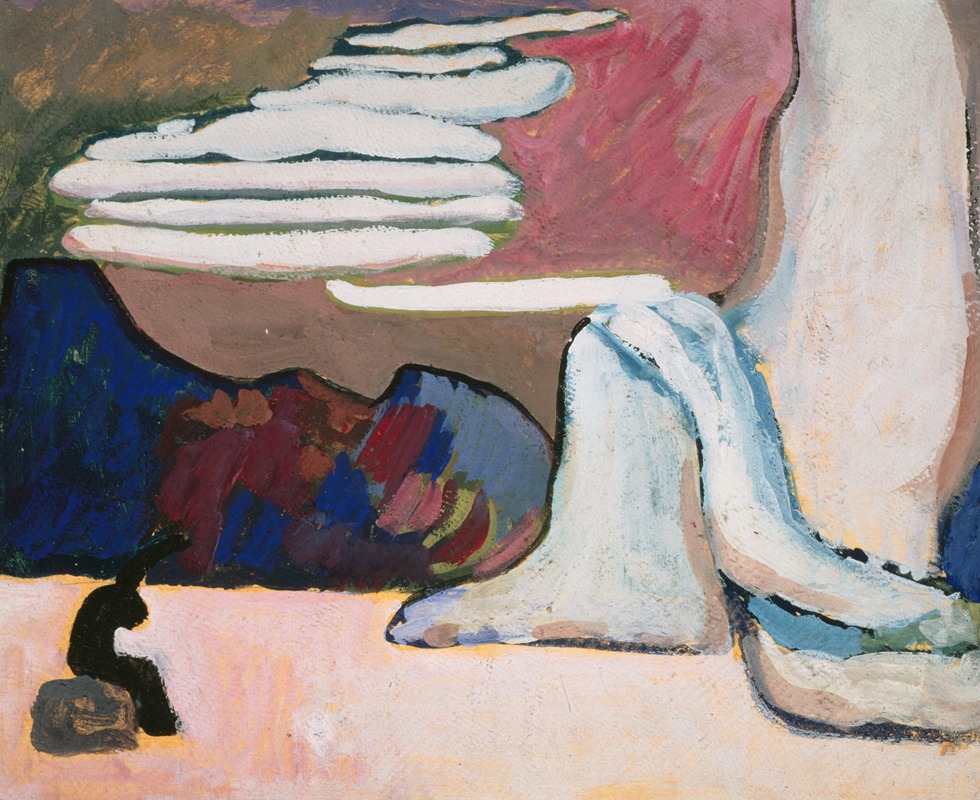
- Medium
- Oil on canvas (or canvas mounted on cardboard)
- Collection
- Centre Pompidou (Musée National d'Art Moderne, Paris, France)
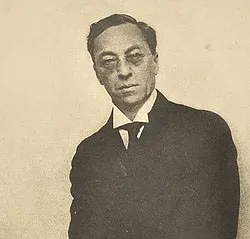
Wassily Wassilyevich Kandinsky was a Russian painter and art theorist. Kandinsky…
✦ Highlights (technique & color)
While drawing on the intense color contrasts of Post-Impressionism and Fauvism, this Expressionist style foreshadows his leap toward pure abstraction. Thick, impassioned brushstrokes and palette knife applications transform concrete motifs into masses of color. A key highlight is the striking tonal contrast: bold black frameworks intensify the surrounding hues, while passages of white lend a sense of openness to the canvas.
✦ The setting of this painting
The setting is Murnau, a town at the foot of the Bavarian Alps in southern Germany, where Kandinsky lived with his partner, Gabriele Münter. With its rolling hills and rustic countryside, this environment served as a crucial catalyst in his departure from visual representation toward an autonomous painterly expression.
✦ Historical context
In 1909, Kandinsky co-founded the Neue Künstlervereinigung München (New Artists' Association Munich), cementing his leadership within the avant-garde. Disillusioned by contemporary materialism, he sought spiritual renewal through art. This was a time when he was exploring innovative forms of expression, including drafting stage compositions that aimed to achieve a synesthetic fusion of sound and visual art.
Within a heavy, black framework, vibrant clusters of color drift, freed from the pull of gravity.
Concrete forms dissolve, leaving a landscape dominated by the striking contrast of black and white.
At the age of thirty, Wassily Kandinsky left behind a career in law in Russia and moved to Munich to pursue life as a painter.
In 1901, he founded his own art school, the Phalanx, where Gabriele Münter enrolled as a student.
The two developed a deep romantic relationship, traveling together across Europe and North Africa while continually sketching the landscapes they encountered.
The year was 1909.
It was a pivotal moment when Kandinsky established his leadership within the art world.
Together with Münter and others, he founded the Neue Künstlervereinigung München (New Artists' Association of Munich) and was elected its first chairman.
At the time, he was deeply disillusioned by the materialistic values of society.
What he sought was the revival of spirituality through art.
Aiming for a synesthetic integration of sound and visual expression, he continually explored new artistic avenues, even drafting works for the stage.
Driving him forward was a formative memory from his youth.
When he was thirteen or fourteen, he spent all his savings to buy his very first box of oil paints.
As the paint was squeezed from the tubes, he felt he was witnessing the "birth of a living being."
This primal encounter with color formed the enduring foundation of his creative expression.
About 126 more words
Sign up free and enter Your Museum
Read the stories behind great paintings and music for free, in Your Museum
Your Note
Write down what this painting made you feel in your art notebook.
Please sign up to write notes.
Sign up for freeRecommended Artworks
_by_Ilya_Repin_-_%D0%9D%D0%B5%D0%B0%D0%BF%D0%BE%D0%BB%D0%B8%D1%82%D0%B0%D0%BD%D0%BA%D0%B0.webp)
![Untitled [Rescue boat]](https://musicstory-assets-682855971161-ap-northeast-1-an.s3.ap-northeast-1.amazonaws.com/artworks/paintings/untitled-rescue-boat.jpg)
Sources & references
More artists
If you find an error in this content, please let us know here
This site is protected by reCAPTCHA, and the Google Privacy Policy and Terms of Service apply.