
The Artist’s Garden in Argenteuil (A Corner of the Garden with Dahlias)
1873
- Dimensions
- 61 x 82.5 cm
- Medium
- Oil on canvas
- Collection
- National Gallery of Art, Washington
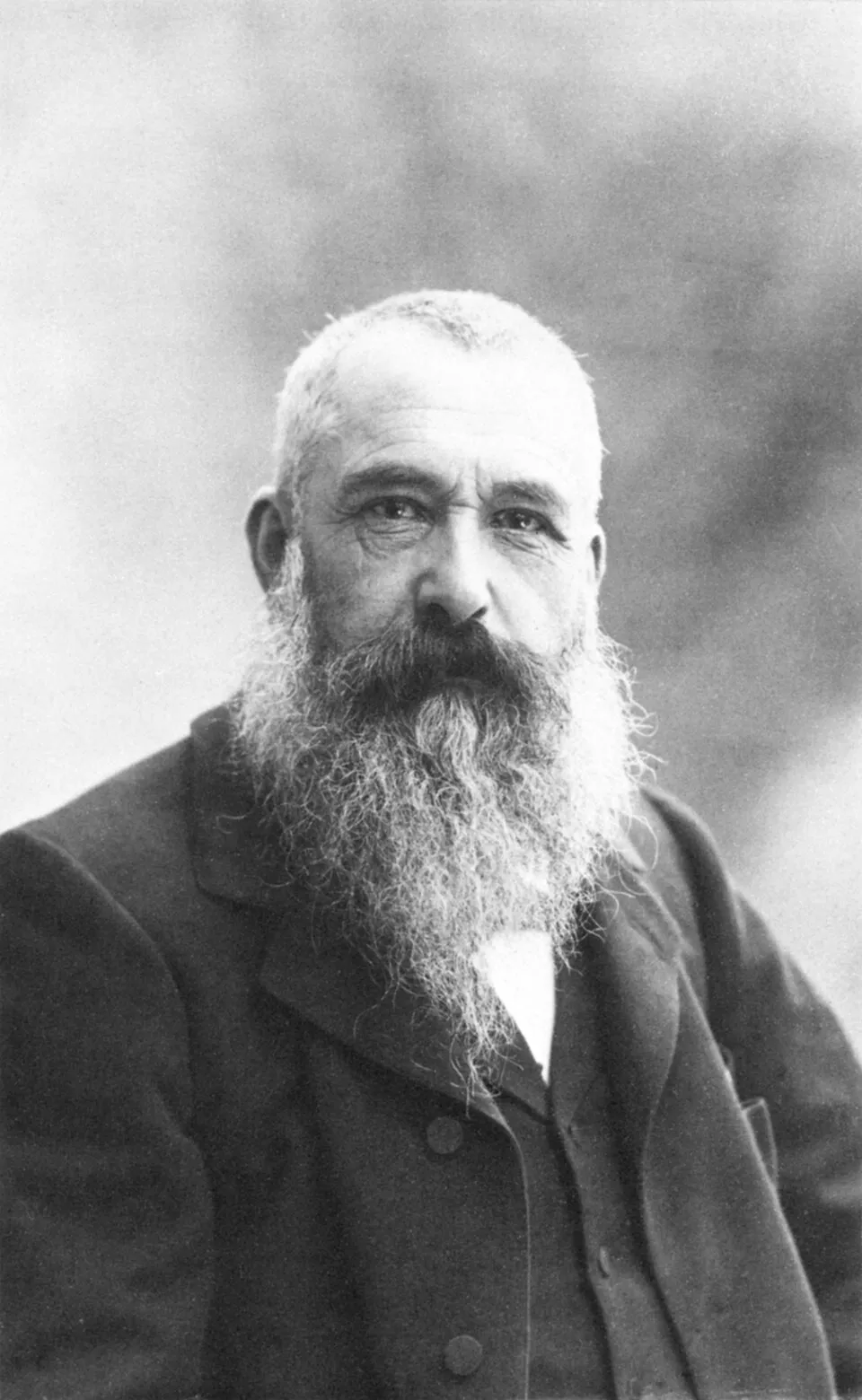
Celebrated as a founding figure of Impressionism, he is one of France’s most ren…
✦ Highlights (technique & color)
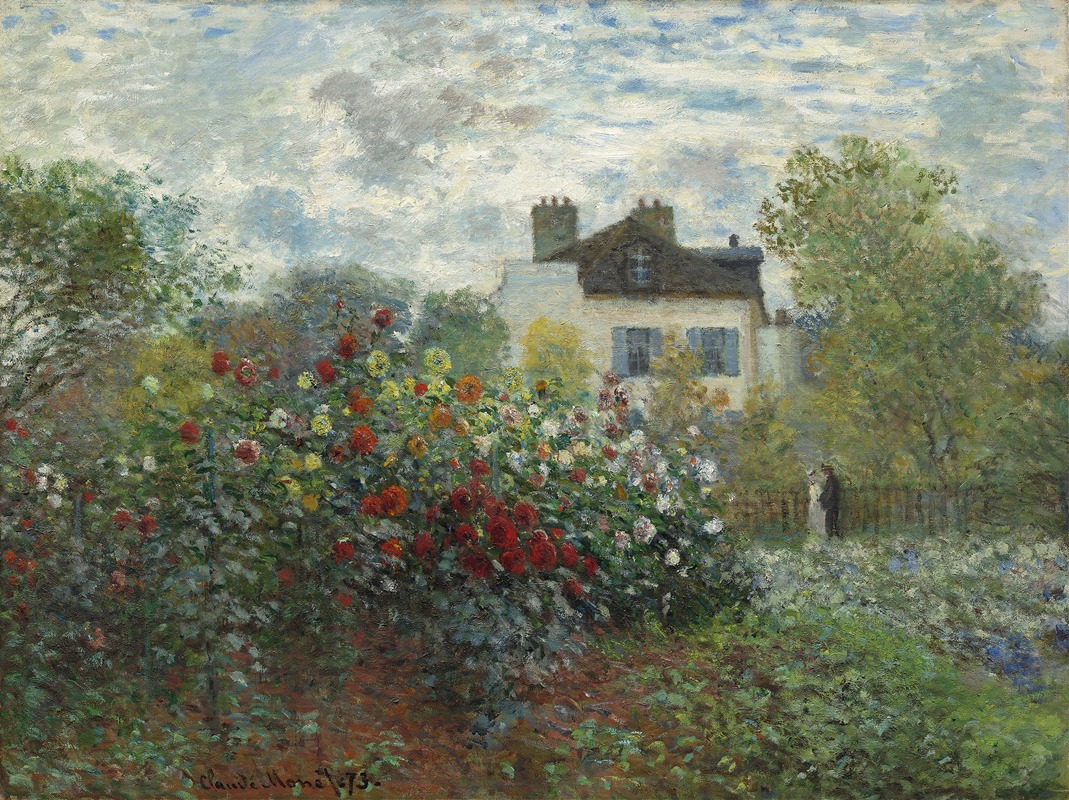
This work thoroughly showcases Monet's developing technique of broken color. The dahlia bushes in the foreground are rendered with juxtaposed thick touches of pure, unmixed paint. Green foliage frames the scarlet red and yellow petals, generating a dazzling vibrancy through complementary color contrast. In the sky, swift brushstrokes of white and gray capture the shimmering quality of the atmosphere.
✦ The setting of this painting
Argenteuil, a suburban town along the Seine located about 11 kilometers northwest of Paris. This painting depicts the garden of the second house Monet rented there. Monet landscaped this spacious garden himself, planting vibrant flowers such as dahlias and roses to create a visual oasis. Seen in the background on the right is the actual house where he lived with his family.
✦ Historical context
In the 1870s, Argenteuil was a popular boating and leisure destination for Parisians, while also developing rapidly as an industrial area. As French society sought to recover from the defeat in the Franco-Prussian War and the turmoil of the Paris Commune, modern suburban settings like this embodied the peaceful ideals pursued by the rising middle class.
Vibrant dahlias bloom in profusion, filling the foreground of the canvas.
A fiery scarlet red, pale yellow.
A rusty orange, and shell pink.
In the background to the right stands a white house with blue shutters.
Near the fence, two figures stand close together.
A peaceful, beautiful home garden beloved by the painter.
It may appear as a blissful landscape bathed in light, quintessential of Impressionism.
Yet in truth, this painting has another story to tell.
It is a work that Monet himself offered to aid the people of far-off Japan.
In late 1871, Monet settled in Argenteuil, a suburb of Paris.
The turmoil of the Franco-Prussian War and the Paris Commune.
Having fled this tragic double upheaval to seek refuge in London and the Netherlands,
it was a peaceful haven he finally found upon returning after the war.
At the time, Argenteuil was a hub for boating and leisure for Parisians.
At the same time, it was an emerging industrial area undergoing rapid growth.
Monet cultivated the spacious garden of his second rented house himself.
Planting colorful flora such as dahlias and roses, he created a visual oasis.
The three-story building depicted in the background to the right.
With its ivory-white walls and aquamarine-blue shutters,
it was the actual house where he lived with his family.
The delicate trees seen on the center-left soften the linear contours of the building.
Monet completed this painting of his garden in 1873.
This was a time when he was preparing for an independent exhibition to counter the conventional jury system of the official Salon—
what would become the First Impressionist Exhibition the following year.
In December 1873, shortly after its completion,
the art dealer Paul Durand-Ruel purchased the painting directly.
Through several subsequent exhibitions, it conveyed the allure of Impressionism across Europe—
at the Grafton Galleries in London in 1905,
and at the Galerie Miethke in Vienna in 1910.
Then in 1924,
a benefit exhibition for Japanese earthquake relief was held at the Galerie Georges Petit in Paris.
The Great Kanto Earthquake had struck the previous year on September 1, 1923.
It was organized to provide direct financial aid to the Japanese people who had suffered immense devastation.
The exhibition was a collective effort organized by the French art world.
Monet contributed this painting, an important piece from his own collection,
under the poetic title "The House among the Flowers."
From Japanese art, especially ukiyo-e woodblock prints,
Monet had drawn profound inspiration.
A deep sense of gratitude and solidarity for his long-standing devotion—
that was what this gesture embodied.
About 68 more words
Sign up free and enter Your Museum
Read the stories behind great paintings and music for free, in Your Museum
Your Note
Write down what this painting made you feel in your art notebook.
Please sign up to write notes.
Sign up for freeRecommended Artworks
Sources & references
More artists




If you find an error in this content, please let us know here
This site is protected by reCAPTCHA, and the Google Privacy Policy and Terms of Service apply.