
 日本語 (JA)
 English (EN)
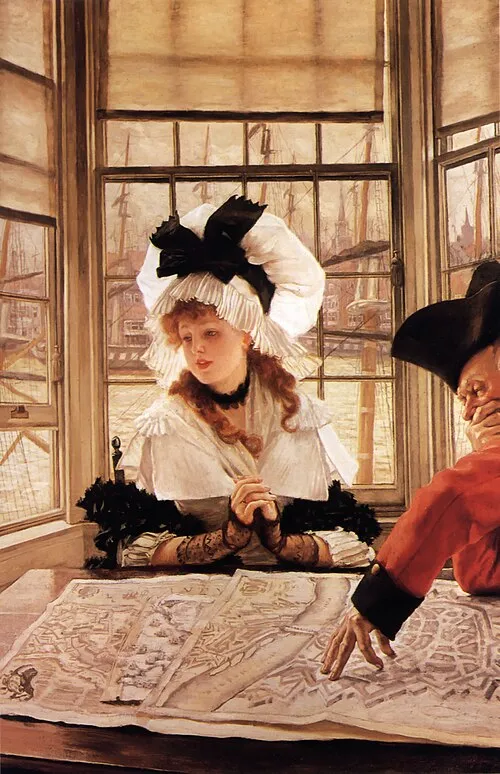
- Medium
- Oil on canvas
- Collection
- Private collection
19世紀後半にフランスとイギリスの両国で活躍した画家。 初期はパリで成功を収めていたが、普仏戦争とそれに続くパリ・コミューンの動乱を逃れ、1871年にロンドンへ…
To depict, with cool detachment, the sense of alienation felt as an exile in London and the disconnect between people in the modern city, captured through unaligned gazes and the absence of dialogue.
✦ Highlights (technique & color)
Note the wooden frame of the bay window, which divides the composition vertically and horizontally, serving as a psychological threshold between the tedious interior and the freedom of the outside world. Furthermore, the man's vivid red military uniform creates a striking contrast with the woman's delicate dress and the silvery-gray natural light streaming through the window.
✦ The setting of this painting
An upstairs room or private parlor in an actual riverside tavern along the Thames in East London (the Wapping or Rotherhithe district). Beyond the window lies the bustling Pool of London, the world's largest commercial port at the time, crowded with sailing ships and warehouses.
✦ Historical context
A time when French painters, including Tissot, took refuge in London amid the turmoil of the Franco-Prussian War and the Paris Commune (1870–1871). In British society of the period, nostalgia for the eighteenth century (the Georgian era) was growing as a reaction against rapid industrialization.
Under an overcast London sky, the rigging and hulls of sailing vessels plying the Thames stretch out beyond the large gridded window. Inside the tavern, an elderly military officer in a scarlet uniform, painted prominently in the foreground, spreads a map across the table, speaking with fervor of past glories and voyages. Yet the mind of the young woman seated across from him is no longer in this room. With her hands folded quietly before her and her body angled slightly away, she casts her gaze toward the open world outside the window. Separated by a table bearing only a sprawling map, though sharing the very same space, their minds remain hopelessly estranged.
Divergent Gazes Hidden Beneath Applause
In 1871, the French-born painter James Tissot found himself in the midst of a dramatic turning point in his life. Following the grueling hardships of serving in the Franco-Prussian War came the bloody uprising of the Paris Commune. To escape the political turmoil and imminent danger, he made the decision to cross the Channel, temporarily relinquishing the wealth and social standing he had cultivated in Paris. When he arrived in London, it is said that he had less than one hundred francs left in his pocket.
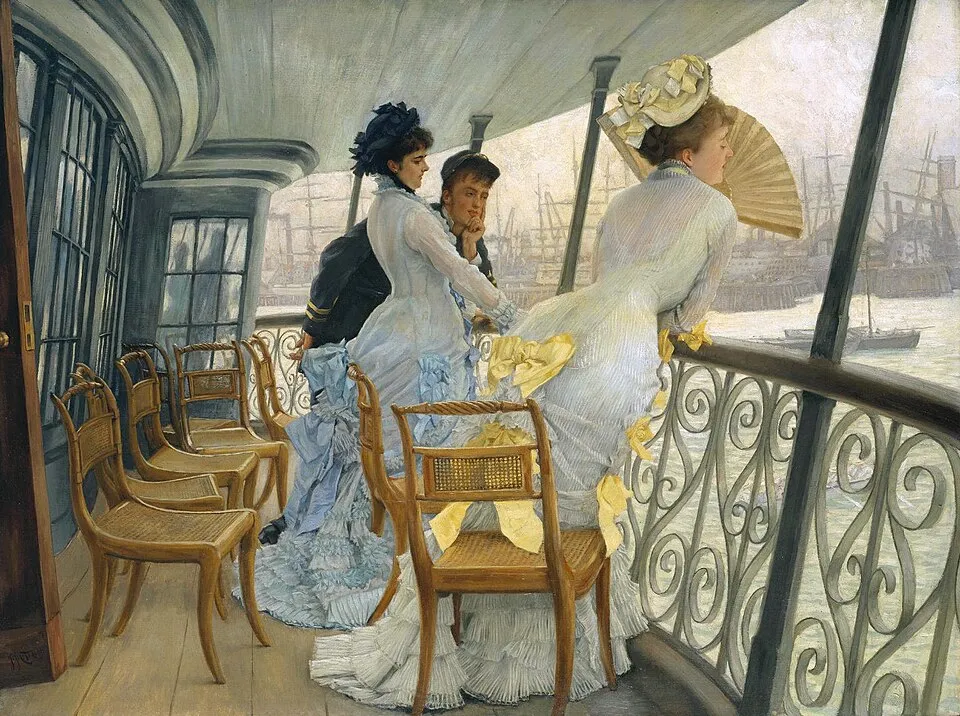
A fresh start in a foreign land was by no means easy. Yet Tissot possessed an extraordinary eye for observation and a sharp instinct for the currents of his time. Guided by friends such as the painter James McNeill Whistler, he frequently explored the taverns and docks along the River Thames in search of subject matter. In the late nineteenth century, the area around the Pool of London was a bustling maritime district, teeming with countless merchant vessels and steamships as the world's greatest commercial port. Having grown up in the home of a merchant in the western French port of Nantes, deeply familiar from childhood with ships and harbor life, the intricate nautical architecture and waterside scenes of London strongly stimulated his visual sensibilities.
At the same time, he dispassionately analyzed the demands of the British art market. In reaction against rapid industrialization and urbanization, British society of the period harbored a deep nostalgia for the Georgian era of roughly a century earlier—the late eighteenth century, remembered for its elegance and tranquil grace. To cater precisely to the tastes of this conservative market, Tissot independently embarked on a series of narrative genre paintings set in taverns along the Thames, featuring figures attired in eighteenth-century costume.
Painted around 1872, The Tedious Story is one of the works from this series.
In the right foreground, a veteran in the vivid scarlet uniform of the late eighteenth century points intently at a map or nautical chart spread wide across the table. He is recounting his military campaigns and seafaring exploits, likely detailing them with relentless thoroughness. Yet the demeanor of the beautiful young woman seated across the table stands in stark contrast. Dressed in a fashionable eighteenth-century gown and a mobcap, she displays not the slightest interest in his tale. Ignoring the soldier entirely, her gaze escapes past the wooden frame of the bay window toward the River Thames, veiled beneath gray, overcast skies.
About 557 more words
Read the rest of this commentary —
and step into a secret gallery
opened just for you
An "art letter" delivered to you every Saturday morning
Works, music and words chosen for your sensibility, from your artist-type result and the paintings you love
A library of masterpieces and music you can enjoy "in your own words", not just look at
A "digital art notebook" (unlimited) where your impressions build into your own taste
Unlimited likes and notes
¥980 / month¥0 today
¥980/month (tax incl.) from day 8. Cancel anytime.
Already have an account? Log in
Stories featuring this painting
Your Note
Write down what this painting made you feel in your art notebook.
Please sign up to write notes.
Sign up for freeRecommended Artworks
Sources & references
More art movements
Pre-Baroque
1 artworks
Victorian era
10 artworks
Impressionism
48 artworks
Late Pre-Raphaelite
10 artworks
Baroque
2 artworks
American Impressionism
5 artworks
Realism
4 artworks
Pre-Raphaelite
3 artworks
Barbizon School
5 artworks
Academic art
5 artworks
Luminism
3 artworks
Rococo
2 artworks
Symbolism
22 artworks
Neo-Impressionism
3 artworks
Ukiyo-e
1 artworks
Japonism
4 artworks
Edo period
1 artworks
Fauvism
1 artworks
Naturalism
9 artworks
Russian Realism
1 artworks
Post-Impressionism
13 artworks
Genre painting
9 artworks
Neoclassicism
3 artworks
ウィーン分離派
7 artworks
自然主義
1 artworks
ナショナル・ロマンティシズム
1 artworks
未来派
1 artworks
More artists





If you find an error in this content, please let us know here
This site is protected by reCAPTCHA, and the Google Privacy Policy and Terms of Service apply.