
The Abduction of Psyche
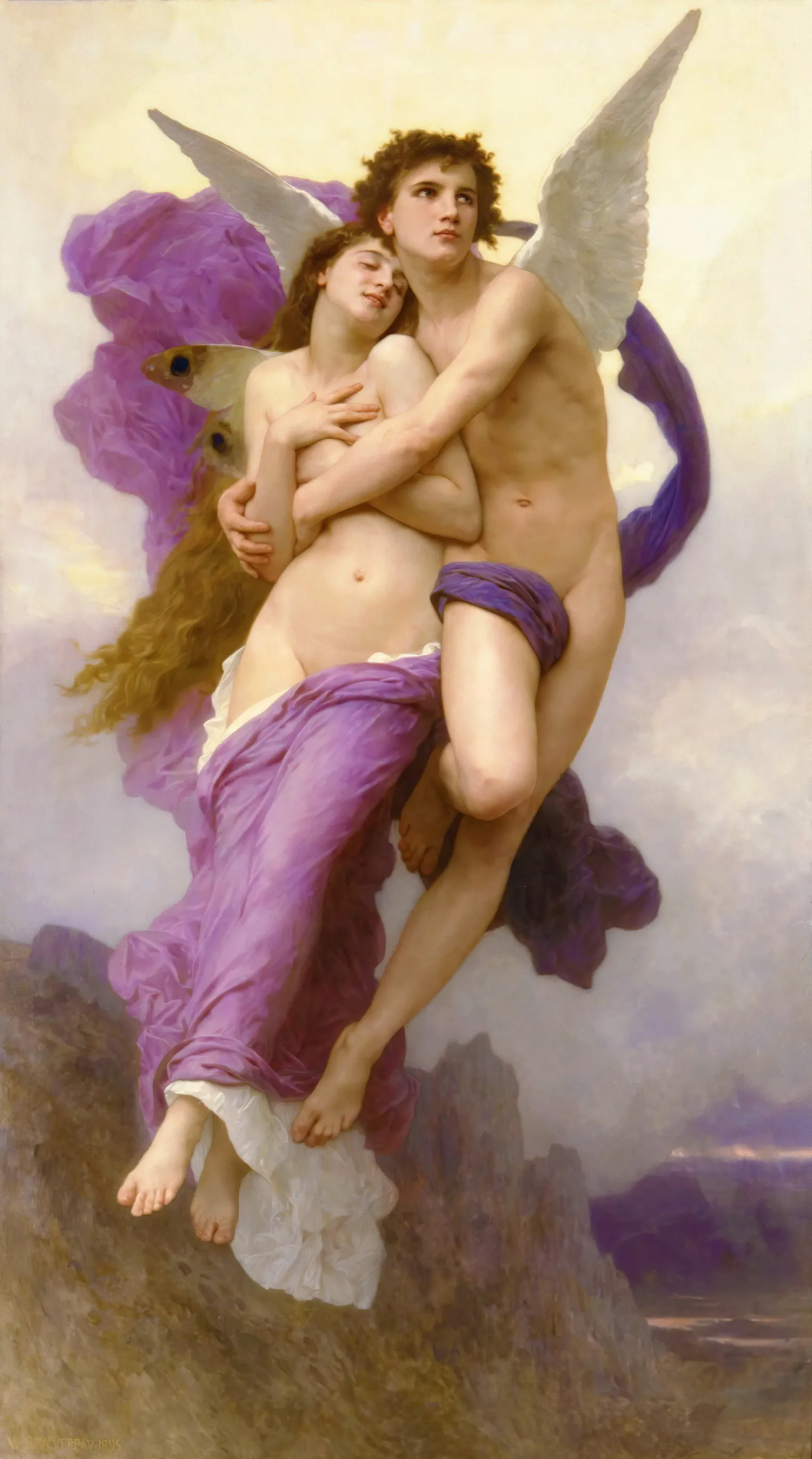
- Dimensions
- 209 × 120 cm
- Medium
- Oil on canvas
- Collection
- Private collection (United States)
✦ Highlights (technique & color)
The crowning achievement of the work lies in the porcelain-smooth texture of the skin, rendered without a single trace of brushstrokes. The contrast between the figures' warm flesh tones and the cool purples of the background and drapery creates a sculpted presence, as if the figures were illuminated from within. Furthermore, the dramatically vertical composition, with the figures resting weightlessly upon the clouds, creates an exquisite sense of levitation.
✦ The setting of this painting
The scene is set in the celestial realm on the ascent from earth to Mount Olympus. Soft light filtering through the clouds and delicate gradations of purple evoke a mystical hour that transcends earthly time. The distant mountains of the world below appear tiny, signifying a moment of transcendence—leaving the material realm behind to rise into the divine.
✦ Historical context
Late nineteenth-century France was at the height of the Belle Époque, a period marked by rapid industrialization and urbanization. In response to this hectic pace and growing materialism, people yearned for the idealized beauty and dreamlike escapism of classical mythology. It was also an era that saw the rise of a modern art market, as advancements in photogravure allowed paintings to be reproduced as prints and circulated worldwide.
A young man with large white wings cradles a nude girl with butterfly wings in his arms.
Swathed in a fluttering purple drape, the two are ascending into the sky.
The painting is titled The Abduction of Psyche.
From the word "Ravissement" in its original French title, it is often assumed to depict a violent abduction, with Cupid, the god of love, carrying off the maiden Psyche by force.
Online rumors also abound—claiming that the woman depicted was the painter's wife, or that the canvas hangs in the Louvre in Paris.
Yet in truth, all of these claims are mistaken.
The model was an Italian professional living in Paris, and the painting is quietly held in an American private collection.
And above all, this work does not depict an abduction.
In French, the word denotes not only an abduction, but also rapture, bliss, and spiritual ecstasy.
Paris, 1895.
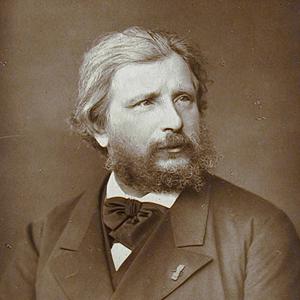
The painter William-Adolphe Bouguereau had turned seventy.
A master reigning at the pinnacle of the French art world,
he had achieved both immense wealth and renown.
Yet his life had been a succession of profound losses.
In 1875, he lost his sixteen-year-old eldest son, Georges.
Two years later, his first wife, Nelly, and their infant son died in rapid succession.
One by one, those he loved slipped from his grasp.
Left behind in his grief, he could only keep painting.
It was in these twilight years, at the age of seventy, that he conceived and submitted this monumental work to the Salon of his own accord.
In his studio on Boulevard du Montparnasse,
the preparatory sketches preserved on Michallet paper reveal that the initial composition was subtly different.
There was a certain unnatural tension in the angle and positioning of their arms.
Yet look at the finished oil painting.
Psyche gently folds her arms across her chest.
She rests her head against Cupid's neck, surrendering herself entirely.
There is no trace of resistance or fear.
About 183 more words
Unlock this story's ending, and every article on MusicStory
- 42
Stories1–2 new every week
An archive of paintings paired with great music, made for a weekend night and a cup of coffee
- 319
Paintings with commentarygrowing daily
From simply looking to truly reading — the brushwork and the obsession of the masters
- 10
Music Librarygrowing daily
Know it first, and what reaches your ear changes — background music becomes art you keep for life
My Notes, unlimited
Every reading adds to a digital art notebook that is yours alone
Already have an account? Log in
Your Note
Write down what this painting made you feel in your art notebook.
Please sign up to write notes.
Sign up for freeRecommended Artworks
.webp)
_Claude_Monet_(W_P_76).webp)
Sources & references
- The abduction of Psyche - Wikidata
- Le Ravissement de Psyche by William-Adolphe Bouguereau Art - GFM Painting
- File:William-Adolphe Bouguereau - The abduction of Psyche, 1895.jpg
- (#583) HENRI GODET (1863-1937), AFTER WILLIAM BOUGUEREAU FRENCH | Le ravissement de Psyche (The Abduction of Psyche) - Sotheby's
- ATTRIBUTED TO WILLIAM-ADOLPHE BOUGUEREAU (LA ROCHELLE 1825-1905), Study for the Abduction of Psyche | Christie's
- Список работ Вильяма Бугро - Википедия
- The Abduction of Psyche • Bouguereau • Canvas Print • Museum Quality Giclée • TopArtPrint 226-BWA
- Le Ravissement de Psyche (The Rapture of Psyche) Painting by William Adolphe Bouguereau - Alpha Art Gallery
- William-Adolphe Bouguereau's Invading Cupid's Realm painting - Facebook
- Adolphe William Bouguereau Art Value Price Guide - Invaluable.com
- Henri Godet, After William-Adolphe Bouguereau | Le ravissement de - Sotheby's
- The Abduction of Psyche, 1895 - Oil Painting - Overstock Art
- Le Ravissement de Psyché - MAH.2016.1.13 - Alienor.org
- William Bouguereau (French, 1825-1905) , Study of a Young Girl's Head | Christie's
- L'Amour et Psyche, Enfants by William-Adolphe Bouguereau - TheHistoryOfArt.org
- Rewriting the ancient world. Greeks, Romans, Jews and Christians in modern popular fiction - EBIN.PUB
- Emile Signol's copy of Bouguereau's Psyche and Cupid - Facebook
- William-Adolphe Bouguereau (1825–1905) At The Fountain - Facebook
- "A dryad" Artist: William Adolphe Bouguereau - Facebook
- Le ravissement de Psyche (also known as The Abduction of Psyche) — William-Adolphe Bouguereau - AllPaintingsStore.com
- The Abduction of Psyche | Bouguereau | Painting Reproduction 226 - TOPofART
More artists
If you find an error in this content, please let us know here
This site is protected by reCAPTCHA, and the Google Privacy Policy and Terms of Service apply.