
 日本語 (JA)
 English (EN)
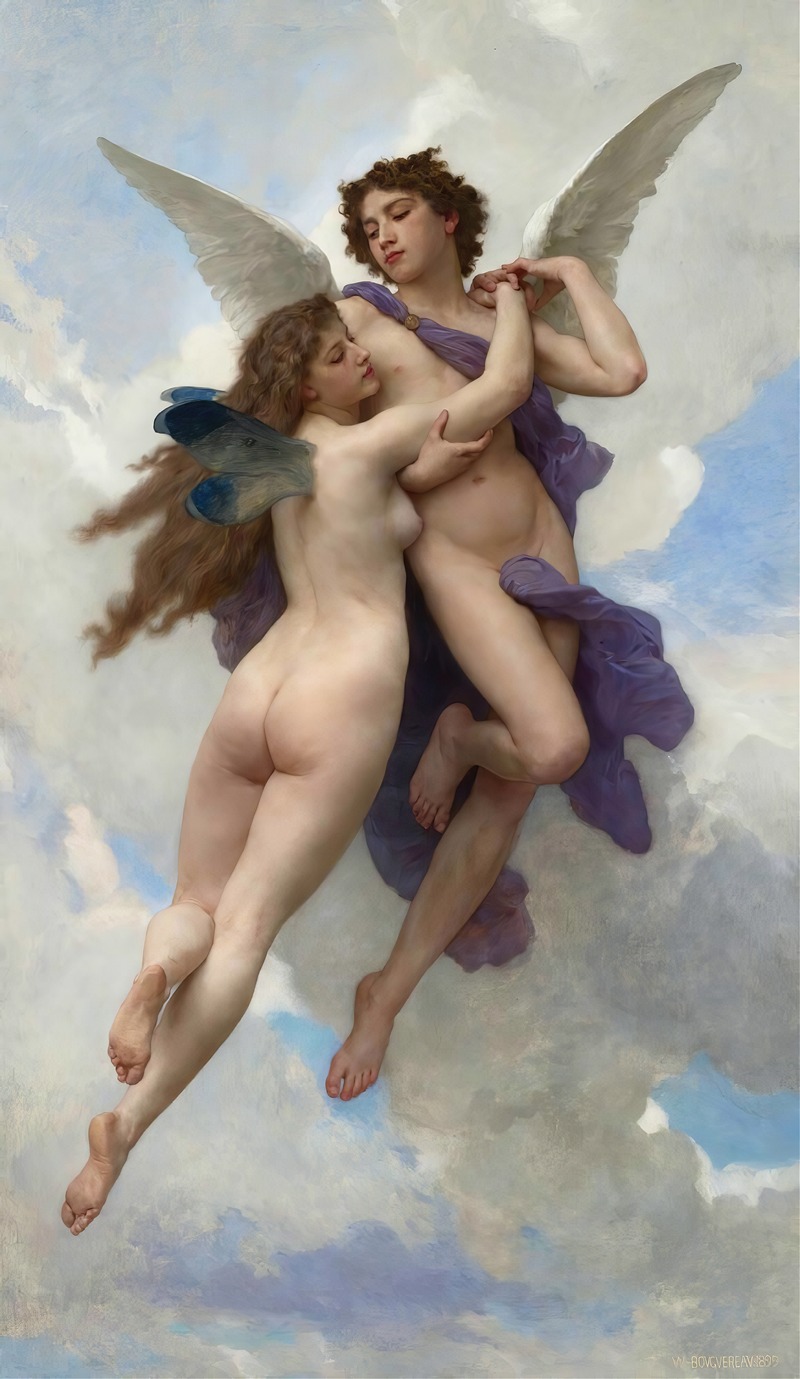
- Dimensions
- 218.7 × 129.2 cm
- Medium
- Oil on canvas
- Collection
- Private collection
✦ Highlights (technique & color)
While tales of love often favor reds and pinks, this work employs a cool color palette dominated by pale blues, crisp whites, and chilly atmospheric tones. This choice strips away earthly, carnal fleshiness, underscoring that their embrace is an exceptionally pure and spiritual union of souls.
✦ The setting of this painting
The setting of this work is a dreamlike celestial void entirely freed from gravity. Amid a mystical atmosphere of rippling, layered pale-blue clouds, it captures the dynamic moment of flight as Cupid, empowered by love, whisks the youthful Psyche away from earthly tribulations toward his own sacred heavenly realm.
✦ Historical context
In the fin-de-siècle art market of 1899, demand among the rising bourgeoisie and Anglo-American collectors for flawless renderings of the human body—under the guise of classical mythology—reached its zenith. Bouguereau continued to command the high-end Salon market by offering refined works that delicately blended purity with sensuality.
Suspended in the blue sky amidst white clouds, two youths float embraced in midair.
From the young man's back spring the white wings of a bird,
while from the young woman's emerge the blue wings of a butterfly.
A violet drapery flutters in the wind, softly enveloping their bodies.
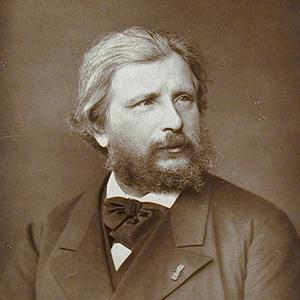
The work was painted by the French artist William-Adolphe Bouguereau.
He created it in 1899, at the age of seventy-three.
At the time, he reigned at the pinnacle of the French art world.
His flawless rendering of the human form and refined elegance were sought after by wealthy patrons around the globe.
Yet his private life was far from serene.
In early 1899,
Bouguereau was staying for an extended period in Menton in the south of France.
He was troubled by concerns over his own health,
and above all, he was there to care for his ailing son, Paul.
By then, he had already lost his first wife and three of his five children.
Now, the life of his remaining son, Paul, was also threatened by illness.
Amid such harrowing circumstances, he never laid down his brush.
In a temporary studio in Menton, driven by fierce resolve, he brought this masterwork to completion.
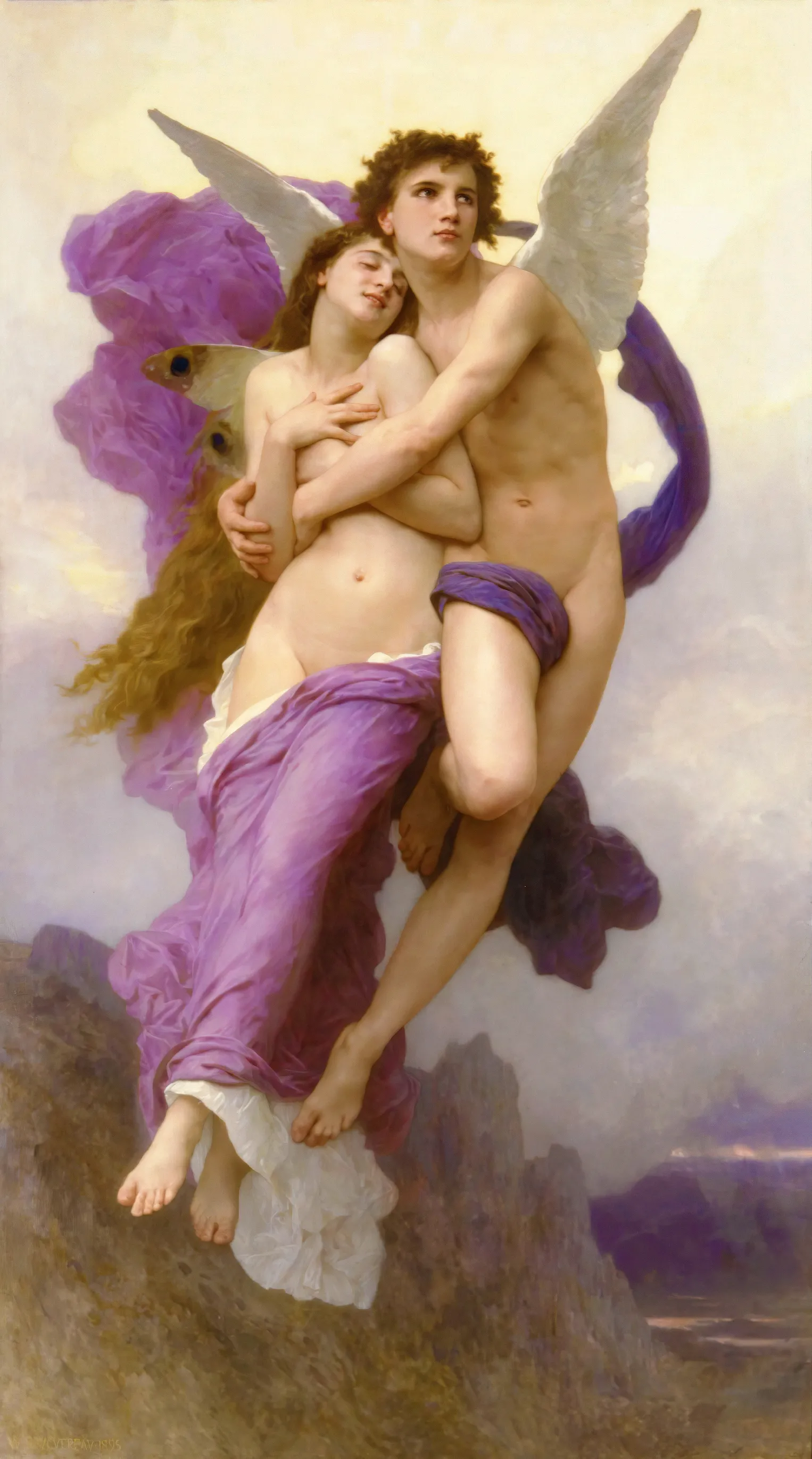
The two figures in the painting are Cupid and Psyche of classical mythology—
two lovers united with the blessing of the gods after enduring agonizing trials.
About 136 more words
Sign up free and enter Your Museum
Read the stories behind great paintings and music for free, in Your Museum
Your Note
Write down what this painting made you feel in your art notebook.
Please sign up to write notes.
Sign up for freeRecommended Artworks
Sources & references
More art movements
Pre-Baroque
1 artworks
Victorian era
10 artworks
Impressionism
48 artworks
Late Pre-Raphaelite
10 artworks
Baroque
2 artworks
American Impressionism
5 artworks
Realism
4 artworks
Pre-Raphaelite
3 artworks
Barbizon School
5 artworks
Academic art
5 artworks
Luminism
3 artworks
Rococo
2 artworks
Symbolism
22 artworks
Neo-Impressionism
3 artworks
Ukiyo-e
1 artworks
Japonism
4 artworks
Edo period
1 artworks
Fauvism
1 artworks
Naturalism
9 artworks
Russian Realism
1 artworks
Post-Impressionism
13 artworks
Genre painting
9 artworks
Neoclassicism
3 artworks
ウィーン分離派
7 artworks
自然主義
1 artworks
ナショナル・ロマンティシズム
1 artworks
未来派
1 artworks
More artists
If you find an error in this content, please let us know here
This site is protected by reCAPTCHA, and the Google Privacy Policy and Terms of Service apply.