
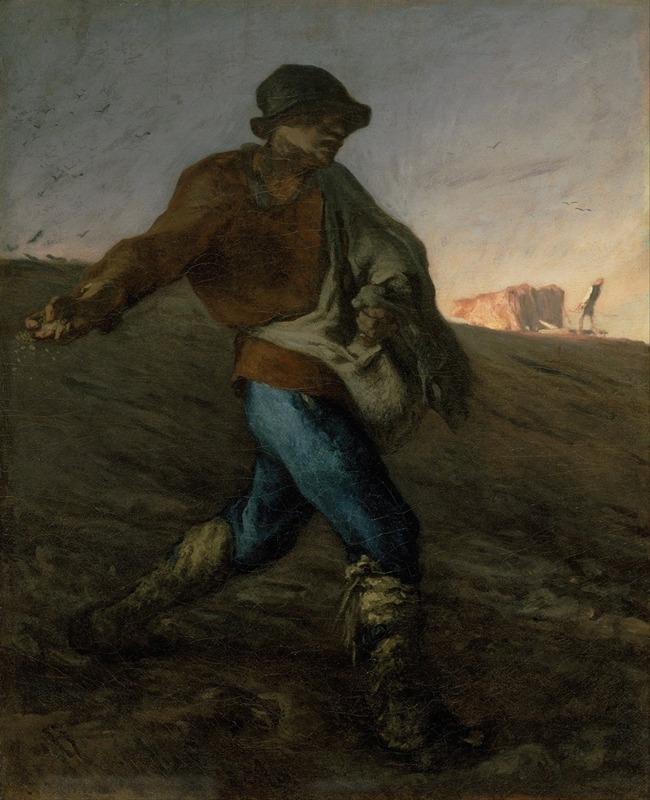
The Sower
1850
- Dimensions
- 101.6 × 82.6 cm
- Medium
- 油彩、カンヴァス
- Collection
- ボストン美術館
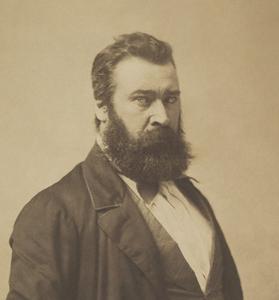
A nineteenth-century French realist painter, he captured humble rural labor on g…
甘美な神話画への決別と、自らの出自である農民の真実を描き出すという強烈な芸術的宣言。苛酷な大地と対峙する無名の労働者に、普遍的な英雄性と神聖な尊厳を付与した、魂のモニュメント。
✦ Highlights (technique & color)
滑らかな仕上げを避け、キャンバスの質感を残した荒々しい絵肌が見どころです。油分を抑えた粘り気のある絵具を、擦り付けるように塗り重ねています。また、見る人の視線を低く設定した仰角の構図を採用。手前の斜面を下る農夫の体が背景の地平線を突き抜け、空へと聳え立つような圧倒的な巨大感を生み出しています。
✦ The setting of this painting
舞台は、フランスのバルビゾン村に隣接するシェイ=アン=ビエールの平原です。広大な小麦畑が続く伝統的な農業地帯でした。季節は秋、10月から11月頃。来春の収穫に向けた冬小麦の播種作業が描かれています。時間帯は黄昏時で、手前の斜面は暗い影に包まれつつあります。
✦ Historical context
1848年の二月革命で第二共和政が成立し、男子無制限普選制が導入されました。これまで政治的権利から排除されていた農民や労働者層が社会の前面に浮上した時代です。階級闘争へのブルジョワ階級の恐怖感が高まる中、本作が出品された1850年のパリ・サロンは、写実主義運動の確立を象徴する場となりました。
A solitary peasant strides vigorously across a steep slope, sowing seeds of winter wheat. The upper half of his face is shrouded in the deep shadow of his hat, hiding his expression from view.
He wears threadbare, torn blue trousers and a red tunic, his legs bound tightly with straw to keep out the cold and mud. This painting is often described as a realistic documentary, capturing the stark reality of a specific peasant suffering in abject poverty.
Yet in truth, this figure is not a portrait of any particular individual.
In June 1849, Jean-François Millet fled the political turmoil and cholera epidemic of Paris, moving with his family to Barbizon.
At the time, Millet was in dire poverty, facing the harsh reality of struggling day to day to support his wife, Catherine Lemaire, and their many children. During his Paris years, he had produced mythological scenes that sold relatively well. Upon moving to Barbizon, however, he radically transformed his artistic style, choosing instead to depict the honest labor of the peasantry—the very world from which he came.
There was no commission.
This painting was created entirely on his own initiative for submission to the 1850 Paris Salon, conceived as his new artistic manifesto. Millet synthesized memories of the peasants he had observed in his native Gruchy and in Barbizon, creating not an individual likeness, but a universal archetype of the peasant class.
Unveiled at the Paris Salon on December 30, 1850, the painting ignited fierce controversy, deeply dividing its audience.
About 239 more words
Read stories of masterpieces for free
Your Note
Write down what this painting made you feel in your art notebook.
Please sign up to write notes.
Sign up for freeRecommended Artworks
_by_Ilya_Repin_-_%D0%9D%D0%B5%D0%B0%D0%BF%D0%BE%D0%BB%D0%B8%D1%82%D0%B0%D0%BD%D0%BA%D0%B0.webp)
Sources & references
More artists
If you find an error in this content, please let us know here
This site is protected by reCAPTCHA, and the Google Privacy Policy and Terms of Service apply.