
The Bridge at Mantes
1868
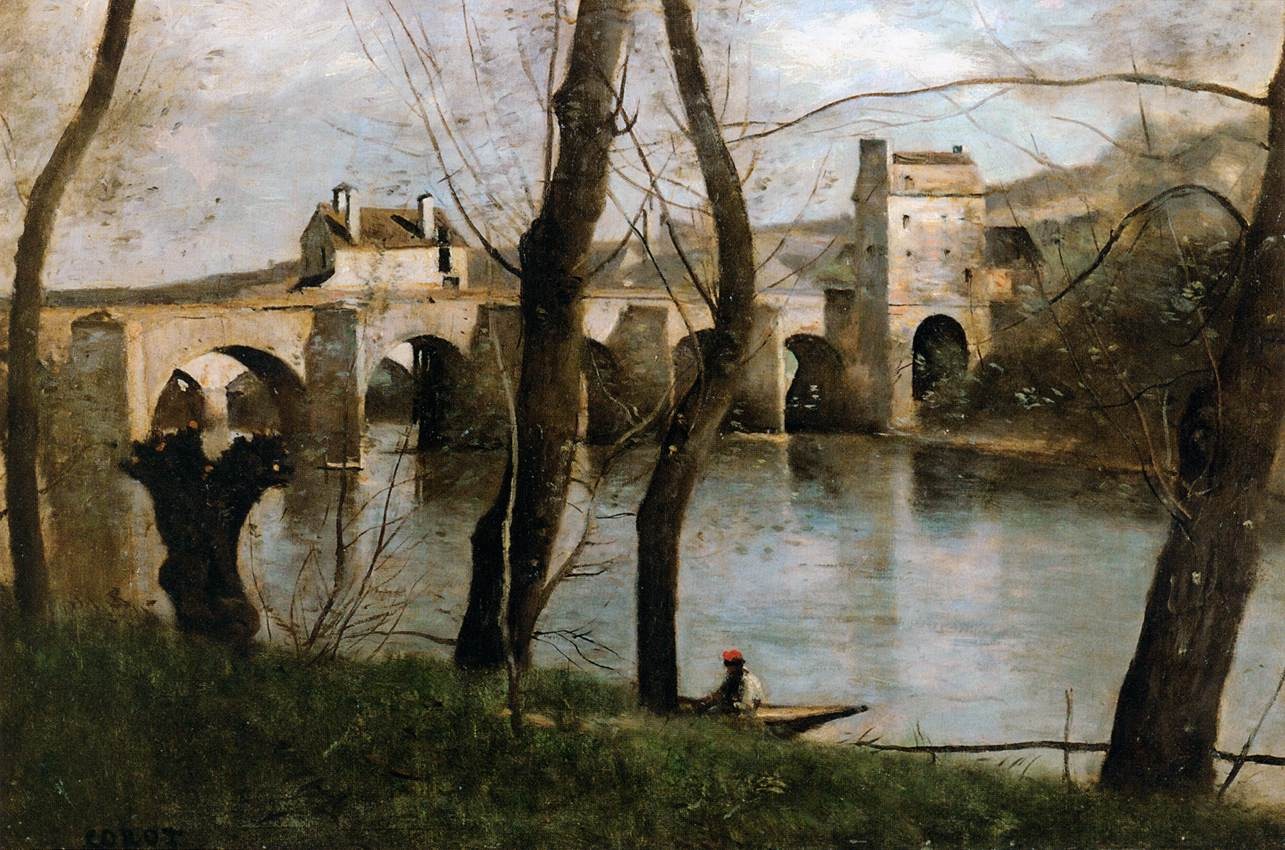
Image: Wikimedia Commons / Public Domain
- Dimensions
- 縦 38.5 cm × 横 55.5 cm
- Medium
- Oil on canvas
- Collection
- Musée du Louvre
19世紀フランスを代表する画家であり、バルビゾン派の中心的な存在である。
Far from the city's turmoil, the artist wished to immortalize a serene, idealized world in Mantes where humanity and nature coexist in harmony, suffused with personal memory and poetic grace.
✦ Highlights (technique & color)
The dark foliage on the left and along the upper edge acts as a repoussoir, framing the composition and drawing the viewer's eye to the luminous water at the center. The horizontal span of the bridge and the vertical church towers create a harmonious, stable structure, while atmospheric perspective softens the contrasts from foreground to background, achieving a profound sense of depth. Notice the subtle, silvery-gray tones, famously known as "Corot's gray," that bathe the entire scene.
✦ The setting of this painting
The banks of the Seine at Mantes-la-Jolie, located approximately 50 kilometers west-northwest of Paris. The multi-arched medieval bridge (the old bridge of Mantes) stretches across the water, with the square towers of the 12th-century Collegiate Church of Notre-Dame rising in the distance. Bathed in the clear, blue-green and silvery-gray light of early morning or dusk, the scene captures late spring to early summer.
✦ Historical context
Circa 1868–1870, at the close of the Second French Empire. As Paris underwent rapid urban modernization, nostalgia for the untouched landscapes of the countryside deepened. This peaceful moment immediately preceded the upheavals of the Franco-Prussian War and the Paris Commune.
Upon the tranquil surface of the water, a clear atmosphere of blue-green and silvery-grey softly dissolves. Across a branch of the Seine stretches an old, multi-arched stone bridge.
On the near shore, a modestly dressed fisherman sits quietly in a small boat, while on the distant horizon, the square towers of a twelfth-century collegiate church emerge in a graceful silhouette through a delicate haze of pale blue-grey.
Leaving the Tumultuous Capital for a Quiet Town Where a Dear Friend Awaits
By the late 1860s, in his early seventies, Jean-Baptiste-Camille Corot stood at the pinnacle of fame and acclaim in the French art world. His standing at the Salon was firmly established, and his works sold steadily through dealers like Paul Durand-Ruel, granting him profound financial security. Dividing his time between his spacious studio on Rue Véron in Paris and his country house in Ville-d'Avray, he devoted himself tirelessly to outdoor sketching and finishing grand canvases in the studio whenever his health permitted. Warmly revered as "Père Corot" by younger painters such as Pissarro, Sisley, and Morisot, he was a gentle soul who generously offered his own wealth to support colleagues in need.
Yet Paris at the time was in the midst of radical upheaval. Under the orders of Napoleon III, Baron Haussmann's grand renovation of Paris was underway, sweeping away historic streets as the city transformed into a modern metropolis. The clamor and dizzying pace of urban modernization may have gradually worn on the aging painter, who so deeply cherished the quiet of nature.
For Corot, Mantes-la-Jolie (commonly known as Mantes), roughly fifty kilometers west-northwest of Paris, was a cherished sanctuary where his heart could find true peace. Following the opening of the railway connecting Paris and Rouen in the 1840s, he visited the town frequently, often staying for extended periods. Above all, it was the presence of his dear friend François-Parfait Robert, a local magistrate in Mantes, and his family that drew him there.
About 588 more words
Read the rest of this commentary —
and step into a secret gallery
opened just for you
An "art letter" delivered to you every Saturday morning
Works, music and words chosen for your sensibility, from your artist-type result and the paintings you love
A library of masterpieces and music you can enjoy "in your own words", not just look at
A "digital art notebook" (unlimited) where your impressions build into your own taste
Unlimited likes and notes
¥980 / month¥0 today
¥980/month (tax incl.) from day 8. Cancel anytime.
Already have an account? Log in
Your Note
Write down what this painting made you feel in your art notebook.
Please sign up to write notes.
Sign up for freeRecommended Artworks
Sources & references
More artists
If you find an error in this content, please let us know here
This site is protected by reCAPTCHA, and the Google Privacy Policy and Terms of Service apply.