
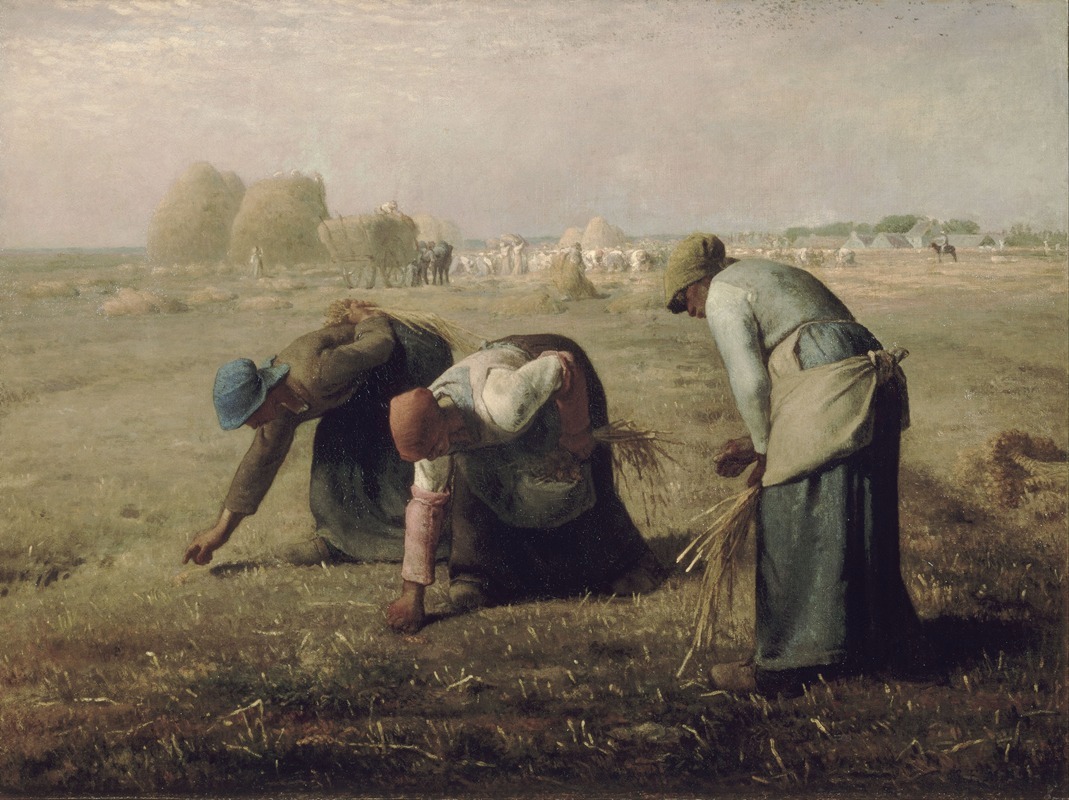
The Gleaners
1857
- Dimensions
- 83.5 cm × 110.0 cm
- Medium
- Oil on canvas
- Collection
- Musée d'Orsay, Paris
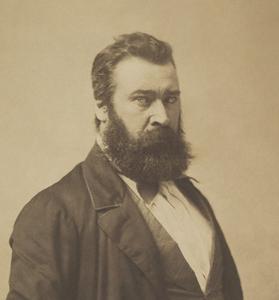
A nineteenth-century French realist painter, he captured humble rural labor on g…
A steadfast conviction that prioritized the human dimension of art over political propaganda, chronicling the harsh fate of nameless peasant women and the universal dignity residing within their labor.
✦ Highlights (technique & color)
Millet employed a coarse linen canvas and built up a dense ground of dark brown impasto, conveying the earthy scent of the soil and the rugged texture of the women's garments. By setting the horizon high in the upper third of the canvas and allowing the figures to break the horizon line, he endowed them with a monumental presence. The overall palette is harmonized in muted earth tones, with the primary colors of their bonnets—blue, red, and yellow—catching the low evening light to form subtle, vibrant accents.
✦ The setting of this painting
The scene is set on the plain of Chailly-en-Bière in the Île-de-France region: a parched field in the late summer twilight, just after the wheat harvest. In the background, towering haystacks, loaded carts, and a mounted supervisor depict the bountiful harvest of a prosperous estate. In the foreground, the low, raking light of the sinking sun casts strong relief upon the backs of three peasant women gathering stray ears of wheat.
✦ Historical context
The Second French Empire of the 1850s was an era marked by the Industrial Revolution and rapid urbanization. The plain of Chailly had become a testing ground for large-scale intensive agriculture, transitioning toward modern capitalist farming. This shift led to a growing class of landless day laborers and destitute rural poor. While gleaning had long been tolerated by custom as a vital means of survival for the impoverished, landowners were increasingly attempting to curtail this right, turning it into a contentious social issue.
A dry field after the harvest. Three women bend deep at the waist, gathering leftover ears of wheat. A peaceful landscape depicting idyllic rural life—or so it is often thought. In reality, however, this is a depiction of the struggle for survival among the destitute. And it stands as the ultimate expression of a painter holding fast to his convictions.
In the early 1850s, Jean-François Millet began conceiving the work in his cramped studio in Barbizon. At the time, he was supporting his wife, Catherine Lemaire, and a houseful of children. Living in extreme poverty, he spent his days hounded by the costs of food and art supplies, all while suffering from chronic eye trouble and severe headaches. Yet, with no commission from anyone, he pressed on with painting it on his own initiative. It took him nearly five years to complete.
The setting is the Plain of Chailly. Born into a peasant family in Normandy, Millet walked this plain on a daily basis. Rural France was then undergoing a transition to large-scale farm management, which led to a rapid increase in impoverished, landless workers. "Gleaning"—collecting leftover grain—was a right granted to widows and the poor so they could survive. It was, quite literally, an act of survival.
In 1857, the painting was unveiled at the Paris Salon. Conservative critics condemned it harshly. "The Three Fates of poverty," they sneered. "The shadows of popular uprisings and the guillotine loom behind them." It was viewed with deep suspicion as socialist propaganda.
About 274 more words
Read stories of masterpieces for free
Your Note
Write down what this painting made you feel in your art notebook.
Please sign up to write notes.
Sign up for freeRecommended Artworks
_by_Ilya_Repin_-_%D0%9D%D0%B5%D0%B0%D0%BF%D0%BE%D0%BB%D0%B8%D1%82%D0%B0%D0%BD%D0%BA%D0%B0.webp)
Sources & references
More artists

If you find an error in this content, please let us know here
This site is protected by reCAPTCHA, and the Google Privacy Policy and Terms of Service apply.