
Polynesia, the Sea
1946
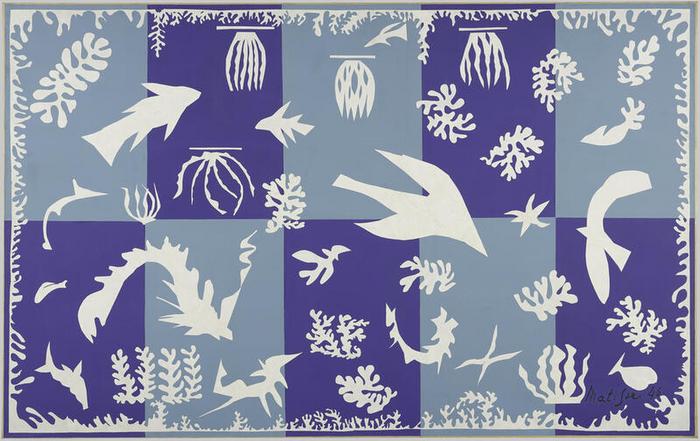
- Dimensions
- 196 × 314 cm
- Medium
- 工業染色紙および手塗りグワッシュペーパーの切り貼り、キャンバス裏打ち
- Collection
- ポンピドゥー・センター国立近代美術館
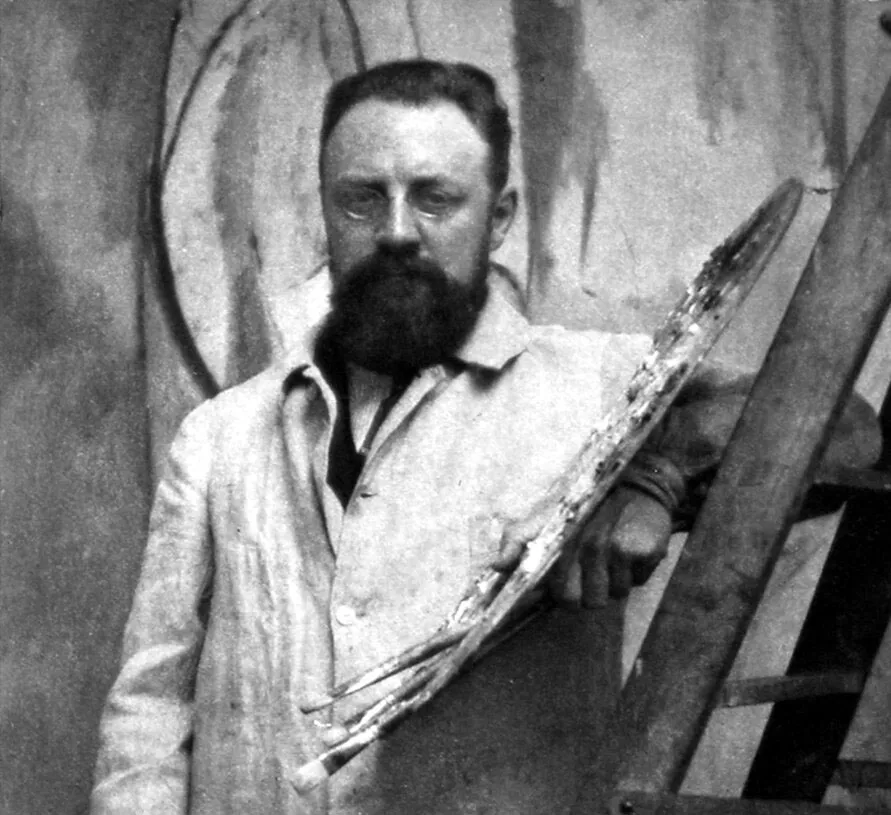
A French visual artist of the early 20th century, he detached color from the imi…
伝統的な遠近法と重力からの、ハサミによる完全な解放。病に倒れた老画家が、自らの記憶の底からすくい上げた永遠の自由と生命の輝き。
✦ Highlights (technique & color)
「切り紙絵」という独自の手法が用いられています。助手が不透明水彩絵具(グワッシュ)を塗った便箋や包装紙を、マティスが下書きなしでハサミで直接切り抜きました。青と緑の市松模様を背景にすることで、伝統的な遠近法を解体しています。白いモチーフは光を象徴し、重力を持たずに配置されることで、画面全体に無重力の感覚が生み出されています。
✦ The setting of this painting
描かれているのは、南太平洋のフランス領ポリネシアに位置するタヒチ島の海原とサンゴ礁のラグーンです。しかし、現地で直接写生された風景ではありません。1930年にタヒチを訪れたマティスの記憶が、16年の歳月を経て脳裏で結晶化した情景です。実際の制作は、南仏ヴァンスのアトリエ「ヴィラ・ル・レーヴ」で行われました。
✦ Historical context
制作年の1946年は、第二次世界大戦終結直後の復興期にあたります。ナチス・ドイツの占領から解放されたフランスでは、国家の文化的威信を取り戻すため、中世以来の伝統工芸であるタペストリー技術の復興運動が推進されていました。巨匠マティスが国営ゴブラン織物製作所の委嘱に応じたことは、戦後フランス文化復興の象徴的な意味を持っていました。
White shapes drift across a checkerboard of blue and green.
They resemble seaweed, coral, fish, and even birds soaring through the sky.
Painted with an easel set up on a tropical shore—
at first glance, one might easily imagine so.
In truth, however, this work was not created in Tahiti.
It was made indoors in the South of France, far from the South Pacific.
Moreover, sixteen long years had passed since he had last gazed upon that ocean.
In 1930,
having turned sixty, Matisse was searching for a breakthrough in his artistic expression.
He journeyed to Tahiti, immersing himself in the crystalline waters
and losing himself in the colors of the coral reefs.
Yet while there, he made scarcely any sketches.
Though he carried an expensive camera, he deliberately chose not to take photographs.
"Taking a photograph only results in an impoverished image."
Fearing that his profound impressions would be compromised,
he simply absorbed everything with his eyes, like a sponge soaking up water.
Eleven years later, in 1941,
Matisse underwent major surgery for duodenal cancer in Lyon.
Miraculously, his life was saved,
yet he was forced to endure a prolonged convalescence confined to a wheelchair and bed.
The physically demanding process of oil painting was no longer possible.
In 1946, at his studio, Villa Le Rêve, in Vence in the South of France,
he received a commission from the Gobelins Manufactory to design tapestries.
It was then that he proposed a novel technique.
His assistants applied flat coats of gouache onto letter paper or wrapping paper.
Matisse then cut directly into these colored sheets using large shears.
Just as a sculptor carves directly into stone, he carved into pure color with his scissors.
The cut-out motifs were pinned to the studio walls.
Bathed in the ambient light of the room, he arranged and rearranged them endlessly to compose the image.
After more than fifteen years, the miracle of the Pacific was reborn as a vivid memory.
About 182 more words
Unlock this story's ending, and every article on MusicStory
- 42
Stories1–2 new every week
An archive of paintings paired with great music, made for a weekend night and a cup of coffee
- 282
Paintings with commentarygrowing daily
From simply looking to truly reading — the brushwork and the obsession of the masters
- 10
Music Librarygrowing daily
Know it first, and what reaches your ear changes — background music becomes art you keep for life
My Notes, unlimited
Every reading adds to a digital art notebook that is yours alone
Already have an account? Log in
Your Note
Write down what this painting made you feel in your art notebook.
Please sign up to write notes.
Sign up for freeRecommended Artworks
_1893.webp)
_Claude_Monet_-_Muse%CC%81e_des_Beaux-Arts_de_Lyon_(W821)+(1).webp)
Sources & references
More artists
If you find an error in this content, please let us know here
This site is protected by reCAPTCHA, and the Google Privacy Policy and Terms of Service apply.