
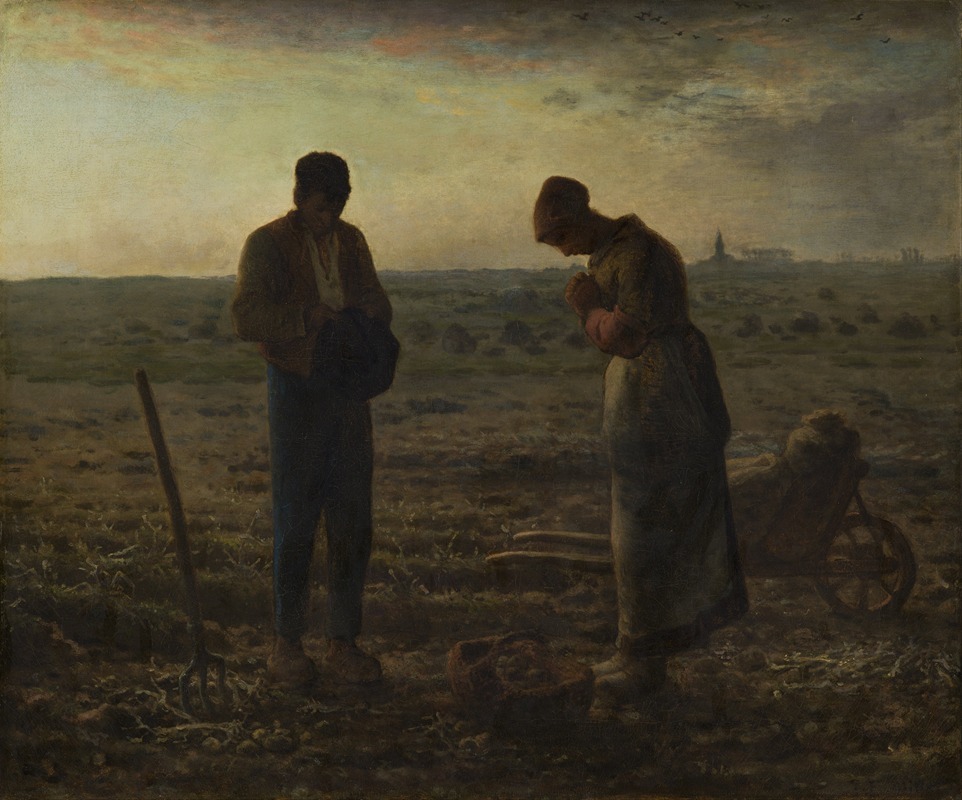
The Angelus
1857
- Dimensions
- 55.5 × 66.0 cm
- Medium
- 油彩・カンヴァス
- Collection
- オルセー美術館(パリ)
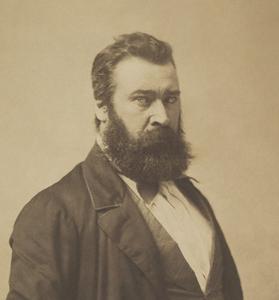
A nineteenth-century French realist painter, he captured humble rural labor on g…
幼き日に祖母と捧げた、死者への祈りの記憶。過酷な労働の果てに響く鐘の音に、農民の静謐な尊厳と深い郷愁を刻みつけた、追憶の風景。
✦ Highlights (technique & color)
キャンバスに赤褐色や中性色の下地を施し、それを透けさせるスカンブリング(擦筆)技法を用いることで、夕暮れ時の空気の層を表現しています。一方で、農民の粗末な衣服や足元の土には絵具を厚く盛り上げるインパスト技法が使われ、物体の重厚な物質感が強調されています。
✦ The setting of this painting
舞台はフランスのバルビゾン村に隣接するシャイイの平原。季節は秋、時刻は日没時の薄暮です。遠景の地平線上には、隣村シャイイ=アン=ビエールに実在するサン=ポール教会の尖塔が小さく描かれています。当時の農村では、夕刻になると教会の鐘が鳴り、一日の過酷な農作業の終わりと祈りの時間を告げていました。
✦ Historical context
1850年代のフランスは、ナポレオン3世の治世下で急速な産業革命と都市改造が進んでいました。農村から都市部への激しい人口流出が起こり、伝統的な農村の生活様式が消失の危機に瀕していた時代です。都市住民の間には、失われゆく農村への強い郷愁が生まれていました。
In the twilight glow, two silhouettes pause their farm work on a vast plain to offer a quiet prayer. On the left stands a man, holding his removed hat in both hands and bowing his head deeply. On the right, a woman presses her hands tightly together in front of her chest. Between them sits a small basket filled with freshly harvested potatoes. Behind the man, a three-pronged pitchfork is stuck into the soil, while behind the woman stands a wheelbarrow loaded with sacks of potatoes. Devout peasants praying to the sound of a distant church bell. It is often thought that this painting was created as an instant masterpiece to praise the sanctity of Catholic faith. Or that its perfect composition was meticulously calculated from the very beginning. In reality, however, that was not the case. At first, there was no church steeple in the picture—it was simply a scene of a potato harvest. This masterpiece was born out of the painter's unexpected despair.
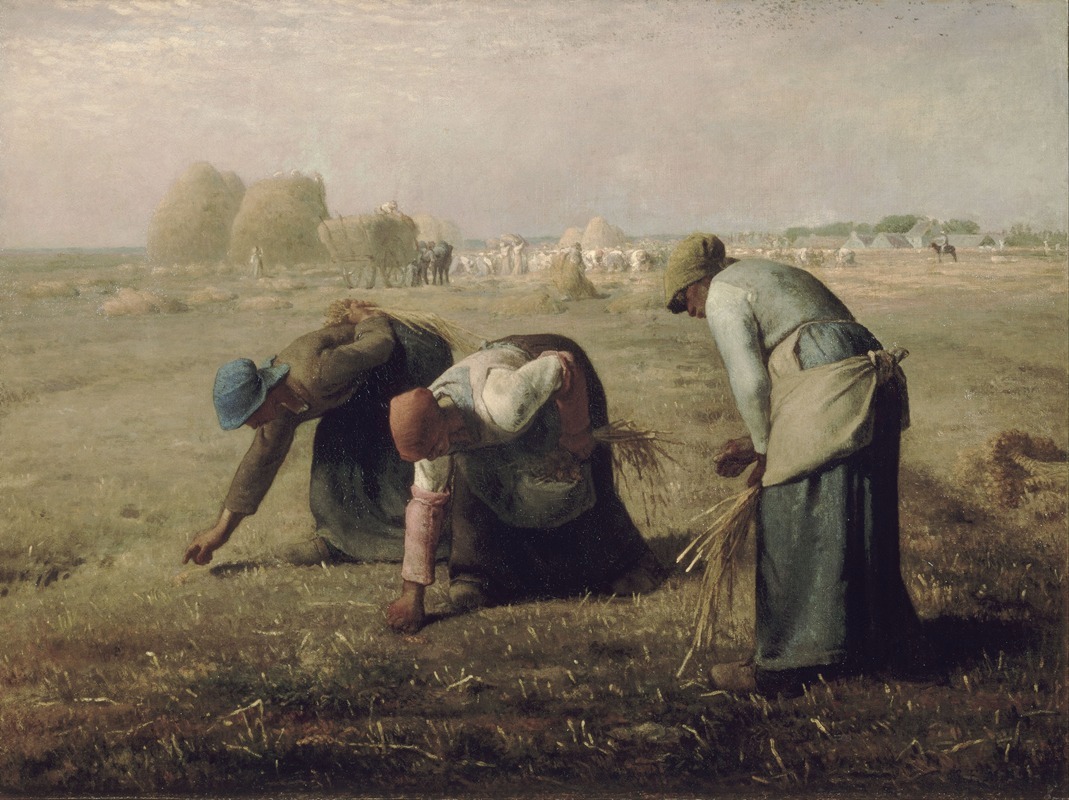
In 1857, in his studio in Barbizon. Jean-François Millet was supporting a large family with his common-law wife, Catherine Lemaire, living in extreme financial hardship. The Gleaners, his major work exhibited at the Salon that same year, faced fierce condemnation from conservative critics who denounced it as a radical painting inciting peasant discontent. With his pictures unsold, he struggled daily even to pay rent or buy food. Amidst this hardship, an order for a painting arrived from Thomas Gold Appleton, an American collector. For Millet, it was a lifeline to feed his family. He set to work under the working title Prayer for the Potato Crop. By the summer of 1857, he had completed the basic composition.
In 1859, however, when the painting was finished, an unexpected turn of events occurred. The buyer refused delivery. The reason was never recorded. The patron would not accept the painting, and no payment was made. A painting without a buyer. On the brink of despair, Millet kept this small canvas in his hands. And he touched his brush to the distant horizon. The small bell tower of the Church of Saint-Paul, a real church in the neighboring village of Chailly-en-Bière. That is what he added to the scene.
Why a bell tower? What rose in Millet's mind was a memory from his childhood. Long ago, while working in the fields, whenever the church bell tolled at dusk, his grandmother would make them stop their work. It was to recite a prayer for the poor souls of the departed. This was no dogmatic religious propaganda. It was a warm, poignant nostalgia for his early years with his grandmother.
About 170 more words
Read stories of masterpieces for free
Your Note
Write down what this painting made you feel in your art notebook.
Please sign up to write notes.
Sign up for freeRecommended Artworks
_1893.webp)
_Edouard_Manet_(National_Gallery_of_Art%2C_Washington_D.C.).webp)
Sources & references
More artists

If you find an error in this content, please let us know here
This site is protected by reCAPTCHA, and the Google Privacy Policy and Terms of Service apply.