
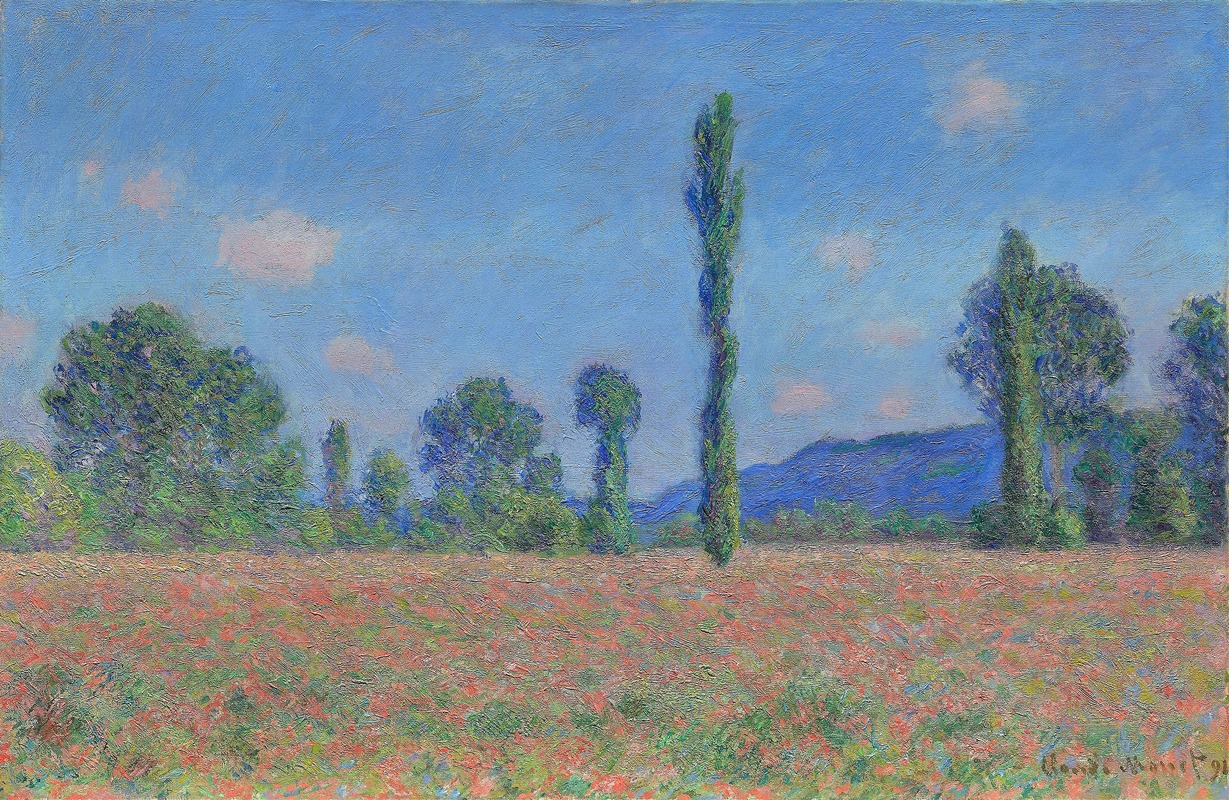
Poppy Field (Giverny)
1890
- Dimensions
- 61.2 × 93.1 cm
- Medium
- Oil on linen canvas
- Collection
- The Art Institute of Chicago
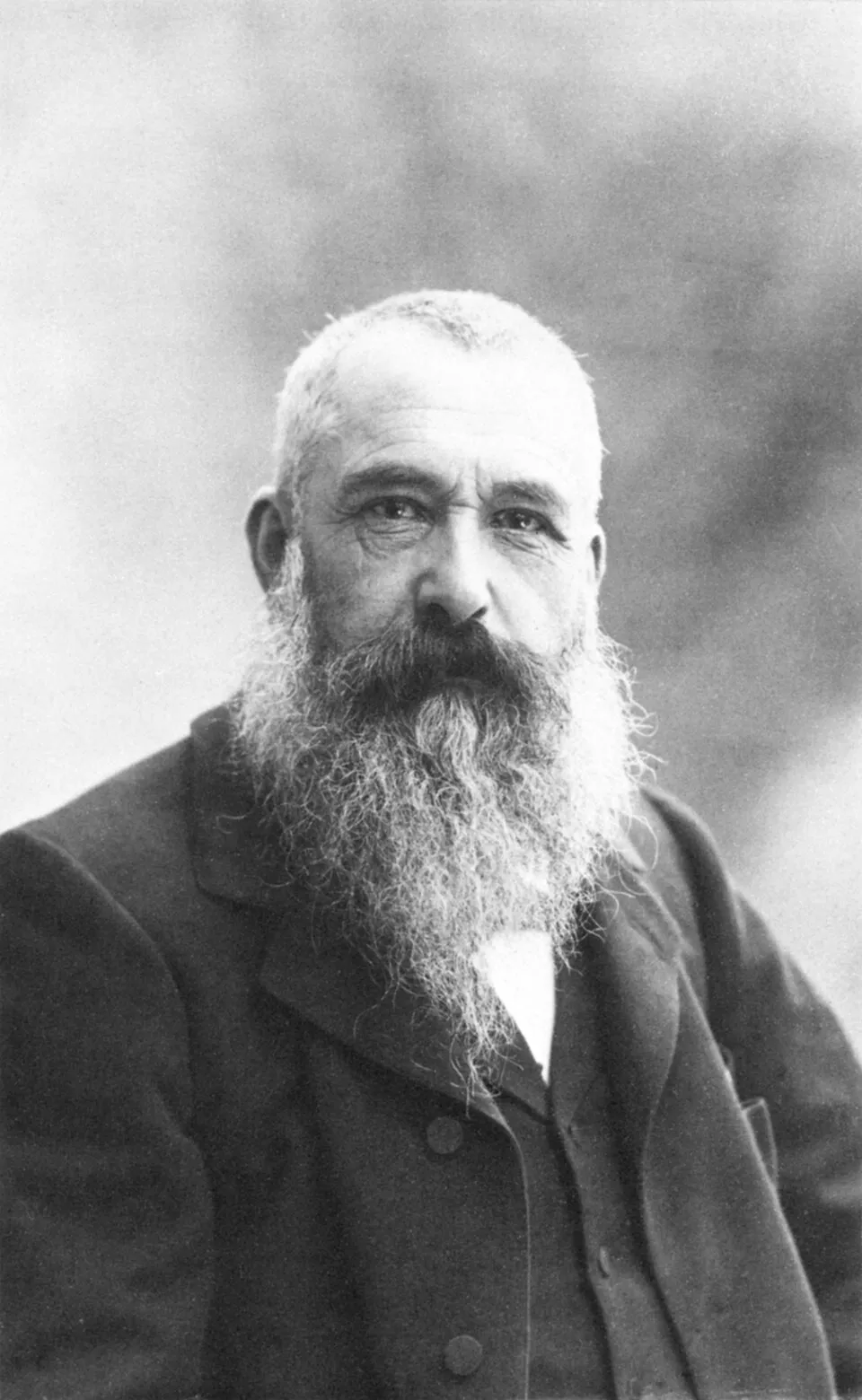
Celebrated as a founding figure of Impressionism, he is one of France’s most ren…
✦ Highlights (technique & color)
Monet rendered the green wild grasses with long, parallel horizontal brushstrokes, upon which he dabbed pure red pigment in small flecks to capture the gentle tremor of poppies swaying in the breeze. The paint creates a flat, decorative texture reminiscent of woven fabric, showcasing an exquisite color harmony that can be seen as Monet's unique response to contemporary Pointillism.
✦ The setting of this painting
This is the farmland known as "Les Essarts," located about a ten-minute walk south of Monet's home in Giverny. It is a flat field nestled between the Epte River and a canal, with the hills behind Monet's property stretching across the background. The arrangement of poplar trees vertically dividing the composition indicates that the scene was painted looking west of the Giverny pond toward the neighboring village of Vernon.
✦ Historical context
In the summer of 1890, Monet returned to painting after a year-long hiatus, following his successful fundraising campaign to acquire his late friend Édouard Manet's Olympia for the French state. During this period, he began experimenting with working on multiple canvases of the same composition simultaneously—a direct precursor to the dedicated "series" paintings that would fully emerge with his Haystacks soon after.
Amid the green grasses swaying in the breeze, vibrant red poppies bloom in profusion.
In the distance stands a row of poplars, framing the idyllic landscape of Giverny.
A serene and picturesque pastoral scene, so beloved by Monet.
It appears to be a quintessential Impressionist work, capturing the shimmer of shifting light.
Yet beneath this painting lies an entirely different landscape.
Scientific analysis by the Art Institute of Chicago revealed an astonishing truth.
Infrared and X-ray imaging detected the rugged ridge of a cliff towering toward the top of the canvas.
Beneath this tranquil field lay the chalk cliffs of Étretat on the Normandy coast, which Monet had painted years before.
Why did Monet paint a different scene over an old canvas?
To understand, we must turn back the clock.
Between June 1889 and the summer of 1890,
Monet spent a fallow year without picking up a single paintbrush.
It was all for his late friend, Édouard Manet.
Manet had passed away in 1883.
His masterwork, Olympia, was in danger of being sold to an American collector.
Monet stepped forward to prevent the sale and support Manet's surviving widow.
He aimed to have the French state acquire the painting.
To that end, he took the lead in a major fundraising campaign to collect the substantial sum of nearly 20,000 francs.
It was a massive undertaking that rallied supporters across the country.
Days were spent in constant motion.
He had no time left to paint for himself.
Then, in the summer of 1890,
the campaign finally achieved success.
Having at last returned to his art,
Monet headed to a patch of farmland called Les Essarts, just a ten-minute walk from his home in Giverny.
It was a flat meadow bordered by the Epte River and a canal.
As if to reclaim the lost year, he resumed painting with fierce intensity.
From his studio, he hauled out an old canvas.
It was an unfinished study of cliffs, quickly sketched in Étretat around 1883 or 1885 and subsequently abandoned.
Whether motivated by financial thrift or simply tidying his studio remains unknown.
Monet did not even scrape away the paint of the cliffs, which had already hardened solid.
Directly over the rugged rock surfaces, he layered the green tones of the wild meadow.
About 190 more words
Read stories of masterpieces for free
Your Note
Write down what this painting made you feel in your art notebook.
Please sign up to write notes.
Sign up for freeRecommended Artworks
Sources & references
More artists

If you find an error in this content, please let us know here
This site is protected by reCAPTCHA, and the Google Privacy Policy and Terms of Service apply.