
 日本語 (JA)
 English (EN)
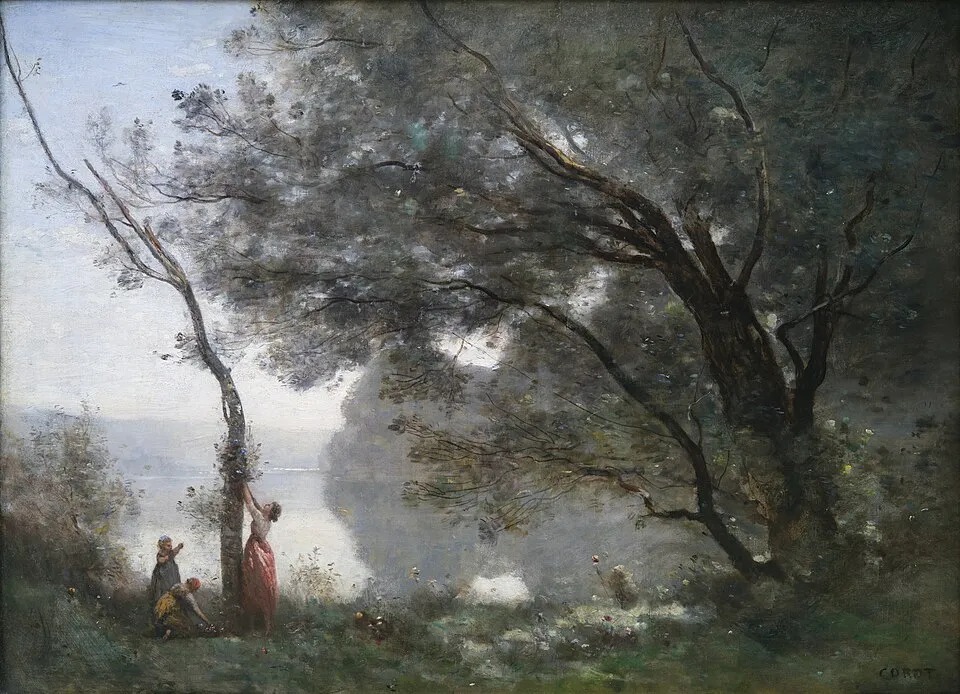
- Dimensions
- 縦 65.0 cm × 横 89.0 cm
- Medium
- 油彩、カンヴァス
- Collection
- ルーヴル美術館
19世紀フランスを代表する画家であり、バルビゾン派の中心的な存在である。
現実の風景をそのまま写し取るのではなく、長年蓄積した視覚的記憶と情緒をアトリエ内で再構成し、自らの内面にある完璧な詩的理想郷を創出すること。
✦ Highlights (technique & color)
画面全体を包み込む「銀灰色」のトーンと、輪郭をかすませるスフマート(ぼかし)技法に注目。画面左に傾く木の葉は、羽毛のようなフェザータッチで不規則に絵具を叩き重ねることで、風による微動と光の散乱が表現されている。
✦ The setting of this painting
パリの北東約40キロメートルに位置するオワーズ県の村落モルトフォンテーヌ。18世紀末に人工湖やイギリス風風景庭園が造成され、19世紀初頭には政財界や文人の社交場として繁栄した景勝地。
✦ Historical context
1860年代のフランスは第二帝政の全盛期であり、社会が急激な近代化と都市化を遂げていた。美術界ではアカデミズムの伝統的歴史画と、新しい視覚芸術との対立が激化していた時代。
A silvery-grey mist hangs over a quiet lakeside. A solitary tree leans, sweeping in a graceful arc toward the water's surface. At its base, a young girl in a pink skirt stretches upward to reach for the branches, while smaller children huddle near her feet. An air of gentle nostalgia and unearthly serenity softly envelops the entire scene.
The Landscape That Captivated an Emperor at First Sight
In the spring of 1864, the Paris Salon buzzed with an excitement far greater than usual. France was at the height of the Second Empire. Amid the bustling crowds reveling in glamorous urban life, Emperor Napoleon III visited the exhibition—and came to an abrupt halt before a single landscape painting.
By nature and position, the emperor favored grand history paintings that projected state prestige or formidable military scenes. Yet this tranquil, silvery-grey landscape instantly stole the monarch's heart. Deeply enchanted by its poetic grace and visionary elegance, Napoleon III is said to have promptly arranged to acquire the canvas directly from the artist, paying a substantial sum of 3,000 francs from his personal privy purse.
The painting was none other than the work of Jean-Baptiste-Camille Corot, then sixty-eight years old. Even an emperor standing at the pinnacle of power in a turbulent era could not resist finding an inescapable solace in this quiet waterside view.
The Masterpiece Cherished by the Artist Himself
This painting, which so captivated the emperor, held an equally special place in the heart of its creator. Though Corot had painted countless landscapes over his long career, he took extraordinary pride in the perfection achieved in this work.
It is said that Corot kept a photograph of the painting displayed reverently above the head of his bed, gazing upon it each night as he brought his day to a close.
Why did the painter hold this piece so dear, choosing to look upon it at the end of every day? Surely it was because this painting was far more than a mere record of scenery—it was the embodiment of the purest, most peaceful sanctuary within his own soul. In his twilight years, this silvery-grey landscape was likely the very haven to which his spirit longed to return.
Not a Depiction of a Real Place
The Mortefontaine of the title is an actual village northeast of Paris. Renowned for its picturesque ponds and verdant gardens, it was a familiar retreat that Corot had visited many times over the years to sketch en plein air.
Remarkably, however, this painting was not painted on site from a specific viewpoint in Mortefontaine. Corot did not simply transcribe the scene before his eyes onto the canvas.
Instead, it is an imagined landscape born of memory—a lyrical reconstruction assembled in his Paris studio from visual recollections and myriad sketches gathered over many decades. Rather than merely documenting reality, Corot allowed the landscape to mature within his mind, distilling it until all impurities vanished and only its purest essence remained. It is precisely for this reason that the work exudes an idyllic harmony and stillness that no real landscape could ever possess.
A Fusion of Four-Decade-Old Memories and Cutting-Edge Technology
The landscape Corot reconstructed in his mind also summoned memories from the distant past. According to analyses by art historians Germain Bazin and Sarah Herring, the distinctive composition—with the large trunk leaning over the water on the left—can be traced back to drawings Corot made nearly forty years earlier during his travels in Italy in 1826. The elemental forms of nature he absorbed in a foreign land in his youth were revived decades later, purified and reimagined in the visionary landscape of his old age.
Moreover, the techniques that create the painting's ethereal atmosphere were influenced by the cutting-edge technology of the time. Studies by art historians such as Aaron Scharf and Peter Galassi suggest that Corot's distinctive approach—dissolving contours and bathing the composition in a soft haze—interacted deeply with the blurring effects seen in early landscape photography, where long exposure times softened moving elements. Corot embraced the delicate blurring of wind-stirred foliage and water, translating this photographic phenomenon into his painterly language.
Youthful memories from forty years prior merged with the visual language of photography, the newest medium of his day. In the hands of the aging master within his studio, they coalesced to create a poetic landscape the likes of which had never been seen before.
About 458 more words
Read the rest of this commentary —
and step into a secret gallery
opened just for you
An "art letter" delivered to you every Saturday morning
Works, music and words chosen for your sensibility, from your artist-type result and the paintings you love
A library of masterpieces and music you can enjoy "in your own words", not just look at
A "digital art notebook" (unlimited) where your impressions build into your own taste
Unlimited likes and notes
¥980 / month¥0 today
¥980/month (tax incl.) from day 8. Cancel anytime.
Already have an account? Log in
Stories featuring this painting
Your Note
Write down what this painting made you feel in your art notebook.
Please sign up to write notes.
Sign up for freeRecommended Artworks
Sources & references
More art movements
Pre-Baroque
1 artworks
Victorian era
10 artworks
Impressionism
48 artworks
Late Pre-Raphaelite
10 artworks
Baroque
2 artworks
American Impressionism
5 artworks
Realism
4 artworks
Pre-Raphaelite
3 artworks
Barbizon School
5 artworks
Academic art
5 artworks
Luminism
3 artworks
Rococo
2 artworks
Symbolism
22 artworks
Neo-Impressionism
3 artworks
Ukiyo-e
1 artworks
Japonism
4 artworks
Edo period
1 artworks
Fauvism
1 artworks
Naturalism
9 artworks
Russian Realism
1 artworks
Post-Impressionism
13 artworks
Genre painting
9 artworks
Neoclassicism
3 artworks
ウィーン分離派
7 artworks
自然主義
1 artworks
ナショナル・ロマンティシズム
1 artworks
未来派
1 artworks
More artists
If you find an error in this content, please let us know here
This site is protected by reCAPTCHA, and the Google Privacy Policy and Terms of Service apply.