
Interior with Young Woman Seen from Behind
1904
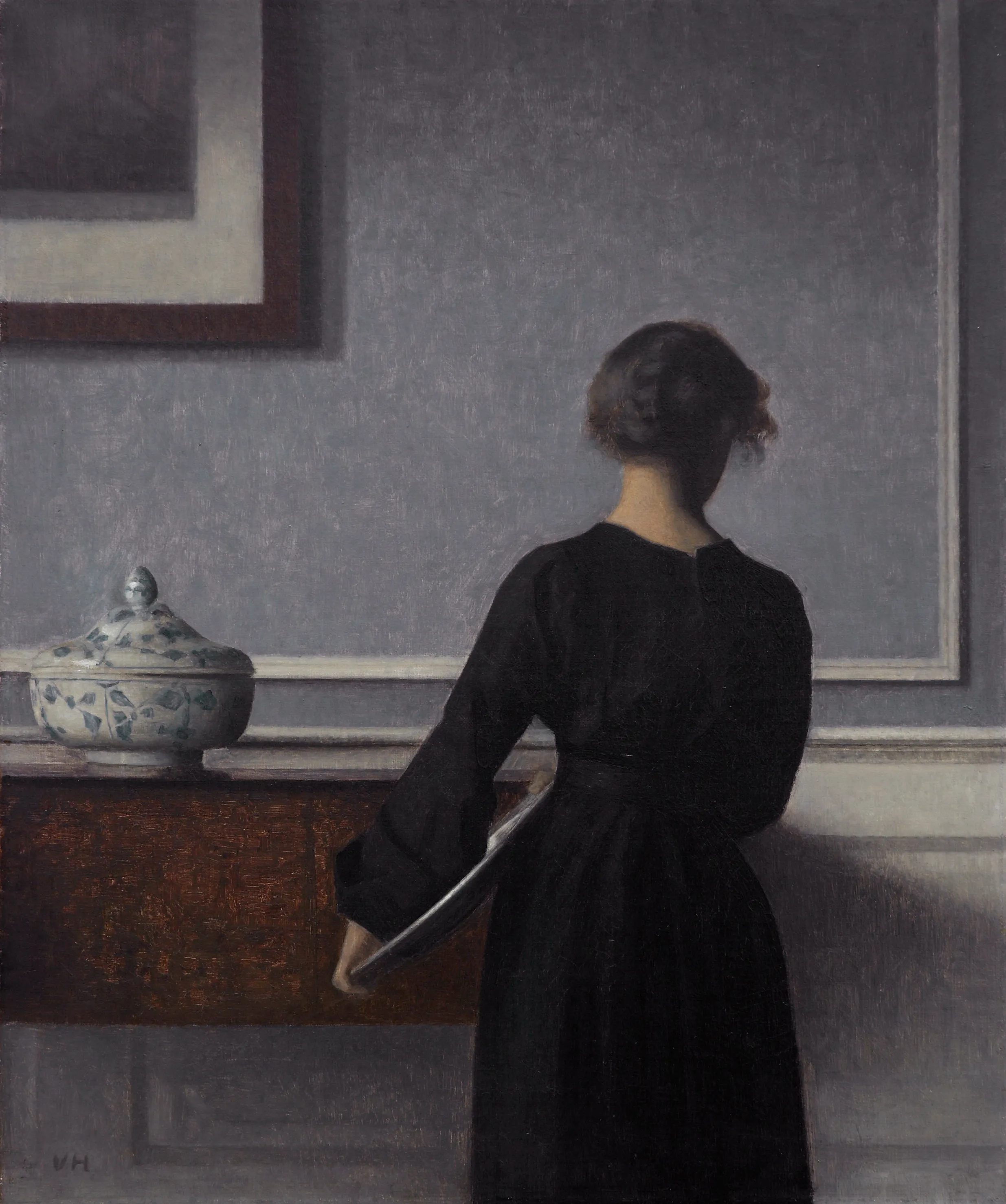
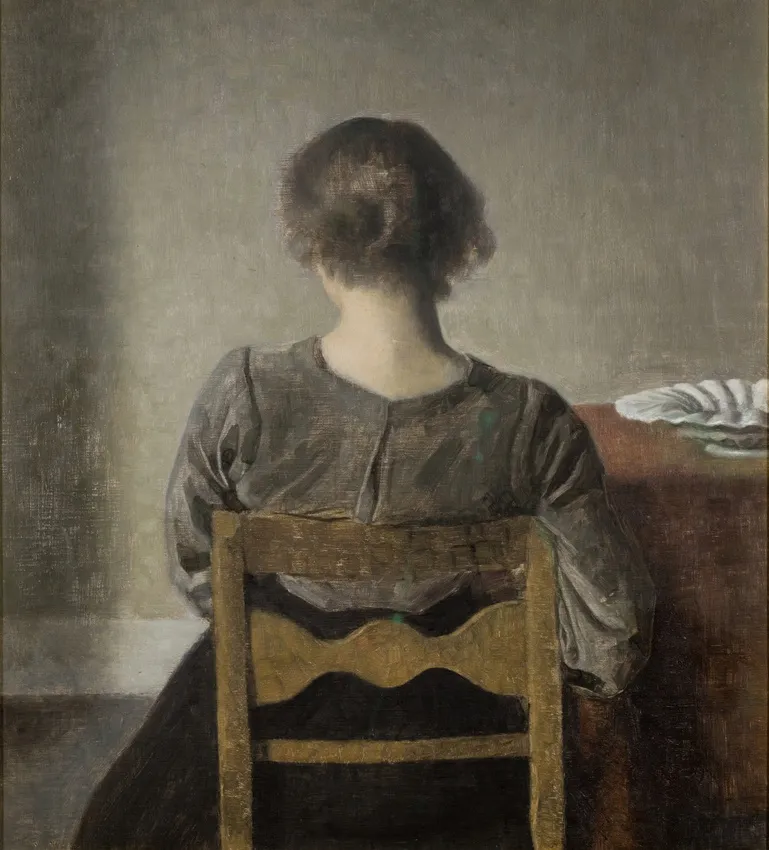
Image: Vilhelm Hammershøi, Hvile (Rest), 1905, Musée d'Orsay.
- Dimensions
- 60.5 × 50.5 cm
- Medium
- Oil on canvas
- Collection
- Randers Museum of Art (Denmark)
A quiet, resolute rebellion against a conservative art establishment and excessive colorism. Through meticulous observation directed even to the space between his wife's turned back and broken porcelain, this piece remains a soulful record of artistic experimentation, capturing the existential stillness hidden within everyday life.
✦ Highlights (technique & color)
The oil paint is applied in exceptionally thin layers, creating a distinctive texture through which the weave of the canvas remains perceptible. For the woman's skin and hair, Hammershøi blended brushstrokes wet-on-wet to render soft surfaces and subtle light reflections with smooth delicacy. He also intentionally avoided varnishing, leaving a restrained, matte finish. Another remarkable detail is the depiction of fine dust motes drifting in the gloom, illuminated by the light streaming through the window.
✦ The setting of this painting
This is the interior of an apartment at Strandgade 30, a historic building in the old quarter of Christianshavn, Copenhagen. Dating from the late 17th century, the residence was kept remarkably sparse by Hammershøi and his wife. The walls were finished in pale grays and whites, set off only by polished floorboards and a carefully curated selection of antique furniture. For the painter, this room functioned as a laboratory for experimenting with light and space.
✦ Historical context
Between 1903 and 1904, Europe was undergoing mature industrialization and rapid urbanization, bringing dramatic shifts to everyday life. In the art world, following Impressionism, groundbreaking movements such as Symbolism and Fauvism were emerging in quick succession. Yet Hammershøi resisted the allure of bold colorism, remaining steadfast in his pursuit of quiet, evocative interior scenes. Critics and scholars have frequently noted a profound resonance between his paintings and the existential philosophy of Danish thinker Søren Kierkegaard.
A young woman in a black dress stands with her back turned completely toward us. She holds a large silver platter near her right hip. On the black cabinet to her left sits a punch bowl adorned with blue and white decorations. Her face is entirely hidden from view. For this reason, it is often said that the painting reflects a wife’s domestic anxieties or inner psychological turmoil. The punch bowl on the left, too, is often described as an imaginary motif symbolizing something deeper. Often dubbed the "Vermeer of the North," the artist is frequently expected to have embedded a rich, emotional narrative within his work. In reality, however, that is not the case. This is neither an outpouring of emotion nor a realm of fictional symbolism. It is a record of rigorous, matter-of-fact observation of reality.
In 1891. Vilhelm Hammershøi, rebelling against the conservative jury of the Royal Danish Academy of Fine Arts, co-founded "The Free Exhibition" with fellow artists to establish a new venue for their work. That same year, he married Ida, the sister of painter Peter Ilsted. In a tumultuous era where vibrant new styles swept through art following Impressionism, he refused to chase excessive colorism. Instead, he devoted himself single-mindedly to quiet, near-monochromatic interior scenes.
In 1898. The couple moved into an old apartment at Strandgade 30 in Copenhagen. This apartment became his "pictorial laboratory." While typical homes of the era were filled with heavy furniture and dark wallpaper, Hammershøi kept his space sparse and simple. He repainted the walls in pale grays and whites. He placed only a carefully selected handful of antique pieces. He would shift furniture by mere millimeters. He opened and closed doors, studying how the angle of light shifted across seasons and hours of the day. And with his wife, Ida, as his model, he painted this same room over sixty times.
Around 1903 to 1904. His art was entering its maturity. With support from patrons like the dentist Alfred Bramsen, his working environment was stable. Uncommissioned by anyone, this painting was produced as a pure artistic pursuit. Contemporary critics were puzzled by his work. "Neurasthenic," some sneered. "A chilling silence," declared others. Such voices rose against canvases stripped of both color and story.
- This work is part of “6 works for you” for The Solitary Seeker → See
About 207 more words
Unlock this story's ending, and every article on MusicStory
- 42
Stories1–2 new every week
An archive of paintings paired with great music, made for a weekend night and a cup of coffee
- 319
Paintings with commentarygrowing daily
From simply looking to truly reading — the brushwork and the obsession of the masters
- 10
Music Librarygrowing daily
Know it first, and what reaches your ear changes — background music becomes art you keep for life
My Notes, unlimited
Every reading adds to a digital art notebook that is yours alone
Already have an account? Log in
Your Note
Write down what this painting made you feel in your art notebook.
Please sign up to write notes.
Sign up for freeRecommended Artworks
Sources & references
More artists
If you find an error in this content, please let us know here
This site is protected by reCAPTCHA, and the Google Privacy Policy and Terms of Service apply.