
Rest
1905
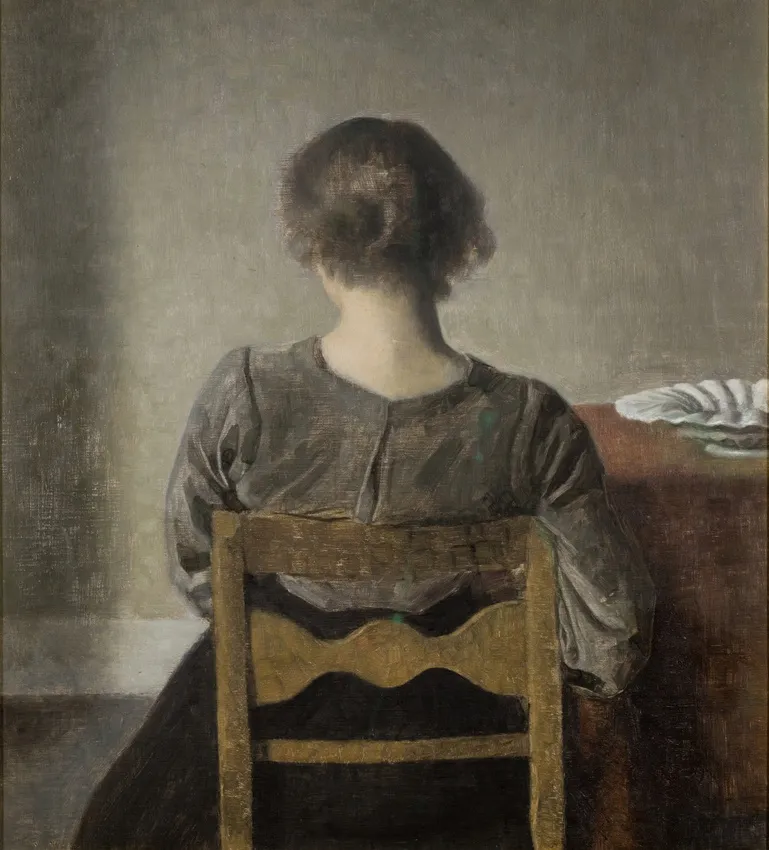
- Dimensions
- 49.5 × 46.5 cm
- Medium
- Oil on canvas
- Collection
- Musée d'Orsay, Paris
A quiet rebellion against an era enamored with excessive ornamentation and vivid color. A secret memory of quiet joy and understated sensuality, discovered within an austere home shared with his beloved wife.
✦ Highlights (technique & color)
Thinly diluted oil paint is meticulously layered in a fine mesh-like texture using small, soft-bristled brushes. By subtly revealing the underlying texture of the canvas, this technique evokes a hazy, translucent shadow and a palpable stillness, as though light were catching faint specks of airborne dust. The drastically desaturated palette produces an overwhelming sense of quietude.
✦ The setting of this painting
The setting is the apartment at Strandgade 30 in the Christianshavn district of Copenhagen. Built in the first half of the 18th century as a historic merchant's residence, the artist stripped away excessive ornamentation and repainted the walls in shades of gray and white. Filled with the low, soft sunlight characteristic of the North, the room became a space of austere serenity, suffused with tiny particles of opalescent light.
✦ Historical context
In 1905, the European art world, centered in Paris, was swept by the vivid, intense colors of Fauvism. It was also an era when advances in photography began reshaping how artists perceived space. Setting himself apart from contemporary trends, Hammershøi embraced an aesthetic of restraint by strictly limiting his palette, forging his own distinctive, modern expression of space.
In the center of an austere room, a woman sits on a chair.
Her back is turned completely toward us, her head bowed slightly.
Her expression remains entirely hidden from view.
Who is she?
Some have seen her as a weary maidservant, resting from the burdens of domestic labor.
Others have imagined a lonely wife grieving in a cold room, neglected by her husband.
The muted palette undoubtedly invites such melancholy readings.
Even in Denmark at the time, his paintings stirred bewilderment, criticized as bizarrely drained of color and unsettlingly empty.
Yet in truth, they were mistaken.
This is not a depiction of tragedy.
What is captured here is the artist's quiet happiness.
Copenhagen, Denmark, 1905.
In Christianshavn, a historic harbor quarter laced with canals,
the painter Vilhelm Hammershøi lived in an apartment.
The building stood at Strandgade 30.
He occupied the second floor of an eighteenth-century merchant's townhouse.
His model was Ida, his wife and lifelong companion,
the woman who had remained faithfully by his side ever since their marriage in 1891.
Hammershøi was forty-one years old at the time.
With the support of his patron, the dentist Alfred Bramsen,
he enjoyed financial stability and lived in peaceful contentment.
Nor was this canvas painted to fulfill a commission.
It was a singular work born purely of his own creative inquiry.
This apartment where they lived was the painter's greatest laboratory.
While busy wallpaper and ornate furnishings were in vogue across fashionable society,
he stripped them all away.
He repainted the walls in subdued tones of gray and white,
fashioning a tranquil, ascetic space furnished with only a bare minimum of old pieces.
For a decade beginning in 1898, he painted these rooms incessantly.
Roughly a third of his entire body of work consists of interiors of this apartment.
Ida, too, modeled for more than thirty of these compositions.
He never hired outside models;
he simply placed his wife within the interior as a quiet, structural element of the space.
- This work is part of “6 works for you” for The Meticulous Artisan → See
About 256 more words
Unlock this story's ending, and every article on MusicStory
- 42
Stories1–2 new every week
An archive of paintings paired with great music, made for a weekend night and a cup of coffee
- 319
Paintings with commentarygrowing daily
From simply looking to truly reading — the brushwork and the obsession of the masters
- 10
Music Librarygrowing daily
Know it first, and what reaches your ear changes — background music becomes art you keep for life
My Notes, unlimited
Every reading adds to a digital art notebook that is yours alone
Already have an account? Log in
Your Note
Write down what this painting made you feel in your art notebook.
Please sign up to write notes.
Sign up for freeRecommended Artworks
Sources & references
More artists






If you find an error in this content, please let us know here
This site is protected by reCAPTCHA, and the Google Privacy Policy and Terms of Service apply.