
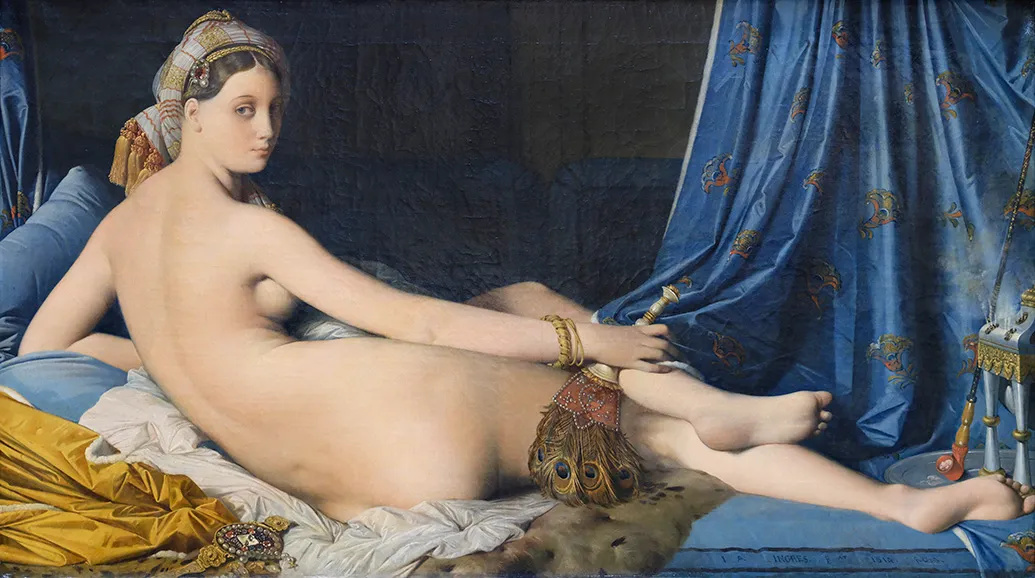
Grande Odalisque
1814
- Dimensions
- 91.0 × 162.0 cm
- Medium
- Oil on canvas
- Collection
- Musée du Louvre, Paris, France
A quiet rebellion against a realism tethered to anatomical truth. Regardless of the harsh criticism it drew, this work embodies a solitary aesthetic—one that inscribed onto the canvas an unwavering devotion to the ultimate beauty of line and form.
✦ Highlights (technique & color)
The artist prepared the canvas with a remarkably smooth ground, applying thin glazes to erase almost any trace of brushwork. The odalisque’s skin appears porcelain-smooth, softly diffusing the light. A vivid color contrast unfolds between the cool blue drapery of the divan, her warm, pearlescent flesh, and the delicate gold-thread embroidery.
✦ The setting of this painting
This imaginary setting envisions the chamber of an odalisque serving the sultan in an Ottoman imperial harem. Props such as a turban, a hookah, and an incense burner evoke an exotic ambiance, yet the painter himself never traveled to the Middle East. It is an intimate scene conjured entirely within his studio, pieced together from travelogue illustrations and decorative objects available in the West.
✦ Historical context
Painted between 1814 and 1815, this work emerged during a turbulent chapter in modern European history marked by Napoleon's downfall and the collapse of the First French Empire. Although Neoclassicism was at its height in the French art world, the seeds of Romanticism—seeking exoticism and an introspective sensuality—were already sprouting, alongside a burgeoning fascination with Orientalism in literature.
A luxurious couch draped in rich blue fabric and delicate embroidery.
A reclining nude, her back turned to us, casts a cool, detached gaze in our direction.
In her hand rests a fan fashioned from peacock feathers.
At her feet sit a hookah and an incense burner.
The Paris Salon of 1819.
When this painting was unveiled for the first time, it was met with fierce condemnation.
"She has three vertebrae too many."
"No bone, no muscle, no blood, no life."
Critics mocked Ingres mercilessly, claiming he had committed an amateurish blunder born of a failure to understand human anatomy.
Yet in recent years, modern medical investigations have brought an astonishing truth to light.
A scientific analysis conducted in 2004.
According to its findings, it was far more than a matter of three vertebrae.
Her entire back and pelvis had been elongated by the equivalent of roughly five vertebrae.
Furthermore, her left arm is markedly shorter than her right, resulting in a posture physically impossible for a living human.
And this was by no means an error in draftsmanship.
Ingres was a painter of supreme technical mastery.
He had deliberately distorted the human form.
Rome, 1814.
Ingres received the commission for this painting from Caroline Murat, Queen of Naples.
The queen's husband had previously purchased Ingres's "The Sleeper of Naples."
It was a painting of a nude woman sleeping on her back.
The queen wished for a companion piece to pair with it.
Ingres prepared a canvas of the exact same dimensions.
To contrast with the supine figure, he chose a pose with her back turned, looking over her shoulder.
Yet the following year, in 1815.
With the collapse of the Napoleonic Empire, the Murat regime fell.
The queen's husband was executed.
Having lost his patron, the artist was left unpaid.
Aided by his friend, the painter Dupré, Ingres had to personally retrieve the painting that was originally bound for Naples.
- This work is part of “6 works for you” for The Graceful Harmonist → See
About 161 more words
Unlock this story's ending, and every article on MusicStory
- 42
Stories1–2 new every week
An archive of paintings paired with great music, made for a weekend night and a cup of coffee
- 319
Paintings with commentarygrowing daily
From simply looking to truly reading — the brushwork and the obsession of the masters
- 10
Music Librarygrowing daily
Know it first, and what reaches your ear changes — background music becomes art you keep for life
My Notes, unlimited
Every reading adds to a digital art notebook that is yours alone
Already have an account? Log in
Your Note
Write down what this painting made you feel in your art notebook.
Please sign up to write notes.
Sign up for freeRecommended Artworks
Sources & references
More artists




If you find an error in this content, please let us know here
This site is protected by reCAPTCHA, and the Google Privacy Policy and Terms of Service apply.