
 日本語 (JA)
 English (EN)
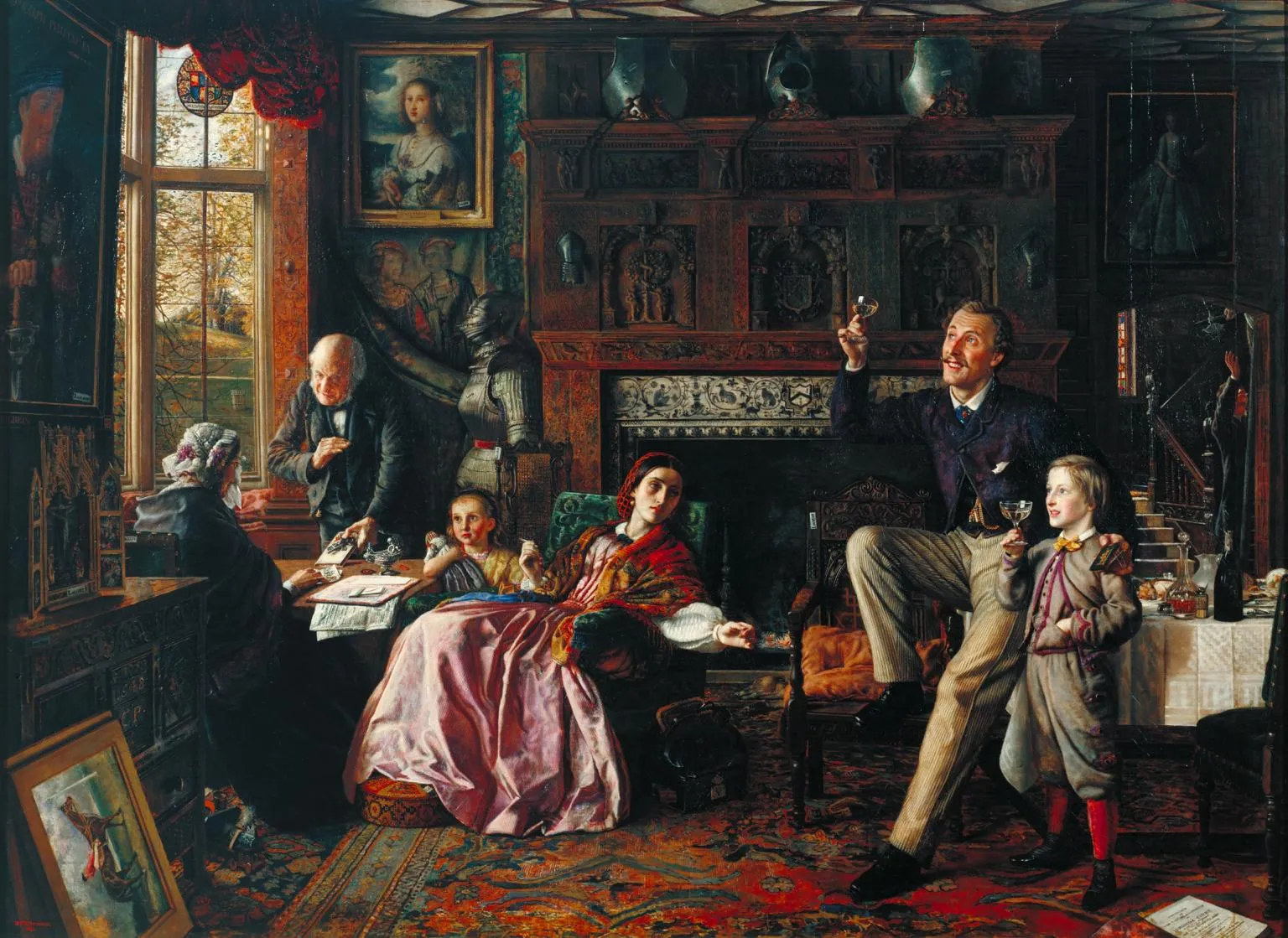
- Dimensions
- 107.3 cm × 144.8 cm
- Medium
- 油彩・カンヴァス
- Collection
- テート・ブリテン
社会の暗部や人間の愚かさから目を逸らさず、没落していく旧家の悲劇を極限の細密描写で描き出すことで、同時代の人々に強烈な道徳的教訓を突きつけたかった。
✦ Highlights (technique & color)
画面手前の床に散らばる競馬の版画や競売カタログが観客側に突き出るように描かれ、中景の家族のドラマ、奥の部屋の競売業者の作業風景へと続く、立体写真(ステレオスコープ)のような奥行きのある空間構成が見どころです。また、乾杯する父子の上昇する視線と、絶望する家族の下向きの視線が交差する対比にも注目してください。
✦ The setting of this painting
ケント州アシュフォードに実在するチューダー・ジャコビアン様式の邸宅「ゴディントン・ハウス」の大広間。1440年から約450年間にわたりトーク家が所有していた歴史的空間が舞台となっている。
✦ Historical context
1860年代のイギリス。産業革命による新興階級の台頭の一方で、競馬などのギャンブルや過剰消費により、伝統的な地主階級が破産し歴史的邸宅を手放すことが大きな社会問題となっていた。
In a somber, cavernous hall surrounded by heavy oak furnishings, a family's long and storied history is drawing to an agonizing close. On the right, despite the impending loss of the ancestral estate handed down through generations, the father displays no remorse, raising a glass of champagne in a buoyant toast. Cradled in his arm, his young son mimics his father by lifting his own small glass with an innocent smile. In stark contrast to their reckless, hedonistic indulgence, the wife and daughter on the left clasp hands, their faces veiled in dread and despair. The elderly grandmother, dressed in solemn mourning clothes, dabs at her tears as she hands a parting payment to the aged butler who has faithfully served the household for decades. Clasping the bundle of estate keys tightly in both hands, the butler appears heartbroken to his very core over the ruin of the lineage. Through the open door in the background, auctioneers methodically attach numbered tags to the furniture, quietly preparing to haul everything away.
A Family Facing Their Final Day
This painting portrays an aristocratic family who has squandered generations of wealth, captured moments before they are forced to abandon their home to the auction block. A noble residence nurtured and preserved across centuries is about to be lost forever to the irresponsible dissipation of a single generation. Yet on the face of the father, the very architect of their ruin, there is not the slightest hint of gravity or regret. In his hand he holds a miniature portrait symbolizing their past glory, clinging to a hollow optimism as if turning a blind eye to reality. With his arm around his young son, who innocently raises his glass, the scene tragically hints that the father's moral decay and pursuit of pleasure will be passed directly on to the next generation. Through this unsparing contrast, the painter Robert Braithwaite Martineau laid bare the profound themes of human folly and familial collapse upon his canvas.
The Hidden Emblems of Ruin
Rather than merely rendering expressions and poses, Martineau meticulously filled every corner of the composition with symbolic details that speak volumes about the narrative. As art historians such as Frances Fowle and Edward Tyas Cook have observed, the print of a racehorse discarded on the floor reveals that the squire lost his family fortune betting on thoroughbreds. Horses, once the proud pastime of the gentry, had been reduced to instruments of gambling that drove the family to the brink of catastrophe. Furthermore, a newspaper peeking out from beneath a desk blotter near the grieving grandmother clearly bears the words "Apartments to Let." This quietly signals the cramped rented lodgings to which the family must retreat after being expelled from their sprawling estate. Alongside the auction lot labels plastered throughout the room and the Christie's sale catalog abandoned on the floor, these artifacts present an unvarnished confrontation with the family's inescapable downfall.
A Wealthy Painter's Devotion to Detail
To bring such an intricately detailed and didactic painting to fruition, Martineau devoted an immense amount of time and labor. Born into London's affluent upper-middle class, he possessed a comfortable private income and felt no financial urgency to rush his works to market. While many contemporary painters were compelled to produce vast quantities of work merely to earn a living, Martineau enjoyed the financial independence to pursue his artistic vision without compromise. He began preparing this work around 1858 and spent some three to four years perfecting it until its completion in 1862. Employing the rigorous observation of nature and meticulous technique he had absorbed from his mentor, William Holman Hunt, Martineau rendered everything—from the intricate grain of the woodwork to the rich texture of the velvet garments, down to the intricate web of conflicting emotions among the figures—with unrelenting precision. This near-obsessive commitment to his art imparts an overwhelming sense of reality and emotional tension to the canvas.
About 584 more words
Read the rest of this commentary —
and step into a secret gallery
opened just for you
An "art letter" delivered to you every Saturday morning
Works, music and words chosen for your sensibility, from your artist-type result and the paintings you love
A library of masterpieces and music you can enjoy "in your own words", not just look at
A "digital art notebook" (unlimited) where your impressions build into your own taste
Unlimited likes and notes
¥980 / month¥0 today
¥980/month (tax incl.) from day 8. Cancel anytime.
Already have an account? Log in
Your Note
Write down what this painting made you feel in your art notebook.
Please sign up to write notes.
Sign up for freeRecommended Artworks
Sources & references
More art movements
Pre-Baroque
1 artworks
Victorian era
10 artworks
Impressionism
48 artworks
Late Pre-Raphaelite
10 artworks
Baroque
2 artworks
American Impressionism
5 artworks
Realism
4 artworks
Pre-Raphaelite
3 artworks
Barbizon School
5 artworks
Academic art
5 artworks
Luminism
3 artworks
Rococo
2 artworks
Symbolism
22 artworks
Neo-Impressionism
3 artworks
Ukiyo-e
1 artworks
Japonism
4 artworks
Edo period
1 artworks
Fauvism
1 artworks
Naturalism
9 artworks
Russian Realism
1 artworks
Post-Impressionism
13 artworks
Genre painting
9 artworks
Neoclassicism
3 artworks
ウィーン分離派
7 artworks
自然主義
1 artworks
ナショナル・ロマンティシズム
1 artworks
未来派
1 artworks
More artists
If you find an error in this content, please let us know here
This site is protected by reCAPTCHA, and the Google Privacy Policy and Terms of Service apply.