
 日本語 (JA)
 English (EN)
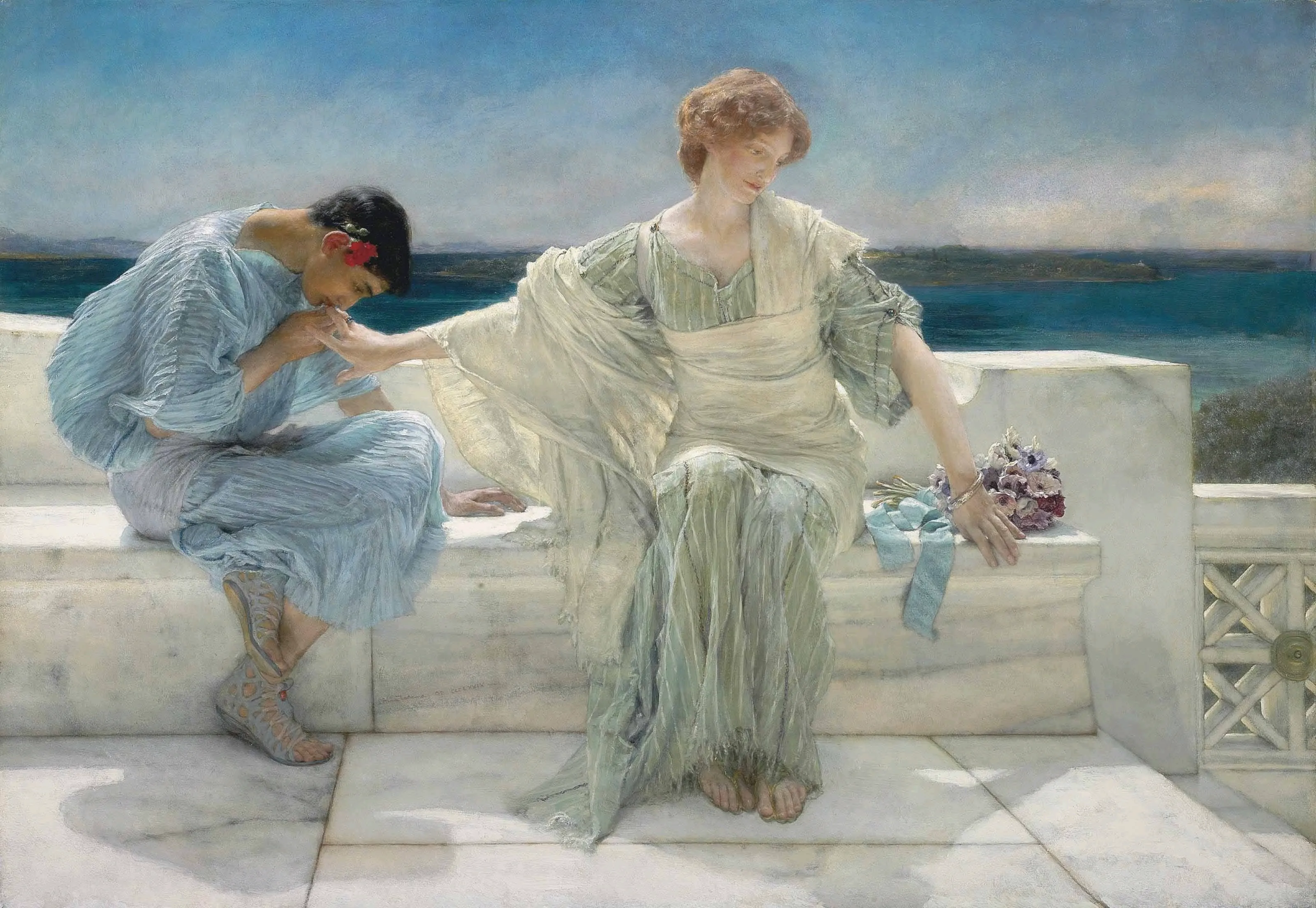
- Dimensions
- 78.8 × 113.6 cm
- Medium
- 油彩・カンヴァス
- Collection
- 個人蔵
ヴィクトリア朝のイギリスを代表する画家であり、王立芸術院(ロイヤル・アカデミー)会員。オランダで生まれ、後にイギリスへ移住して同国に帰化した。
絵画を音楽と同等の「厳密に構成された芸術的自律物」と捉え、テニスンの詩が持つ普遍的な愛の抒情性を、理想化された古代空間の中で視覚化すること。
✦ Highlights (technique & color)
画面左下から右中央へと伸びる白大理石の手摺の対角線と、背景の地中海の水平線がもたらす強固な視覚的安定感。大理石の白や海と空の青といった冷色調の中で、女性の栗色の髪やアネモネの花束の暖色が鮮やかに際立っている。
✦ The setting of this painting
イタリアのポンペイやナポリ湾沿岸の古代遺構に着想を得て、画家のスタジオで構築された想像上の情景。地中海を一望する大理石のテラス。
✦ Historical context
ヴィクトリア朝からエドワーディアン期へと移り変わる英国社会。古典主義風俗画が愛好され、文学や音楽と美術が深く交差していた時代。
Under the early-to-midsummer afternoon sunlight of the Mediterranean coast, a cloudless, clear blue sky stretches out above calm waters. On a sun-drenched marble terrace by the sea, a young couple quietly leans toward one another in tender communion.
On the right side of the canvas, a young woman clad in ancient-style white drapery sits on a semicircular marble bench. She leans back slightly with an air of hesitant, yielding surrender; in her hands rests a bouquet of anemones in shades of purple and soft pastel. From the left, a young man in a blue-grey tunic sits on the bench, leaning forward toward her with earnest devotion.Tilting his head, he tenderly raises her left hand toward his lips with desperate passion.
The contrast between the cool texture of the white marble and the warmth of human flesh and soft drapery accentuates the subtle emotional tremors within the figures.
Sir Lawrence Alma-Tadema masterfully harmonized this tranquil natural landscape with the quiet psychological drama unfolding between the pair. The pictorial techniques he honed over half a century, combined with a meticulously calculated visual structure, are distilled onto this single canvas.
The Question Entrusted to Touching Fingertips
Vern G. Swanson, the foremost authority on Alma-Tadema, explains that the suspenseful question of this painting—"Will she accept his suit, or will she reject it?"—is concentrated entirely upon their sole point of contact: their clasped hands.
Rather than portraying love fulfilled at its climax, the artist chose to depict a transitional threshold where emotional tension builds.The strong diagonal line of the white marble bench, sweeping from the lower left to the center right, smoothly guides the viewer's eye into the depth of the composition. In contrast to the young man's forward-leaning posture and the dynamic folds of his garment, the woman maintains a near-vertical bearing; their gazes and emotions converge upon the singular point where their fingertips meet.
During the creative process, the artist produced meticulous preparatory pencil drawings studying the intertwined hands of the lovers. It is easy to imagine how deeply he contemplated the emotional nuance to be invested in this small point of connection. The bouquet of anemones the woman holds carried connotations of "anticipation," "fleeting love," and "surrendering to love" within classical floriography and Victorian symbolism. The blue ribbon binding the flowers echoes the color of the young man's attire, serving as a visual bridge uniting their bond and reciprocal feelings. The mute dialogue of flowers and harmonious hues speaks volumes of the unspoken exchange passing between them.
The Heart of the Woman Revealed in Poetic Verse
The title of the work is drawn directly from "Ask me no more," an interpolated song from the narrative poem The Princess by Victorian Poet Laureate Alfred, Lord Tennyson.
"Ask me no more: thy fate and mine are seal'd: I strove against the stream and all in vain: Let the great river take me to the main: No more, dear love, for at a touch I yield."
Rather than literally illustrating the narrative of the poem, the painter resonated with its emotional essence: the initial resistance that gives way to surrender at the mere touch of a hand. Instead of faithfully recreating a specific narrative scene from Tennyson's verse, he abstracted the poem's universal lyricism of love. Cool tones—the gleaming white of the marble, the blue of the clear sky and tranquil sea, and the blue-grey tunic—dominate the canvas, vividly setting off the warm accents of the woman's rich auburn hair and the anemone bouquet. Against the cooler palette, these glowing, warm touches seem to hint at the awakening of a secret passion within her heart.
The Misconception of the Tragic Lovers
On certain stock image platforms and commentary websites, this painting has been mistakenly described as depicting the tragic Babylonian lovers Pyramus and Thisbe.
However, there is no mention whatsoever of Pyramus and Thisbe in the artist's own correspondence, Vern G. Swanson's 1990 catalogue raisonné, or Christie's official auction essays; it is an undeniable error that proliferated online. It can be concluded that a mislabeled caption on stock photo websites and similar repositories later spread across the internet.
Alma-Tadema did not paint lovers destined for a tragic fate, but rather a Roman-inspired genre scene of courtship inspired by Tennyson's poetry. As the contemporary art critic Rudolf Dircks noted, observing "the delicate emotional tension between the two," this quiet communion of souls is the very essence of the work. Forcing a false narrative framework upon it risks blinding us to the delicate psychological nuances the artist so painstakingly rendered.
An Idealized World Painted by a Master at Seventy
In 1906, at the age of seventy, the artist painted this work on commission from the prominent London art dealers Arthur Tooth & Sons.
The architectural setting in the background is not a direct sketch of an existing ruin, but an "idealized classical realm" reconstructed from the vast archaeological knowledge and photographs he amassed on site. After first visiting Pompeii, Herculaneum, and Rome during his honeymoon in 1863, he returned to Italy repeatedly throughout his life. His observational records of semicircular exedrae, marble balustrades, and relief carvings seen in various Roman villas—including Pompeii's House of the Tragic Poet—formed the foundation for this spatial composition.
The meticulous techniques of rendering textures that he mastered in his youth at the Royal Academy of Fine Arts in Antwerp, rooted in seventeenth-century Dutch still-life painting, were applied here to classical architecture. The sheen of the marble surface, its subtle translucence, and even the fine fissures in the stone are recreated with absolute precision.
Tooth & Sons purchased the original canvas while simultaneously acquiring the rights to reproduce and sell it as high-quality photogravures, launching a worldwide commercial success. Following the triumph of this work, the artist created a watercolor version based on the same subject and composition, titled Youth, in 1908. Even in his ripe maturity at seventy, his creative vitality and artistic inquiry remained undiminished.
About 455 more words
Read the rest of this commentary —
and step into a secret gallery
opened just for you
An "art letter" delivered to you every Saturday morning
Works, music and words chosen for your sensibility, from your artist-type result and the paintings you love
A library of masterpieces and music you can enjoy "in your own words", not just look at
A "digital art notebook" (unlimited) where your impressions build into your own taste
Unlimited likes and notes
¥980 / month¥0 today
¥980/month (tax incl.) from day 8. Cancel anytime.
Already have an account? Log in
Your Note
Write down what this painting made you feel in your art notebook.
Please sign up to write notes.
Sign up for freeRecommended Artworks
Sources & references
More art movements
Pre-Baroque
1 artworks
Victorian era
10 artworks
Impressionism
48 artworks
Late Pre-Raphaelite
10 artworks
Baroque
2 artworks
American Impressionism
5 artworks
Realism
4 artworks
Pre-Raphaelite
3 artworks
Barbizon School
5 artworks
Academic art
5 artworks
Luminism
3 artworks
Rococo
2 artworks
Symbolism
22 artworks
Neo-Impressionism
3 artworks
Ukiyo-e
1 artworks
Japonism
4 artworks
Edo period
1 artworks
Fauvism
1 artworks
Naturalism
9 artworks
Russian Realism
1 artworks
Post-Impressionism
13 artworks
Genre painting
9 artworks
Neoclassicism
3 artworks
ウィーン分離派
7 artworks
自然主義
1 artworks
ナショナル・ロマンティシズム
1 artworks
未来派
1 artworks
More artists
If you find an error in this content, please let us know here
This site is protected by reCAPTCHA, and the Google Privacy Policy and Terms of Service apply.