
Snow at Louveciennes
1872
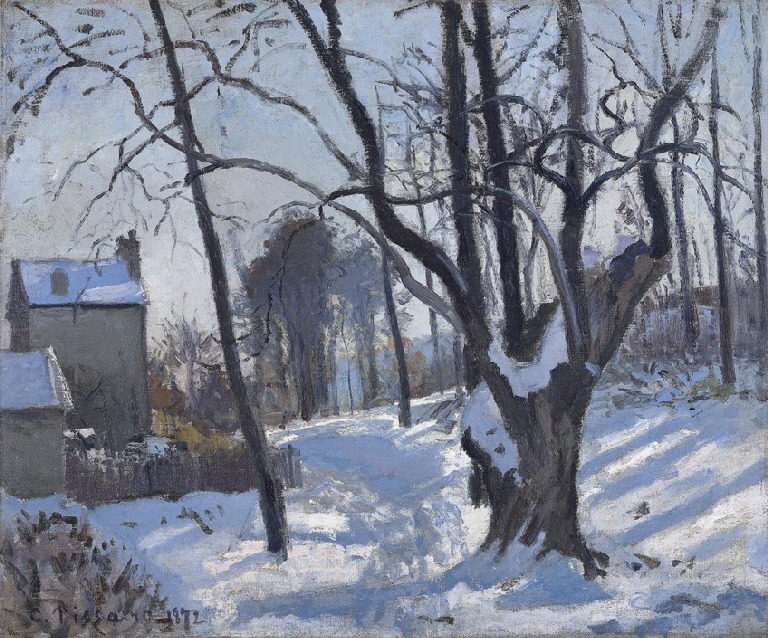
Image: Wikimedia Commons / Public Domain
- Dimensions
- 縦 46 cm × 横 55 cm
- Medium
- Oil on canvas
- Collection
- Museum Folkwang
フランス印象派を代表する画家。 仲間内で最年長であり、その面倒見の良さから「印象派の父」として多くの画家に慕われた。
To establish a new visual language and rebirth as a painter by re-examining serene everyday landscapes and the beauty of light, despite the despair of losing more than 1,500 early works in the Franco-Prussian War.
✦ Highlights (technique & color)
Rather than rendering the snow in plain white, the artist mixed cobalt blue and violet into the shadows and ochre into the sunlit areas, capturing the diffused reflection of light and the gentle winter sun. In addition, the path stretching diagonally from the lower left to the center background creates a composition that naturally guides the viewer's gaze into the distance.
✦ The setting of this painting
The Chemin des Creux, a real-life country lane in Louveciennes, in the French department of Yvelines. Situated within walking distance of Pissarro's home, this everyday setting captures a scene after snowfall in the winter of 1871–1872.
✦ Historical context
A period when French society was moving toward recovery after the turmoil of the Franco-Prussian War and the Paris Commune. Rather than focusing on turbulent political events, the Impressionists captured a sense of serenity on canvas by depicting everyday life in the rural suburbs.
A soft winter light gently envelops a gentle, snow-covered slope. A light dusting of snow clings to the bare branches of the trees, while the roofs of farmhouses can be glimpsed in the distance. Bundled in warm clothing, a villager walks alone down the quiet path. It is a tranquil, everyday winter scene, filled with stillness, the kind one might find anywhere. Yet in the heart of the artist who painted it, Camille Pissarro, a storm of unimaginable despair had been raging only months before.
Fifteen Hundred Lost Souls
In mid-1871, Pissarro returned with his family to the village of Louveciennes from London, where they had sought refuge. Located about twenty kilometers west of Paris, this quiet village was the cherished backdrop of daily life with his beloved family. Yet the moment he unlocked his front door after his long absence, he was met with a scene of devastation that left him utterly speechless.
During the chaos of the Franco-Prussian War, his house had been requisitioned by Prussian troops and savagely ransacked, used as a slaughterhouse and a barracks. But what cut Pissarro to the quick was not the loss of his household goods. More than fifteen hundred oil paintings and sketches—the accumulated output of his entire artistic life to date—had been used as doormats to wipe muddy boots or burned as kindling in the fireplace. Almost all of them had been destroyed.
For an artist, works created by one's own hand are the very soul, the proof of a life lived. In a single instant, they had been reduced to ashes and trampled in the mud. To suffer such a loss past the age of forty was unimaginably cruel. Plunged into financial ruin and near despair, barely able to find hope for tomorrow, Pissarro had every reason to abandon his craft. Instead, he looked up at the cold winter sky over Louveciennes.
About 615 more words
- ・Pissarro's path to renewal after losing everything
- ・Beyond mere white: The secret of richly colored snowscapes
- ・A painter's hope for renewal, entrusted to ordinary everyday life
Read the rest of this commentary —
and step into a secret gallery
opened just for you
An "art letter" delivered to you every Saturday morning
Works, music and words chosen for your sensibility, from your artist-type result and the paintings you love
A library of masterpieces and music you can enjoy "in your own words", not just look at
A "digital art notebook" (unlimited) where your impressions build into your own taste
Unlimited likes and notes
¥980 / month¥0 today
¥980/month (tax incl.) from day 8. Cancel anytime.
Already have an account? Log in
Your Note
Write down what this painting made you feel in your art notebook.
Please sign up to write notes.
Sign up for freeRecommended Artworks
Sources & references
More artists
If you find an error in this content, please let us know here
This site is protected by reCAPTCHA, and the Google Privacy Policy and Terms of Service apply.