
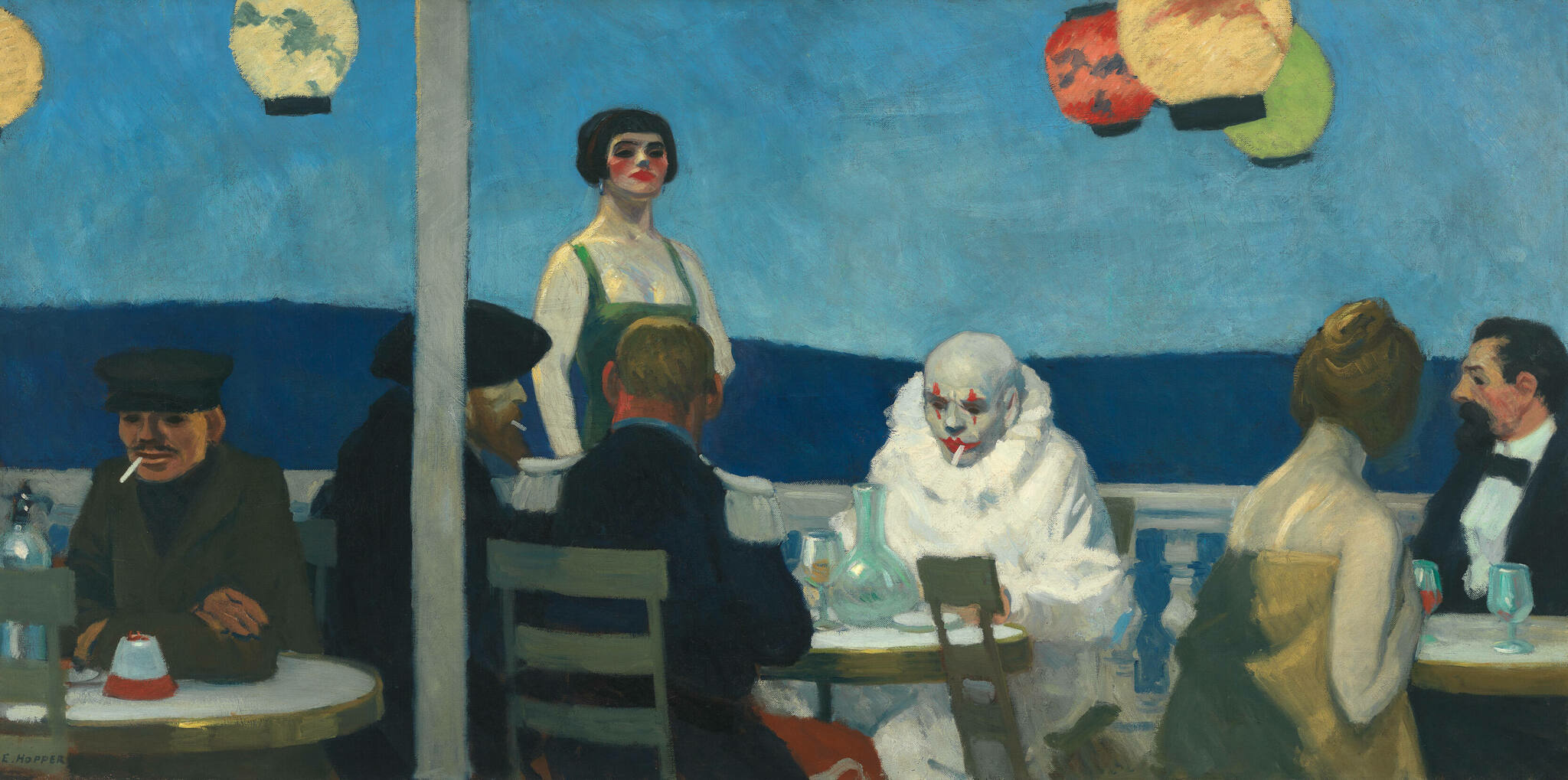
Blue Evening
1914
- Dimensions
- 91.8 × 182.7 cm
- Medium
- 油彩、カンヴァス
- Collection
- ホイットニー美術館
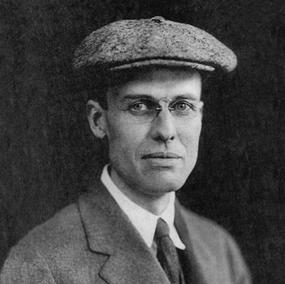
A defining figurative painter of twentieth-century American art, he captured urb…
商業イラストレーターとしての鬱屈した現状を打破し、マティスやピカソらヨーロッパの前衛に対抗して自らの芸術的野心を示す。
✦ Highlights (technique & color)
横幅が縦の約2倍というパノラマ的な水平比率。上部の黄色のランタンとテントの傾斜線が視線を横方向の人物群へ誘導します。背景の青、ピエロの白、娼婦の赤というフランス国旗を思わせる強い原色対比や、パレットナイフによる厚塗りが見どころです。
✦ The setting of this painting
フランス・パリの黄昏時におけるカフェの屋外テラス。実在の店舗ではなく、ホッパーがパリ滞在中に収集した観察スケッチや記憶を統合してニューヨークで再構成した「合成の都市空間」。
✦ Historical context
1914年、第一次世界大戦が勃発した年。当時のアメリカ美術界では反ヨーロッパ・ナショナリズムの風潮が高まり、自国のリアリズムが求められていた。
A café terrace at dusk. Under the sheltering awning, as yellow lanterns begin to glow, the quiet presence of a blue evening steals in. An ambiguous hour unfolds, transitioning from the daily toil to the secretive pleasures of the night. In his New York studio, a young Edward Hopper was conjuring memories of his past sojourns in Paris onto canvas. What he sought to portray, however, was far more than a mere foreign landscape.
It was the inescapable loneliness of humanity, lurking beneath the glamorous bustle of the city. Within Hopper's own heart as he held the brush, a profound isolation unshared by anyone and an aimless passion swirled together. Quietly sealed within this single painting are the immense ambitions of a young artist and the cruel fate that awaited him.
Sharing the Same Space, Yet No One Meets Another's Gaze
Seven figures are depicted on the café terrace at twilight, yet not a single gaze or conversation is exchanged among them, expressing a thorough psychological isolation. On the far left of the canvas sits a working-class man wearing a cap and dangling a cigarette from his lips. At the adjacent table looms a pimp with a menacing, unsettling expression. In the center, a white-faced pierrot is lost in contemplation, while behind him stands a prostitute dressed in a low-cut gown with heavily rouged lips. Shifting the gaze further right, an officer in uniform sits alongside a bohemian artist, and at the far right table, a bourgeois couple in evening attire sits motionless before their wine glasses.
On the canvas, disparate social classes—a worker, a pimp, a pierrot, a prostitute, a soldier, a bohemian, and the bourgeoisie—are depicted coexisting within a single café space. People who in reality would never cross paths are compressed into a wide, panoramic composition. While Hopper placed them in close physical proximity, he intentionally eliminated any intersection of gazes. Each remains enclosed within their own world, seemingly oblivious to the presence of those beside them. This theatrical tension and psychological fracture created a "synthetic urban space," in which the figures Hopper observed on the streets of Paris were reconstructed through the lens of his own inner psyche. The realization that everyone is overwhelmingly alone, despite sharing the same space, pierces the viewer's heart.
Who Is the White-Faced Pierrot?
At the center of this strange ensemble, standing out with singular presence, is a pierrot clad in traditional pure white costume. With a cigarette between his lips, he sits expressionless, staring into the void. His pale figure, floating free from the surrounding hues, exudes a deep sorrow and resignation. Art historian Gail Levin has proposed that this heartbroken pierrot in the center is a "spiritual self-portrait" of the artist himself, Edward Hopper.
At the time, Hopper earned his living as a commercial illustrator, work he despised from the bottom of his heart, leaving him plagued by despondency and a sense of powerlessness. While he yearned to be recognized as a painter in the world of fine art, his reality was spent churning out unwanted illustrations day after day. In late nineteenth-century modern European art, the pierrot symbolized the "social outcast" and the "misunderstood artist." Hopper may have seen his own wretched plight reflected in this clown, who concealed his true face beneath flamboyant attire and wept in secret. The despair of having no one see who he truly was is etched into this white-painted face. The pierrot's silence was nothing less than the artist's own wordless cry.
Refusing to Be Outdone by Picasso and Matisse
This painting was not a commission, but an entirely self-directed endeavor to assert Hopper’s artistic ambitions against the monumental canvases of Matisse, Picasso, and other figures at the forefront of the Parisian avant-garde. At thirty-two, Hopper was driven by a keen impatience to break free from the humiliating routine of an illustrator and make his mark upon the art world as a true artist. He sought to prove his prowess by creating a grand work that could stand shoulder to shoulder with the European masters.
He prepared what was then his largest canvas to date—measuring roughly 1.8 meters across—and threw himself into this major undertaking. In his studio on 14th Street in New York, he synthesized motifs and memories from his time in Paris, pouring every ounce of his technique into the work. Using a palette knife with heavy impasto, he imparted a tactile quality to the surface, experimenting with bold, primary contrasts—the blue of twilight, the pierrot's pure white, and the scarlet rouge of the prostitute—evoking the French tricolor. It was a tribute to the French Symbolism he had absorbed in his youth, and a soul-baring challenge to put his artistic ambition before the world. Everything in his life was riding on this monumental canvas.
About 562 more words
Read the rest of this commentary —
and step into a secret gallery
opened just for you
An "art letter" delivered to you every Saturday morning
Works, music and words chosen for your sensibility, from your artist-type result and the paintings you love
A library of masterpieces and music you can enjoy "in your own words", not just look at
A "digital art notebook" (unlimited) where your impressions build into your own taste
Unlimited likes and notes
¥980 / month¥0 today
¥980/month (tax incl.) from day 8. Cancel anytime.
Already have an account? Log in
Your Note
Write down what this painting made you feel in your art notebook.
Please sign up to write notes.
Sign up for freeRecommended Artworks
Sources & references
More artists
If you find an error in this content, please let us know here
This site is protected by reCAPTCHA, and the Google Privacy Policy and Terms of Service apply.