
- Dimensions
- 113.0 × 92.7 cm
- Medium
- 油彩、カンヴァス
- Collection
- ワシントン・ナショナル・ギャラリー
✦ Highlights (technique & color)
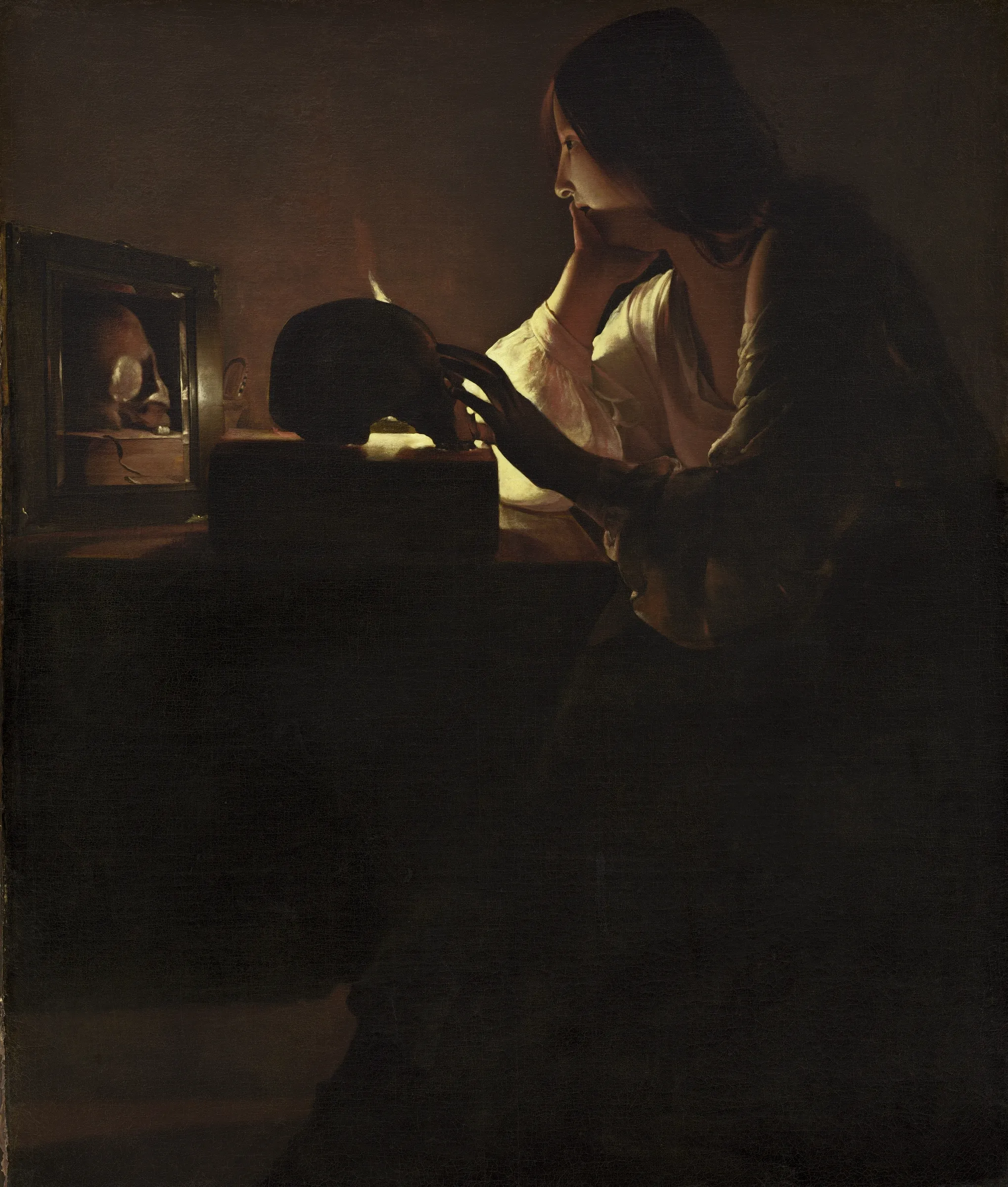
画面の中で最も明るい純白の袖から、左手と髑髏、そして鏡に映る反射像を経て、マリアの静かな横顔へと視線が誘導されるように計算されています。また、ろうそくの炎の核そのものを手前の髑髏で隠すことで、光によって照らし出された物体の質感に集中させる工夫が施されています。
✦ The setting of this painting
実在の特定の部屋を写生したものではなく、画家が観念的に構成した「内省のための私室(黙想の空間)」。極限の「夜」の静寂が支配しています。
✦ Historical context
17世紀前半、三十年戦争の戦火やペストの猛威により死の恐怖が隣り合わせにあった時代。カトリックの対抗宗教改革において、罪の告解と謝罪を伴う「悔悛」が強く求められていました。
Enveloped in deep darkness, I quietly hold my breath. Across my canvas, an endless night continues to unfold. In a dim room, a young woman sits gazing at a skull reflected in a mirror. Beside her lies a discarded pearl necklace, cast aside without care—a sign that she has forsaken the life of luxury she once led. I am a painting imbued with this serene moment of prayer.
A Quiet Hour of Prayer Rising from the Dark
Across my surface extends a world stripped down to absolute stillness. In a dim room, a young woman sits gazing at a skull reflected in a mirror. Her spine is held straight, her profile immersed in profound contemplation. Her left hand gently rests upon a thick book on the table, touching the skull placed atop it. Through the cold touch of bone, she confronts the transience of her own mortal flesh.
Upon the table, an unfastened pearl necklace lies abandoned. This discarded necklace signifies her renunciation of past worldly riches. The luster that once adorned her neck as a symbol of earthly vanity now lies discarded in the shadows, rendered utterly useless. Her gaze is fixed directly upon the wooden-framed mirror. Yet what it reflects is not her youthful beauty, but the skull symbolizing death and the light of a hidden candle. In this taut, reverent quietude, I have silently watched over her soul's inner rite of confession and purification for centuries.
Penance Painted in an Era of War
The world into which I was born was by no means peaceful. The city where my creator lived was set ablaze during war, reducing many of its buildings to ashes. In the first half of the seventeenth century, Europe was engulfed in the Thirty Years' War, and the region of Lorraine was devastated by the ravages of combat and plague. People lived in constant proximity to the terror of death, facing a brutal reality where tomorrow was never guaranteed.
In such tumultuous times, praying in the dark by candlelight was a devotional practice of the day. In the stillness of the night, guided only by the flame of a single candle, believers confronted their sins and offered their prayers to God. I was conceived as an embodiment of their earnest longings and a spiritual sanctuary to soothe their dread of mortality. The painter's brush banished all secular clamor and cruelty, constructing on my canvas a space of absolute inward devotion. I was born to be a vessel for the poignant prayers of those striving to endure an era of strife.
A Master Erased from Art History
Yet the genius who created me was forgotten after his death, and for a long time his works were misattributed to other masters, such as Vermeer. His name vanished entirely from the forefront of history, leaving me to wander for centuries without knowing the name of my true father. Uncredited, and at times attributed to other renowned hands, I passed quietly from one collector to another. The overwhelming serenity and luminous beauty lingering across my canvas never failed to captivate onlookers, yet the identity of the painter who kindled that light remained shrouded in deep obscurity.
It was not until the twentieth century that I finally awoke from this long slumber of oblivion. Through the dedicated research of art historians, the painter's name was restored to light, and I too regained my rightful legacy. Then, when I was included in an exhibition in 1937, it sent a profound shock through the art world. Presented in Paris, I appeared before the public for the first time in centuries. The austere, geometric beauty and resolute calm of my composition resonated deeply with modern sensibilities, and I was embraced with fervor as a miraculous rediscovery in art history.
About 523 more words
Read the rest of this commentary —
and step into a secret gallery
opened just for you
An "art letter" delivered to you every Saturday morning
Works, music and words chosen for your sensibility, from your artist-type result and the paintings you love
A library of masterpieces and music you can enjoy "in your own words", not just look at
A "digital art notebook" (unlimited) where your impressions build into your own taste
Unlimited likes and notes
¥980 / month¥0 today
¥980/month (tax incl.) from day 8. Cancel anytime.
Already have an account? Log in
Your Note
Write down what this painting made you feel in your art notebook.
Please sign up to write notes.
Sign up for freeRecommended Artworks
Sources & references
More art movements
Pre-Baroque
1 artworks
Victorian era
8 artworks
Impressionism
47 artworks
Late Pre-Raphaelite
10 artworks
Baroque
2 artworks
American Impressionism
5 artworks
Realism
4 artworks
Pre-Raphaelite
3 artworks
Barbizon School
5 artworks
Academic art
5 artworks
Luminism
3 artworks
Rococo
2 artworks
Symbolism
22 artworks
Neo-Impressionism
3 artworks
Ukiyo-e
1 artworks
Japonism
4 artworks
Edo period
1 artworks
Fauvism
1 artworks
Naturalism
8 artworks
Russian Realism
1 artworks
Post-Impressionism
13 artworks
Genre painting
8 artworks
Neoclassicism
3 artworks
ウィーン分離派
7 artworks
未来派
1 artworks
More artists
If you find an error in this content, please let us know here
This site is protected by reCAPTCHA, and the Google Privacy Policy and Terms of Service apply.