
A Burial at Ornans
1849
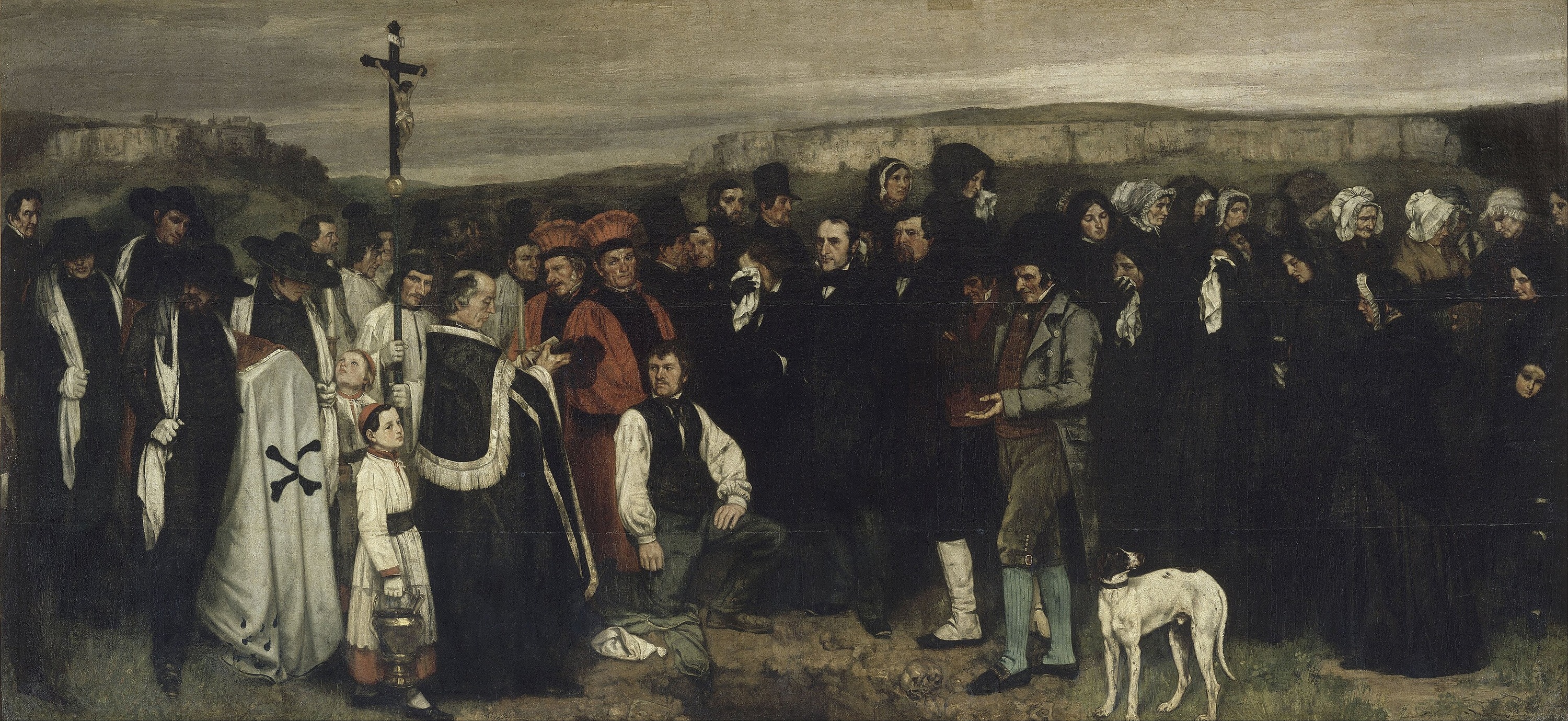
Image: Wikimedia Commons / Public Domain
- Dimensions
- 縦 315.0 cm × 横 668.0 cm
- Medium
- Oil on canvas
- Collection
- Musée d'Orsay
19世紀フランスを代表する写実主義(レアリスム)の画家。 当時の保守的な美術界や伝統に真っ向から反発し、1855年のパリ万国博覧会では審査に不満を持ち、独自に「…
Believing the depiction of invisible gods, angels, or historical heroes to be a falsehood, the artist sought to overturn the academic hierarchy of the art world by portraying the everyday life and death of ordinary provincial people on the monumental scale traditionally reserved for history painting.
✦ Highlights (technique & color)
Heavy dark tones of black and brown occupy more than eighty percent of the canvas, against which the vermilion robes of the church wardens on the left, the women's white handkerchiefs, and the white dog in the foreground create striking contrasts. Notable as well is the generous use of the palette knife, which builds up thick impasto to physically evoke the textures of the rugged cliffs and garments.
✦ The setting of this painting
The Grand-Cimetière municipal cemetery on the outskirts of Ornans, a small town in the Franche-Comté region of eastern France. In the background rise the limestone cliffs typical of the Jura Mountains, enveloped in the cold, heavy, and damp air of late autumn or early winter.
✦ Historical context
Just after the February Revolution of 1848 brought about the Second Republic and introduced universal male suffrage. It was a period when the urban bourgeoisie harbored deep class anxieties as provincial peasants and workers gained a political voice.
Beneath low-hanging grey clouds in Ornans, a small town in eastern France, mourners clad in black gathered in a newly opened cemetery on the town’s outskirts as the chill winds of late autumn gave way to winter. Women quietly dabbed their tears with white handkerchiefs, churchwardens stood in striking red attire, and at their feet, a gravedigger quietly shoveled the earth. It was an ordinary scene, typical of any countryside funeral. Yet to the penetrating gaze of one man watching the proceedings, it revealed an overwhelming truth that surpassed the gods of mythology and the heroes of antiquity. That man was Gustave Courbet, and he was on the verge of launching a daring challenge that would fundamentally transform the history of art.
Longing for the Native Soil in Paris's Shadow
In 1849, upon reaching the age of thirty, Courbet felt a newfound confidence in Paris, the capital of the arts. That year, he was awarded a second-class medal at the official Salon, granting him the coveted privilege of exhibiting his work without having to submit to the scrutiny of the jury. In the art world of the time, history painting—depicting mythological goddesses, ancient heroes, and dramatic biblical scenes—was deemed the most noble and elevated form of art. Having proved his talent, Courbet was practically assured a future of wealth and acclaim if he simply followed this orthodox path.
Yet his heart did not belong in the glittering studios of Paris. Painting shimmering draperies, ethereal angels that no one had ever seen, and an idealized, pristine world felt fundamentally dishonest to him. What truly moved him was the austere nature of his native Ornans and the lives of the people rooted there: the craggy limestone cliffs towering in the background, the heavy, humid air, and the everyday people who toiled in the mud before eventually returning to the earth.
"To paint invisible gods and angels is an imposture. I paint only what my eyes can see."
Courbet made his decision. He would take an immense canvas measuring more than three meters high and six meters wide—a scale previously reserved exclusively for monarchs, aristocrats, and mythological figures—and use it to portray the ordinary funeral of nameless villagers on a life-size scale. By the standards of the era, this was an open rebellion against the artistic establishment, a reckless wager that risked jeopardizing his entire career.
Nameless Heroes Gathering in an Attic
Returning to Ornans with this ambitious vision, Courbet was immediately confronted with a practical obstacle: the small rural town lacked any studio large enough to accommodate such an enormous canvas. Taking pity on his son, his father, Régis, quickly converted the attic of his grandparents' old house into a makeshift workshop. Even so, the space was woefully cramped. Because of the low ceiling, Courbet was forced to tilt the canvas at an angle when working on the upper portions, an inconvenience he lamented in a letter to a poet friend.
About 624 more words
Sign up free and enter Your Museum
Read the stories behind great paintings and music for free, in Your Museum
Your Note
Write down what this painting made you feel in your art notebook.
Please sign up to write notes.
Sign up for freeRecommended Artworks
_by_Ilya_Repin_-_%D0%9D%D0%B5%D0%B0%D0%BF%D0%BE%D0%BB%D0%B8%D1%82%D0%B0%D0%BD%D0%BA%D0%B0.webp)
Sources & references
More artists
If you find an error in this content, please let us know here
This site is protected by reCAPTCHA, and the Google Privacy Policy and Terms of Service apply.