
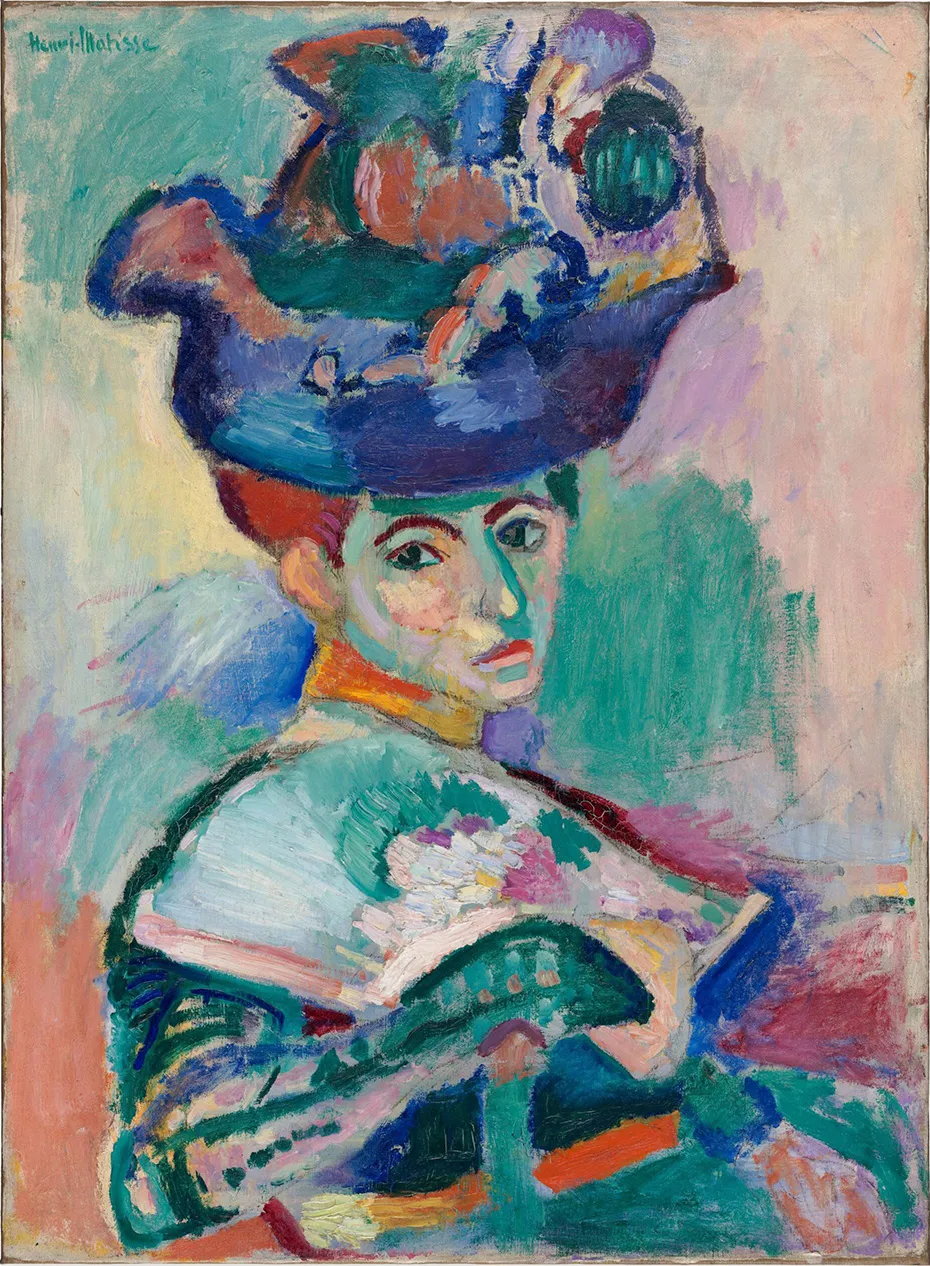
Woman with a Hat
1905
- Dimensions
- 80.8 × 59.7 cm
- Medium
- 油彩、カンヴァス
- Collection
- サンフランシスコ近代美術館(SFMOMA)
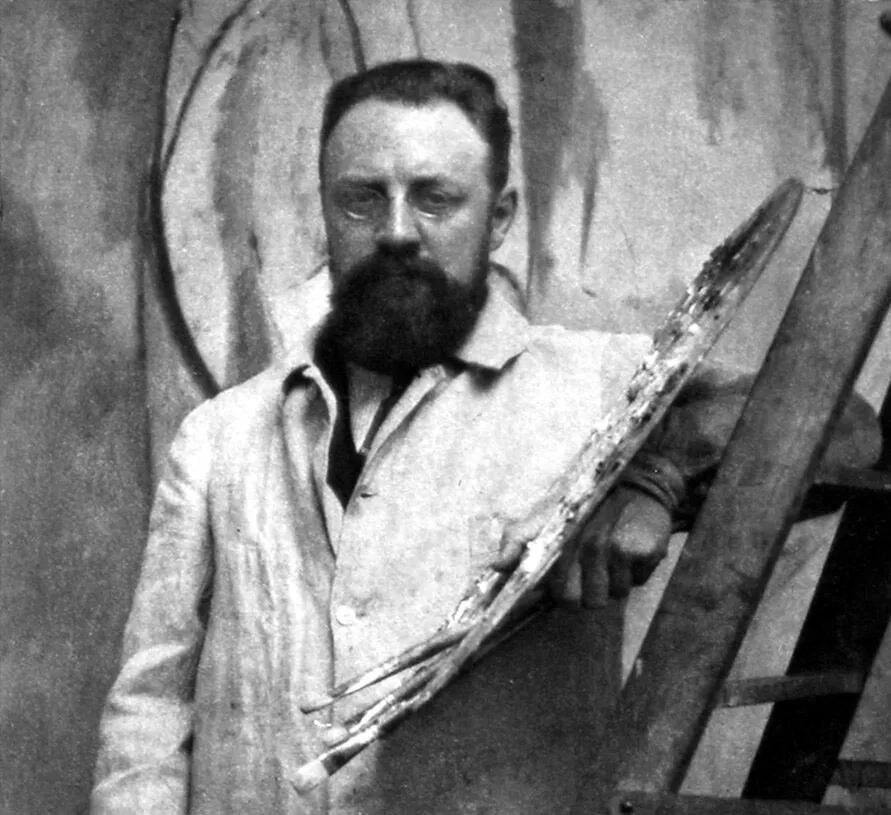
A French visual artist of the early 20th century, he detached color from the imi…
網膜が捉えた色覚表現を完全に破棄し、自らの内面的感覚に基づいて生成された自律的色彩空間を提示するため。
✦ Highlights (technique & color)
画面の複数の箇所で、下地や鉛筆の下描き線がそのまま露出しています。また、モデルの額から鼻筋、顎にかけて引かれた太い緑色の斜線は、顔の立体骨格と光の空間関係を再構築するための純粋な構造線として機能しています。
✦ The setting of this painting
パリのセーヌ川沿い、サン=ミシェル河岸19番地のアパート内にあったマティスのアトリエ兼自宅。ノートルダム大聖堂やセーヌ川を見下ろす位置にありましたが、当時は極度の物資不足と生活上の緊迫感に包まれていました。
✦ Historical context
20世紀初頭のパリは「ベル・エポック」の爛熟期であり、巨大な帽子は女性の社会的ステータスや洗練を象徴していました。また、チューブ入り合成顔料の進化により、画家が直に強烈な原色を塗布することが技術的に可能となっていました。
In a studio along the Seine in Paris, a painter stood before his canvas. Before him sat his wife, dressed in solid black with a red ribbon tied at her neck, quietly holding an open fan across her chest. Yet the colors he applied so forcefully to the canvas were not the black of reality. Radical, unmixed primaries—red, green, yellow, and blue—filled the surface one after another. It marked the dawn of a solitary struggle to overturn centuries of Western painterly tradition and liberate color entirely from the physical world.
A Life at Rock Bottom and a Police Raid
In 1905, at thirty-five years of age, Henri Matisse had yet to achieve public recognition as an artist. His solo exhibition the previous year had been a financial failure, and mounting expenses from his stay in the South of France left his household, with three children to support, in dire poverty. The studio lacked even the most basic necessities, and the strain of barely making ends meet hung heavily over their daily lives.
Deepening his emotional turmoil was a massive financial scandal involving the family of a prominent politician whom his wife Amélie's parents had once served. The fallout extended beyond Amélie's family home, snowballing into a public scandal that even led to a police search of Matisse's own studio. Subjected to unwarranted suspicion and immense psychological stress, the couple saw the very foundation of their livelihood threatened. Both his artistic career and his family's future hung on the precipice of ruin.
A Last-Minute Decision and His Wife's Hat
Amid this acute financial and emotional distress, Matisse was preparing for the autumn Salon d'Automne. He had initially planned to submit a grand landscape reflecting his recent experiments in the South of France, but as the submission deadline drew near, he realized it was impossible to finish the work to his satisfaction.
With very little time remaining, Matisse resolved to execute a substitute piece in a single, intense burst of work, choosing his wife Amélie as his model in the studio. Amélie was a former milliner who had run her own hat shop in Paris from 1899 to 1902. The enormous, flamboyant creation covering the upper third of the canvas is believed to have been based on a hat of her own design. Having long supported him both practically and emotionally, she sat quietly as his model in this hour of crisis, lending herself to his daring aesthetic experiment.
A Studio Casting Aside Literal Color
When Madame Matisse posed in the studio, she actually wore a plain black dress with a red ribbon at her neck. What physically existed in the studio was a model dressed in black wearing a real hat. Yet Matisse completely cast aside the optical colors perceived by the eye. Abandoning reality, he assigned bold primary hues of red, green, yellow, and blue to an imaginative pictorial space.
Though physically rooted in the actual space of a Parisian studio, what unfolded on the canvas was not a faithful depiction of reality, but an autonomous realm of color born of the artist's inner sensibility. There is a famous anecdote from later years: when asked by critics what color Madame Matisse had actually been wearing while posing, the painter curtly replied, "Black, of course." He took the black before his eyes, transmuted it into the colors surging from within, and fixed it onto the canvas.
Vehement Opposition and Public Scandal
When the completed work was submitted to the Salon, fellow painters and committee members of the Salon d'Automne were horrified. Confronted by such shocking hues and raw, violent brushwork, they urged Matisse to withdraw the painting, warning that exhibiting it would make him a laughingstock and utterly ruin his career. Matisse, however, brushed their objections aside and insisted on showing it.
At the opening of the Salon d'Automne, more than twelve thousand people attended on the first day alone, and crowds jostled before the canvas, greeting it with derisive laughter and insults. The press lambasted it as "worse than a child's scribbles," "the product of madness," and "an outrage as though paint had been flung in the face of the public." It was on this occasion that the art critic Louis Vauxcelles, comparing a delicate Renaissance-style sculpture in the center of Room VII with the surrounding riot of canvases by Matisse and his circle, penned the phrase "Donatello among the wild beasts." From this striking metaphor was born the name of the twentieth century's first avant-garde movement: Fauvism.
About 351 more words
Read the rest of this commentary —
and step into a secret gallery
opened just for you
An "art letter" delivered to you every Saturday morning
Works, music and words chosen for your sensibility, from your artist-type result and the paintings you love
A library of masterpieces and music you can enjoy "in your own words", not just look at
A "digital art notebook" (unlimited) where your impressions build into your own taste
Unlimited likes and notes
¥980 / month¥0 today
¥980/month (tax incl.) from day 8. Cancel anytime.
Already have an account? Log in
Your Note
Write down what this painting made you feel in your art notebook.
Please sign up to write notes.
Sign up for freeRecommended Artworks
Sources & references
More artists
If you find an error in this content, please let us know here
This site is protected by reCAPTCHA, and the Google Privacy Policy and Terms of Service apply.