
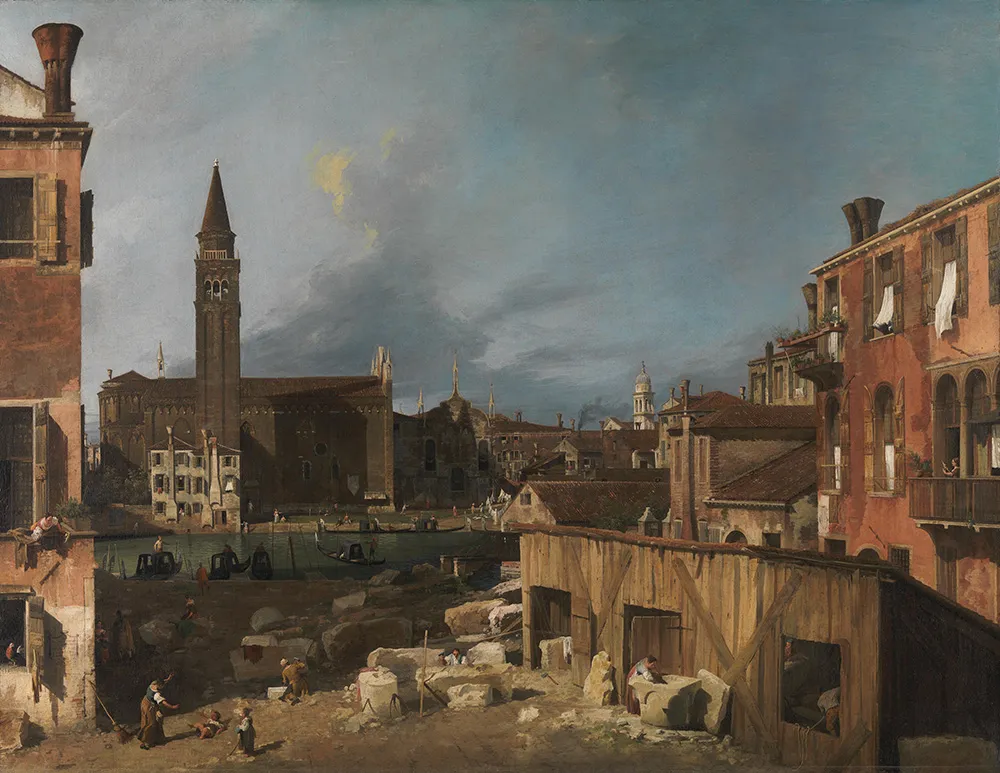
Venice: Campo S. Vidal and Santa Maria della Carità ('The Stonemason's Yard')
1725
- Dimensions
- 123.8 × 162.9 cm
- Medium
- Oil on canvas
- Collection
- The National Gallery, London
✦ Highlights (technique & color)
Canaletto used a reddish-brown ground characteristic of his early works, which lends depth and warmth to the shadows and darker passages. For the blue of the sky, he was an early adopter of Prussian blue, a synthetic pigment discovered just years earlier in 1704. The crumbling plaster and rough brick textures are realistically rendered through thick applications of paint.
✦ The setting of this painting
This painting depicts the view across the Grand Canal from Campo San Vidal, looking toward the Dorsoduro district. At the time, the square served as a temporary stonemason's yard for the restoration of the nearby church. The tall brick bell tower visible on the opposite bank collapsed in 1744 and no longer stands today. With developments such as the construction of the Accademia Bridge across the Grand Canal in 1854, the area has changed dramatically from the 18th century to the present day.
✦ Historical context
In the first half of the 18th century, the Republic of Venice was in political decline, having lost its former military and commercial dominance. At the same time, it transformed into a vast playground for tourism, serving as an essential stop on the Grand Tour for aristocrats and wealthy travelers seeking cultural refinement from across Europe. Beneath the glamorous surface of this tourist destination lay the daily reality of maintaining the city's infrastructure.
In the foreground, massive blocks of white stone lie scattered about. You can almost hear the echoing ring of hammers and chisels as craftsmen carve into the stone. This painting is often described as a depiction of a permanent stonemason’s yard in Venice, or perhaps a glamorous souvenir painting brought home by wealthy travelers from Britain and beyond. Some even say Canaletto used an optical device—a camera obscura—to mechanically trace the view. In reality, however, this was not a stonemason's yard. Nor was it painted for tourists.
Around 1725, Canaletto was in his late twenties. Having stepped away from designing theatrical scenery alongside his father, he was just embarking on his career as a painter specializing in urban views. At the time, Venice was a premier tourist destination for aristocrats across Europe. Artists vied to paint famous landmarks like St. Mark's Square—glamorous, postcard-perfect vistas that sold like hotcakes. Yet Canaletto chose somewhere entirely different.
Campo San Vidal, a square along the Grand Canal. At the time, the area served as a temporary storage site for construction materials used in the renovation of the Church of San Vidal right behind it. It was not a permanent workshop. In fact, in a drawing Canaletto made of the same spot around 1730, the stones and sheds are all gone, leaving behind an empty lot. What he captured in oil was merely a fleeting scene of a temporary construction site.
He did not paint a famous landmark. He painted a gritty scene of labor essential to maintaining the city's infrastructure.
Look at the lower-left corner of the canvas. A mother in a white blouse and brown skirt rushes toward her toddler, who has fallen backward in the mud. Startled, the child has accidentally wet themselves. Behind the mother stands a broom leaning where it was cast aside. A crumbling house with peeling pink and white plaster. A rooster with a red chest perching by a window, announcing the morning. A man and woman chatting in the shade. A woman spinning thread on the balcony of a deep crimson building. The everyday life of the backstreets—unnoticed by any tourist.
- This work is part of “6 works for you” for The Perfectionist Architect → See
About 168 more words
Unlock this story's ending, and every article on MusicStory
- 42
Stories1–2 new every week
An archive of paintings paired with great music, made for a weekend night and a cup of coffee
- 319
Paintings with commentarygrowing daily
From simply looking to truly reading — the brushwork and the obsession of the masters
- 10
Music Librarygrowing daily
Know it first, and what reaches your ear changes — background music becomes art you keep for life
My Notes, unlimited
Every reading adds to a digital art notebook that is yours alone
Already have an account? Log in
Your Note
Write down what this painting made you feel in your art notebook.
Please sign up to write notes.
Sign up for freeRecommended Artworks






Sources & references
- The Stonemason's Yard - Wikipedia
- Canaletto | The Stonemason's Yard | NG127 | National Gallery, London
- Studying and Conserving Paintings
- Canaletto | Venice: The Grand Canal with S. Simeone Piccolo | NG163 | National Gallery, London
- Canaletto | History | Research Starters | EBSCOhost
- The National Gallery London | PDF | Canvas | Paintings - Scribd
- Idyll and Industry at the National Library - Letter from Aberystwyth
- 100 Greatest Paintings Explored | PDF - Scribd
- Canaletto - The Metropolitan Museum of Art
- Canaletto: The Venetian Master Who Built a Market - the exclusivist
- Canaletto, Stonemason's Yard - ColourLex
- Canaletto Paintings, Bio, Ideas - The Art Story
- The Art of Conservation II: Sir Charles Eastlake and conservation at the National Gallery, London by The Burlington Magazine - Issuu
- Revisiting Canaletto and Panini at Farnborough Hall - NGV
- Picture perfect: Canaletto's masterful views of Venice - Art UK
- Fading and Colour Change of Prussian Blue: Methods of Manufacture and the Influence of Extenders - National Gallery
- Canaletto's Colour | British Art Studies
- The Stonemason's Yard by Canaletto
- The Grand Canal near the Ponte di Rialto by CANALETTO - Web Gallery of Art
- Santi Giovanni e Paolo and the Scuola di San Marco by CANALETTO
- artists-pigments-vol3.pdf - National Gallery of Art
More artists








If you find an error in this content, please let us know here
This site is protected by reCAPTCHA, and the Google Privacy Policy and Terms of Service apply.