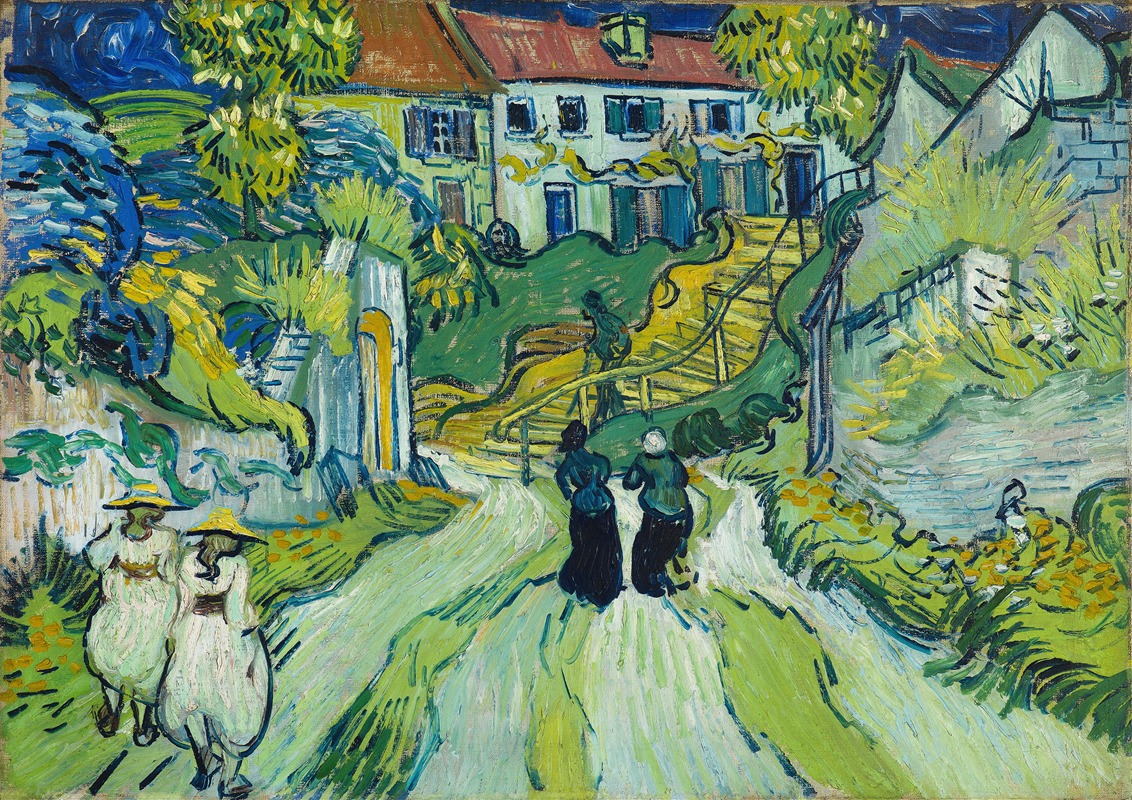
Stairway at Auvers

1890


Winding paths intersect multiple times, leading to a tall stone staircase in the background.

An old man with a cane, and women walking in step. Trees and flowers swaying in the wind.
A beautiful rural landscape painted by Van Gogh in his final years. It is often said that the artist's turbulent brushstrokes and unique composition reveal his unstable mental state.

However, behind the history of this painting lies the fierce determination of one woman.

Johanna, 28 years old. In July 1890, her brother-in-law Vincent took his own life at 37, and in January 1891, her beloved husband Theo also passed away at 33, as if following his brother.
Their marriage abruptly ended after just a year and a half. Before she could even shed tears, the young widow, holding her infant child, was left with nothing but a mountain of paintings that filled their Paris apartment, understood by no one.

Everyone around her told her to dispose of them all.

These were the accursed paintings that had caused her beloved husband so much distress and shortened his life.
During his lifetime, Van Gogh's paintings rarely sold and were scorned by the public as products of madness. Abandoned by relatives and with no means of support, she found herself on the brink.

She made a decision.

To bring to light the talent of her brother-in-law, which her husband had believed in with his life, she chose to single-handedly protect the collection of works deemed worthless.
Enduring the cold gaze of society, she worked tirelessly. For years, she deciphered the vast collection of letters left behind, visited galleries to organize exhibitions, and continuously wrote to art dealers in various countries.

She exhibited this painting, which she had carefully kept, at an exhibition held in Rotterdam in 1896, continuously seeking public recognition.
Then, in November 1909, a clear record of the transaction entrusting this painting to a Paris gallery was found in her meticulously kept account books.

For eighteen long years after her husband's death, she never let go of this painting. No matter what anyone said, she single-handedly protected the works until the world recognized the true value of the art her husband had loved. Later, when an academic error regarding the exhibition history of this painting appeared in a catalog of a renowned specialized book, the truth of its provenance was proven by the investigation of the museum curator and the records she had left in her account books.

Knowing this fact, when you stand before the painting, the scene appears slightly different.
The white paths winding and intersecting in the foreground seem to be the place where the lives of Vincent, Theo, and Johanna converged.

The figures slowly ascending the long staircase leading into the background, step by step. These are the very footsteps of Johanna, who never gave up and never stopped walking, no matter how difficult or uncertain the path, never succumbing to adversity.

It is precisely because she dedicated everything to protecting it that we can now see this painting. The dazzlingly bright and vivid colors that adorn the entire canvas.

Perhaps it was the single ray of hope that she alone continued to believe in amidst overwhelming loss and darkness.

If you find an error in this content, please let us know here

Vincent van Gogh

Netherlands

Vincent van GoghVincent van Gogh

1853 – 1890

Vincent Willem van Gogh was a Dutch post-impressionist painter who posthumously…

Your Note

Write down what this painting made you feel in your art notebook.

Please sign up to write notes.

Sign up for free

Music and art
are waiting for you.

Broaden your own world through the stories of art.
We will notify you by email when new articles are published.

Sign up free to read