
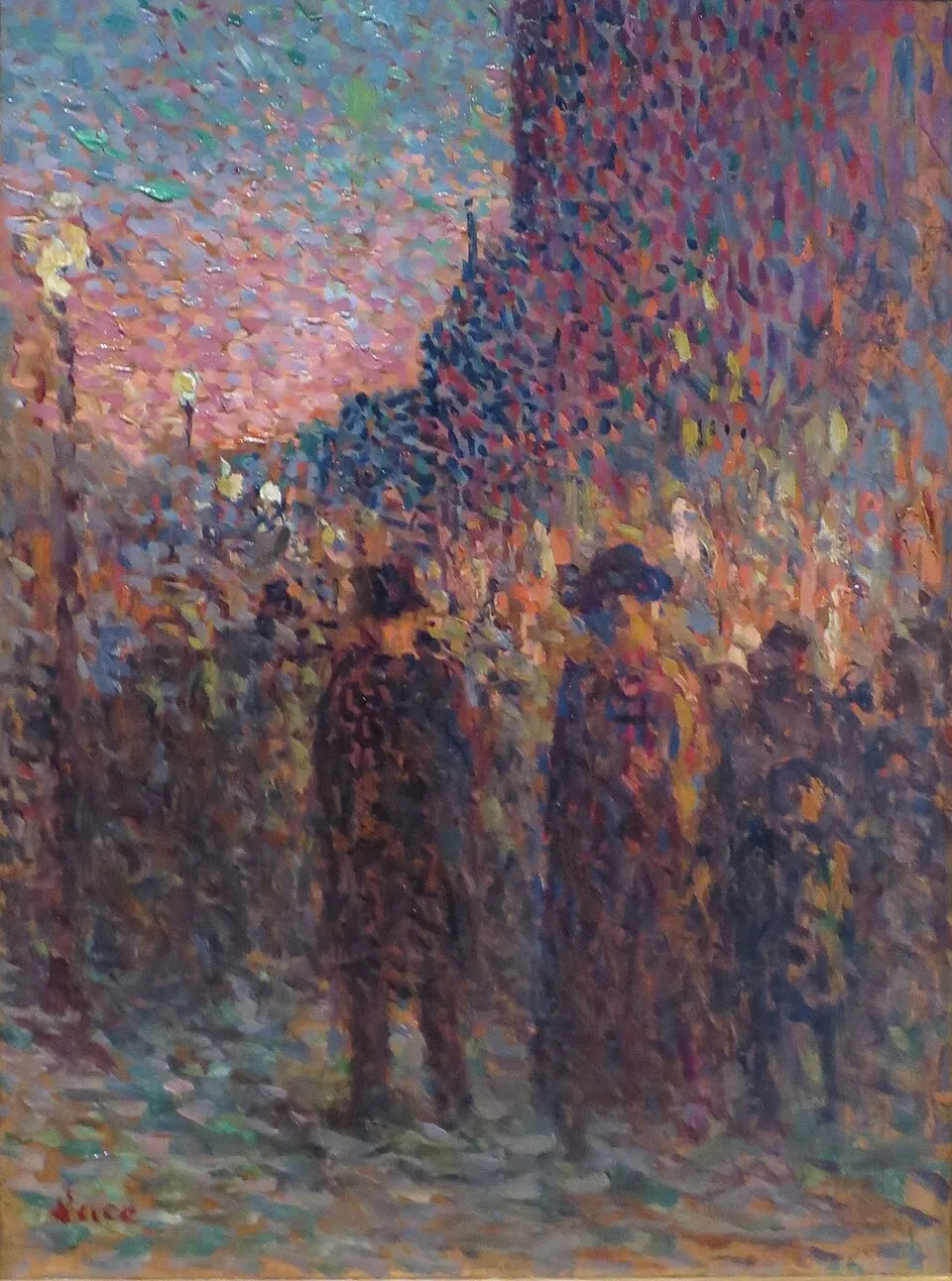
Paris, Boulevard at Night
1893
フランスの新印象派(ネオ・印象派)を代表する画家。 パリの質素な家庭に生まれ、初期は版画職人の見習いとして技術を磨いた。
On a Parisian boulevard, as night descends, the warm artificial light emanating from gas lamps and shops dimly illuminates the shadows of passersby and carriages.
At the end of the 19th century, Paris, undergoing modernization, was transforming its nocturnal landscape as the 'City of Light.' Maximilien Luce, a painter born into the working class, had always observed with a keen eye the lives of those at the bottom of society, working in modern city construction sites and harsh factory districts. Yet, once the sun set, he became utterly captivated by another face of this city: the magic of artificial illumination twinkling in the darkness.
At that time, he was exploring the technique of Pointillism (Divisionism) as a 'Neo-Impressionist' alongside his friend Signac and others. However, his Pointillism was by no means a cold, calculated method. By arranging dots of contrasting colors—orange and yellow lights emerging from the gloom, and the blue and purple darkness of the night illuminated by them—as his emotions dictated, he masterfully expressed the hustle and bustle of the night city, the unique poetry brought by streetlights, and the pulse of light.
About 60 more words
Read stories of masterpieces for free
Your Note
Write down what this painting made you feel in your art notebook.
Please sign up to write notes.
Sign up for freeRecommended Artworks
_1893.webp)
More artists
If you find an error in this content, please let us know here
This site is protected by reCAPTCHA, and the Google Privacy Policy and Terms of Service apply.