
 日本語 (JA)
 English (EN)
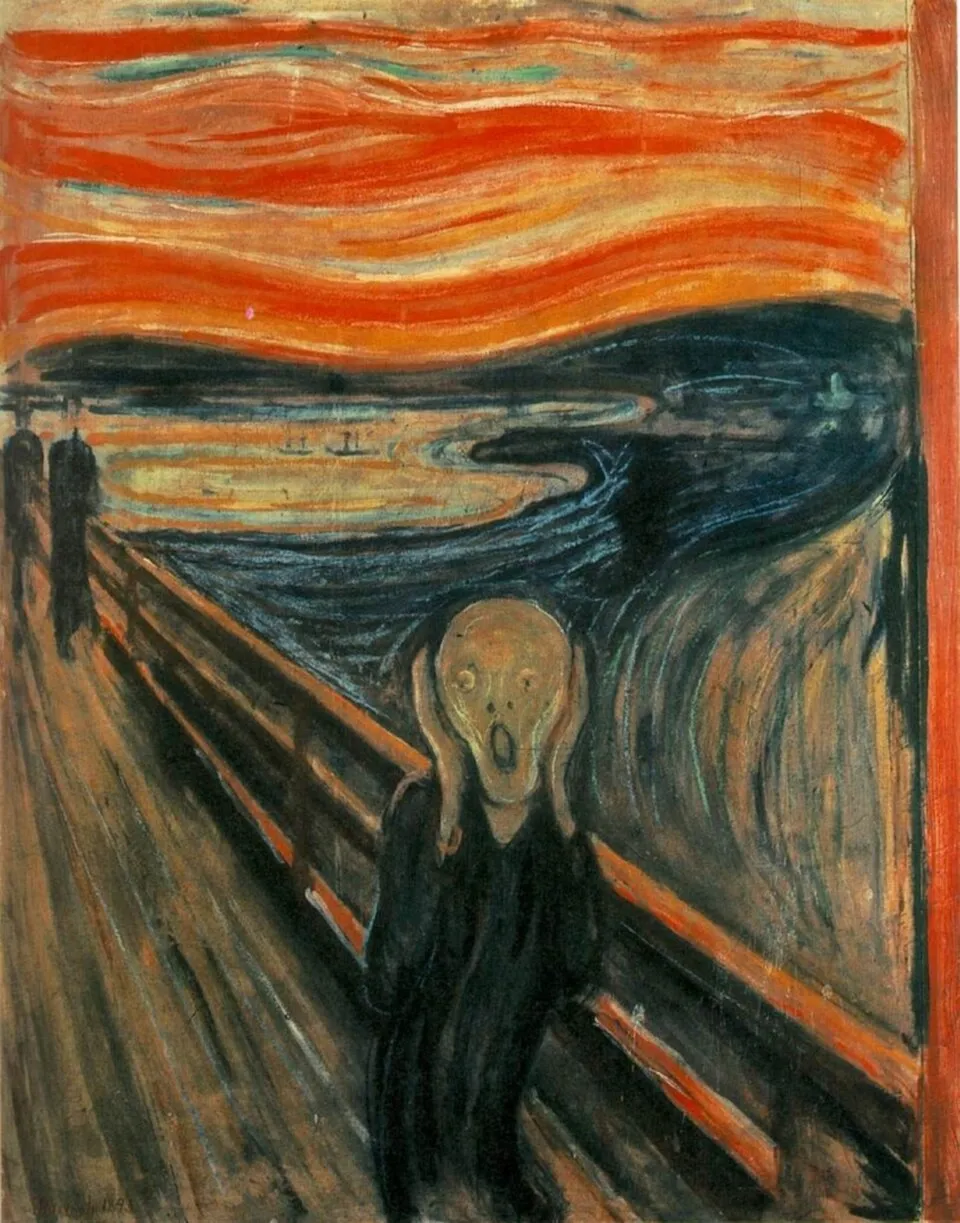
- Dimensions
- 91.0 × 73.5 cm
- Medium
- Tempera and oil pastel on unprimed cardboard
- Collection
- National Museum, Oslo
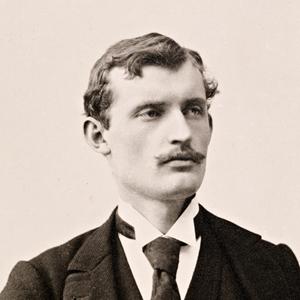
A celebrated Norwegian painter active from the late nineteenth century to the fi…
An expression of self-irony and defiance against the label of madness thrust upon him by conservative art circles. It presents a universal human figure, etched with the terror of the illnesses that took beloved family members and an ontological despair echoing through nature.
✦ Highlights (technique & color)
Executed in tempera and oil pastel on inexpensive, unprimed cardboard. The collision between the sharp, ruler-straight lines of the bridge and the swirling curves of the figure and nature creates a sense of intense tension. The stark complementary contrast between the fiery red sky and the dark blue-black fjord directly conveys a profound psychological shock.
✦ The setting of this painting
The setting is a path on Ekeberg Hill, a scenic overlook in eastern Christiania (now Oslo). The straight line on the left faithfully depicts the railing of a promenade along the cliff. Beyond it lies a panoramic view of the fjord and the city, yet at the foot of the hill in those days stood a public slaughterhouse, near a psychiatric hospital where Munch's sister was institutionalized.
✦ Historical context
The 1890s marked a transitional period from Impressionism, which captured external nature, to Symbolism and Expressionism, which gave voice to the artist's inner psychology. The work also reflects memories of the cataclysmic 1883 eruption of Krakatoa, which produced blood-red volcanic twilights observed throughout Europe for years afterward.
A lone figure stands on a bridge beneath a blood-red sky,
clutching their head with both hands, eyes and mouth wide open.
It is one of the most famous paintings in the world,
an image nearly everyone has encountered at least once.
A soul crying out in sheer terror,
or perhaps a hallucination born of an artist's madness—
such is the common reading of this work.
Yet in truth, this figure is not screaming.
Nor was the painting simply the product of insanity.
In the early 1890s,
the Norwegian painter Edvard Munch was engulfed in despair.
During his childhood, he lost both his mother and his elder sister Sophie to tuberculosis.
Then in 1889, his father, Christian, his principal emotional anchor, died suddenly of acute pneumonia.
His surviving younger sister, Laura Catherine,
also struggled with mental illness and was committed to the Gaustad psychiatric asylum.
Munch himself suffered from chronic respiratory ailments.
Haunted by the dread of inherited madness,
the shadow of death followed him everywhere.
In January 1892, in Nice, France,
Munch recorded a striking memory in his diary.
While walking along a road with two friends at sunset,
the sky suddenly turned blood-red.
In that very instant,
he felt an infinite scream pass through nature.
He sought to give visual form to that experience.
The setting is Ekeberg Hill overlooking Kristiania.
Beyond the straight railing of the path, two companions walk indifferently away,
while in the foreground stands a universal figure, neither distinctly male nor female, young nor old.
The figure is not screaming.
Confronted by the cosmic shriek that reverberates through the natural world,
it is frantically covering its ears to shut out the discord.
About 223 more words
Read the rest of this commentary —
and step into a secret gallery
opened just for you
An "art letter" delivered to you every Saturday morning
Works, music and words chosen for your sensibility, from your artist-type result and the paintings you love
A library of masterpieces and music you can enjoy "in your own words", not just look at
A "digital art notebook" (unlimited) where your impressions build into your own taste
Unlimited likes and notes
¥980 / month¥0 today
¥980/month (tax incl.) from day 8. Cancel anytime.
Already have an account? Log in
Your Note
Write down what this painting made you feel in your art notebook.
Please sign up to write notes.
Sign up for freeRecommended Artworks
Sources & references
More art movements
Pre-Baroque
1 artworks
Victorian era
10 artworks
Impressionism
48 artworks
Late Pre-Raphaelite
10 artworks
Baroque
2 artworks
American Impressionism
5 artworks
Realism
4 artworks
Pre-Raphaelite
3 artworks
Barbizon School
5 artworks
Academic art
5 artworks
Luminism
3 artworks
Rococo
2 artworks
Symbolism
22 artworks
Neo-Impressionism
3 artworks
Ukiyo-e
1 artworks
Japonism
4 artworks
Edo period
1 artworks
Fauvism
1 artworks
Naturalism
9 artworks
Russian Realism
1 artworks
Post-Impressionism
13 artworks
Genre painting
9 artworks
Neoclassicism
3 artworks
ウィーン分離派
7 artworks
自然主義
1 artworks
ナショナル・ロマンティシズム
1 artworks
未来派
1 artworks
More artists
If you find an error in this content, please let us know here
This site is protected by reCAPTCHA, and the Google Privacy Policy and Terms of Service apply.