
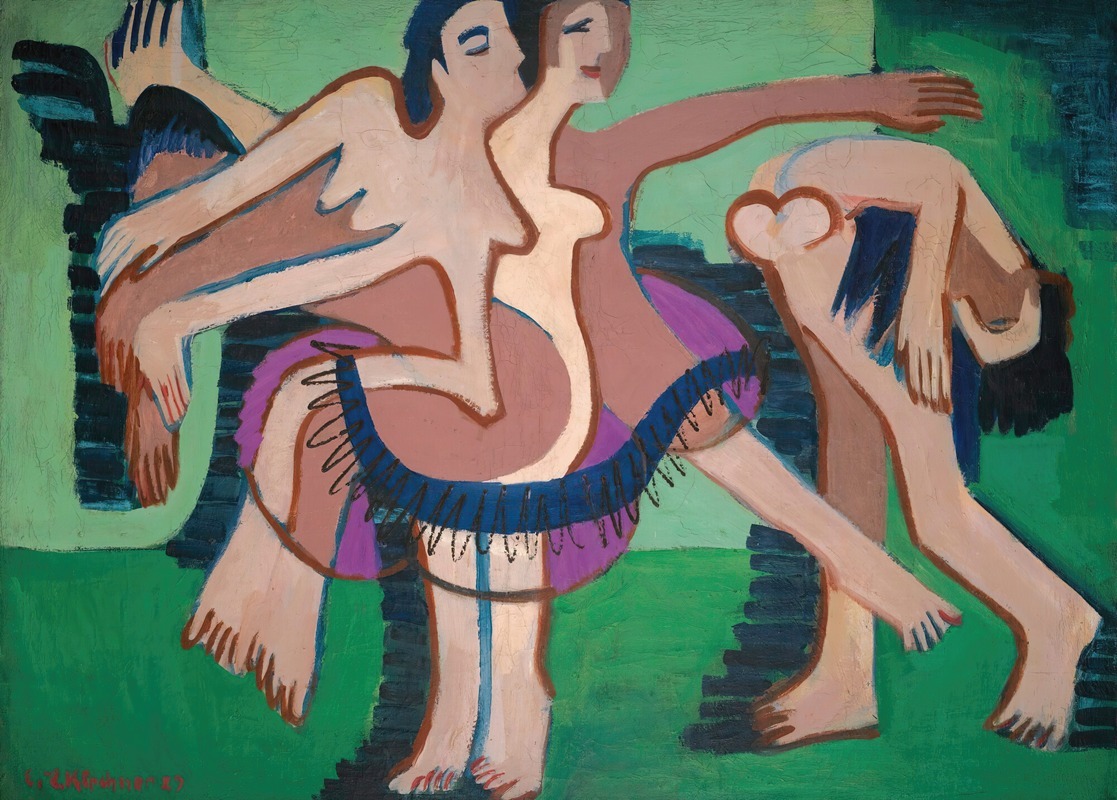
Tanzgruppe (Dance Group)
1929
- Dimensions
- 110.5 x 151.0 cm
- Medium
- Oil on canvas
- Collection
- Private collection
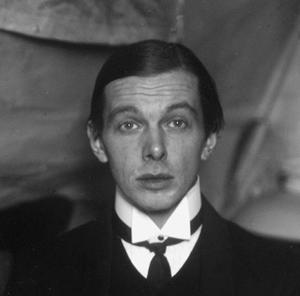
Ernst Ludwig Kirchner was a German expressionist painter and printmaker and one…
✦ Highlights (technique & color)
The dancers' skin is painted in earthy tones reminiscent of the soil, creating a striking complementary tension against the deep green background. In addition, the contours defining their poses are formed by sharp, rigid, saw-toothed lines and angles, lending the composition an intense vitality that pulses like a heartbeat.
✦ The setting of this painting
Rather than an artificial indoor stage, the background of this work is an abstract green expanse stripped of all superfluous ornamentation. This vivid green field reflects how Kirchner was profoundly inspired by open-air performances of physical expression staged amidst the breathtaking nature of Davos, Switzerland.
✦ Historical context
In 1920s Germany and Switzerland, Expressionist dance emerged as an avant-garde movement, rejecting the formal rigidity of classical ballet to express raw, primal emotions directly through physical movement. Dresden-based dancers such as Mary Wigman and Gret Palucca were at the heart of this movement, and Kirchner was deeply fascinated by their work.
In a vibrant green space, three dancers stretch their bodies expansively.
Their dramatically elongated limbs interlock like pieces of a puzzle.
Germany in the 1920s.
Rejecting the formal rigidity of classical ballet entirely,
Expressionist dance—which sought to channel raw, primal emotion directly through physical movement—had become a defining avant-garde movement.
At its epicenter lay Dresden,
where the legendary dancer Mary Wigman and her disciple Gret Palucca led the scene.
In 1926,
the painter Ernst Ludwig Kirchner visited the Mary Wigman School of Dance in Dresden.
Watching the dancers' lessons,
he was captivated by the intensity of their rigorous physical training, producing hundreds of sketches capturing their dynamic motion.
Three years later, in 1929,
Kirchner was living on the high plateau of Davos, Switzerland.
Moved by open-air performances in the crisp mountain air,
he completed this work, reflecting back on his powerful encounters with dance in Dresden.
- This work is part of “6 works for you” for The Avant-Garde Pioneer → See
About 115 more words
Unlock this story's ending, and every article on MusicStory
- 42
Stories1–2 new every week
An archive of paintings paired with great music, made for a weekend night and a cup of coffee
- 319
Paintings with commentarygrowing daily
From simply looking to truly reading — the brushwork and the obsession of the masters
- 10
Music Librarygrowing daily
Know it first, and what reaches your ear changes — background music becomes art you keep for life
My Notes, unlimited
Every reading adds to a digital art notebook that is yours alone
Already have an account? Log in
Your Note
Write down what this painting made you feel in your art notebook.
Please sign up to write notes.
Sign up for freeRecommended Artworks
![Untitled [Rescue boat]](https://musicstory-assets-682855971161-ap-northeast-1-an.s3.ap-northeast-1.amazonaws.com/artworks/paintings/untitled-rescue-boat.jpg)
Sources & references
More artists
If you find an error in this content, please let us know here
This site is protected by reCAPTCHA, and the Google Privacy Policy and Terms of Service apply.