
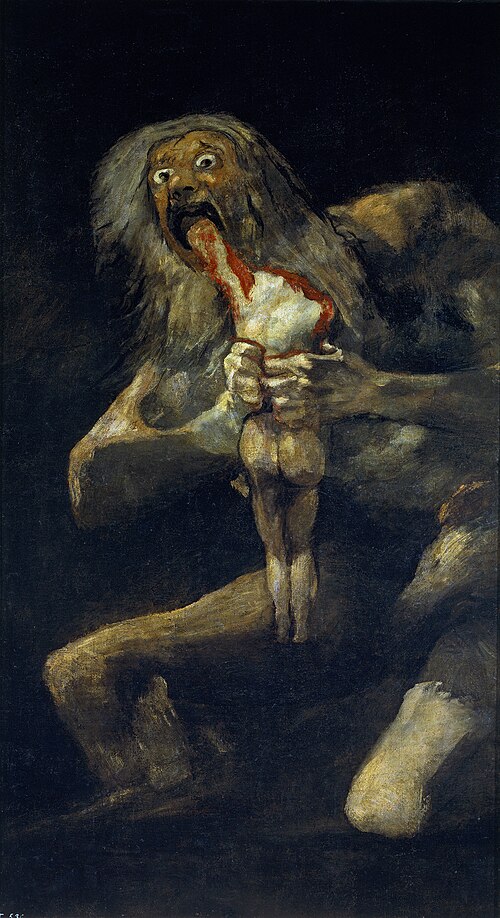
Saturn Devouring His Son
1823
- Dimensions
- 143.5 × 81.4 cm
- Medium
- Oil on plaster, transferred to canvas
- Collection
- Museo del Prado (Madrid, Spain)
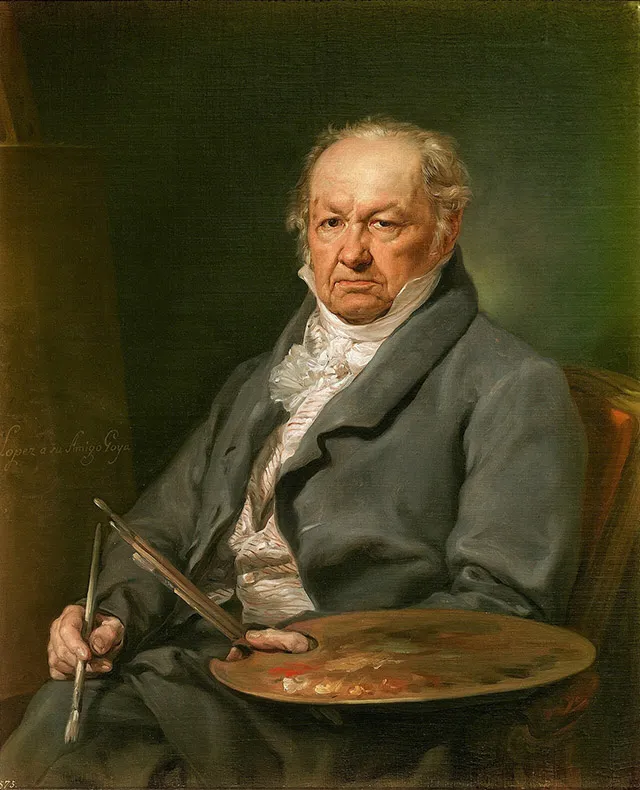
Active at the Spanish court from the late eighteenth to the early nineteenth cen…
A searing, silent indictment of an absolute monarchy devouring its own people—a solitary act of defiance, painted onto the walls of his private home where no one else could see, imbued with despair and fury.
✦ Highlights (technique & color)
Painted directly onto dry plaster using the fresco-secco technique, the mural was later removed from the wall and transferred to canvas. Amid an intensely restrained palette of blacks and earthy browns, the solitary accent of vivid vermilion red delivers a gruesome visual shock.
✦ The setting of this painting
This work originally adorned the eastern wall of the ground-floor dining room at the Quinta del Sordo (House of the Deaf Man), Goya's estate along the Manzanares River on the outskirts of Madrid. It was an intimate, dimly lit space, illuminated only by the natural light filtering through the windows onto the walls.
✦ Historical context
Early 19th-century Spain was an era of profound upheaval, still reeling from the horrors of the Peninsular War. Following the Trienio Liberal (Liberal Triennium) that began in 1820, King Ferdinand VII restored absolute monarchy, initiating a period of brutal reactionary oppression. Immense bloodshed marked this purge, which came to be known as the Ominous Decade.
In the pitch-black darkness, a giant with disheveled gray hair crouches low.
In his hands, he clutches a bloody body, its head and right arm torn away.
Bright red blood spurts from the severed neck as the titan prepares to sink his teeth into the remaining left arm.
A scene of the Greco-Roman god Saturn devouring his children one after another, fearing a prophecy that he would be overthrown.
An eerie painting created by Goya in his final years, supposedly painted while gripped by madness and mental illness.
This is how the work is most commonly described.
It is widely known by the title "Saturn Devouring His Son."
Yet Goya himself never actually gave this painting a title.
Nowhere on the surface did he even leave a signature.
The title we know today is merely a working name given after Goya's death by his friend, the painter Antonio de Brugada, when cataloging the artist's estate.
Furthermore, recent research has uncovered astonishing secrets concealed within the piece.
In 1819.
At the age of seventy-three, Goya purchased a house on a hill outside Madrid.
"Quinta del Sordo" (the House of the Deaf Man).
For a man who had lost his hearing entirely following a severe illness years before, the name was a curious coincidence.
Late that year, Goya once again fell critically ill, hovering near death.
He barely survived, thanks to the devoted care of his physician, Eugenio Arrieta.
Yet the terror of old age and death loomed immediately overhead.
The era, too, was steeped in blood.
Following the "Trienio Liberal" (Three Liberal Years) starting in 1820, Spain was engulfed in turmoil.
King Ferdinand VII, restored to absolute rule, ruthlessly persecuted liberals.
State power relentlessly purged its own citizens, leaving bloodshed in its wake.
Commissioned by no one, Goya poured out that tyranny across the walls of his own home.
The ground-floor dining room.
On the eastern wall of the dim room, the figure of the titan was painted directly in oils.
Originally, a bright landscape adorned that wall.
Goya chose to paint over it himself, overlaying this vision of darkness.
About 203 more words
Unlock this story's ending, and every article on MusicStory
- 42
Stories1–2 new every week
An archive of paintings paired with great music, made for a weekend night and a cup of coffee
- 319
Paintings with commentarygrowing daily
From simply looking to truly reading — the brushwork and the obsession of the masters
- 10
Music Librarygrowing daily
Know it first, and what reaches your ear changes — background music becomes art you keep for life
My Notes, unlimited
Every reading adds to a digital art notebook that is yours alone
Already have an account? Log in
Your Note
Write down what this painting made you feel in your art notebook.
Please sign up to write notes.
Sign up for freeRecommended Artworks
%2C_by_Diego_Vela%CC%81zquez.webp)
Sources & references
More artists




If you find an error in this content, please let us know here
This site is protected by reCAPTCHA, and the Google Privacy Policy and Terms of Service apply.