
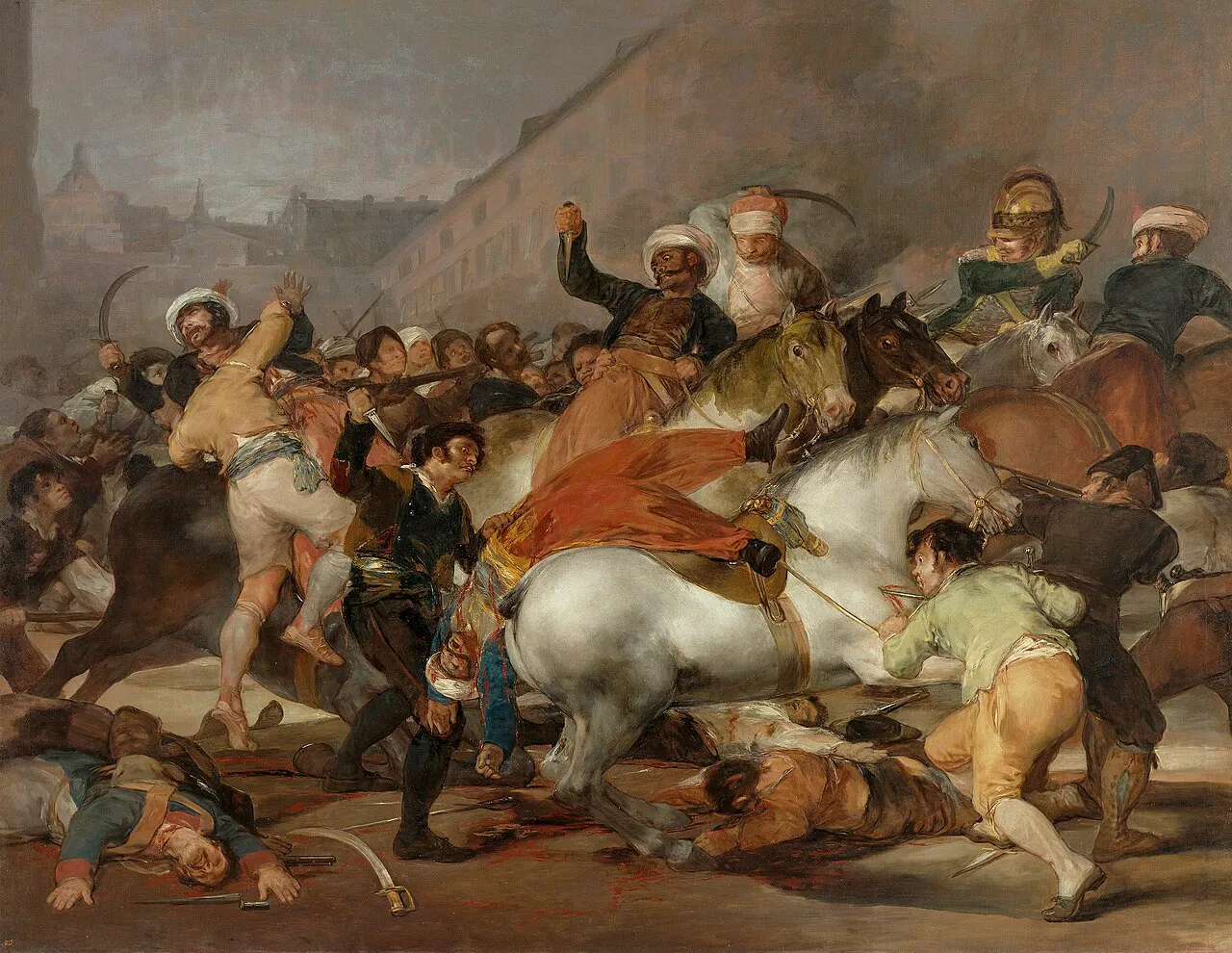
The Second of May 1808 in Madrid
1814
- Dimensions
- 268.5 cm × 347.5 cm
- Medium
- Oil on canvas
- Collection
- Museo del Prado
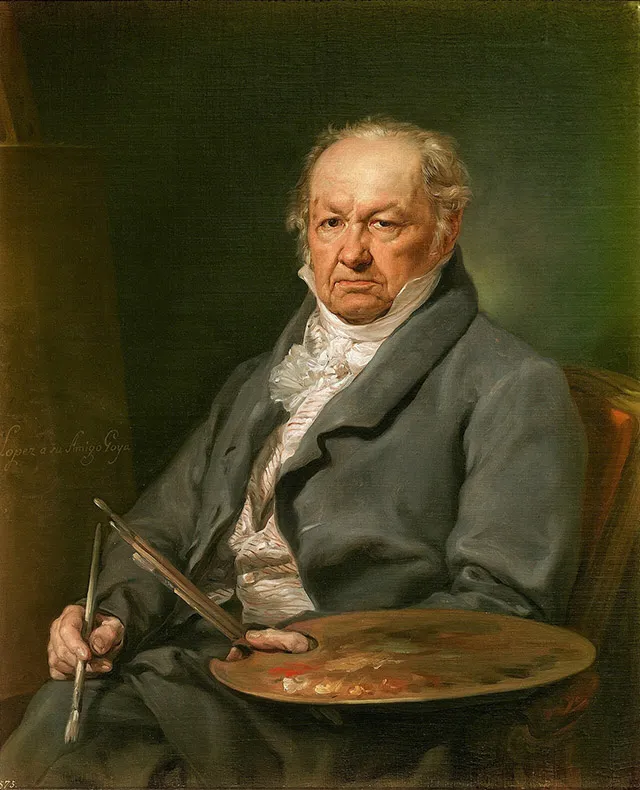
Active at the Spanish court from the late eighteenth to the early nineteenth cen…
A radical departure from traditional history painting that glorified the triumphs of victors. This work stands as an anti-heroic manifesto, searingly capturing the raw madness and visceral destruction of anonymous men slaughtering one another.
✦ Highlights (technique & color)
Characterized by rapid, violent brushstrokes and thick impasto rather than defined contours, the technique creates an intense immediacy. Vivid reds—such as the crimson trousers of the Mamelukes and flowing blood—scatter across the composition, clashing with turquoise blues and yellows to heighten the frenzy and tragedy of the battlefield.
✦ The setting of this painting
The morning of May 2, 1808, around the Puerta del Sol in central Madrid—the fiercest site of the popular uprising against the French occupying forces. In the background, the landscape around the Old Post Office and the Convent of San Felipe Neri is reconstructed under the clear natural light of early summer.
✦ Historical context
This period marks the outbreak of the Peninsular War following the French invasion of 1808. With the restoration of Ferdinand VII in 1814 and the reinstatement of absolute monarchy, Spain was plunged once again into a tempest of reactionary politics and repression. The canvas is underpinned by the deep scars left by the conflict: devastation, poverty, and a fractured nation.
A foreign soldier falls tumbling from his horse.
Townspeople leap upon him, plunging daggers into his flesh.
The entire canvas is consumed by blood and frenzy.
This painting depicts Madrid on May 2, 1808.
A historic day when the citizens rose up against the French occupying forces.
It captures the brutal, close-quarters combat at the Puerta del Sol.
So palpable was its sense of presence that a legend later took hold.
That the painter, Goya, had stood in the very midst of the battle.
That he had watched the clashes from the shadows or a window, sketching them on the spot.
Yet that was not the case.
This work was painted six years after the event.
In 1814.
Goya was safe inside his studio.
He gathered eyewitness accounts and prints, working out the composition from memory.
There was not a single sketch drawn from life on that day.
Why did he paint it only after six years had passed?
In 1808, Goya lived very close to the scene.
At Calle del Desengaño, No. 1, just a stone's throw from the fiercest fighting.
He had been completely deaf since a severe illness in 1792.
Even so.
The shudder of the cannons and the rumbling feet of the crowd must have shaken him to the core.
Yet he did not take up his brush immediately.
Under the French occupation, Goya remained in his post as court painter.
He had even accepted a medal from the pro-French regime.
Then came 1814.
The French troops withdrew, and Ferdinand VII returned from exile.
Absolute monarchy was restored.
Suddenly, Goya found his position precarious.
He lived with the dread of being purged as a collaborator.
In 1812, he had lost his wife, Josefa.
Financial hardship brought on by the war weighed upon him as well.
He stood to lose everything.
About 219 more words
Read stories of masterpieces for free
Your Note
Write down what this painting made you feel in your art notebook.
Please sign up to write notes.
Sign up for freeRecommended Artworks
%2C_by_Diego_Vela%CC%81zquez.webp)
Sources & references
More artists
If you find an error in this content, please let us know here
This site is protected by reCAPTCHA, and the Google Privacy Policy and Terms of Service apply.