
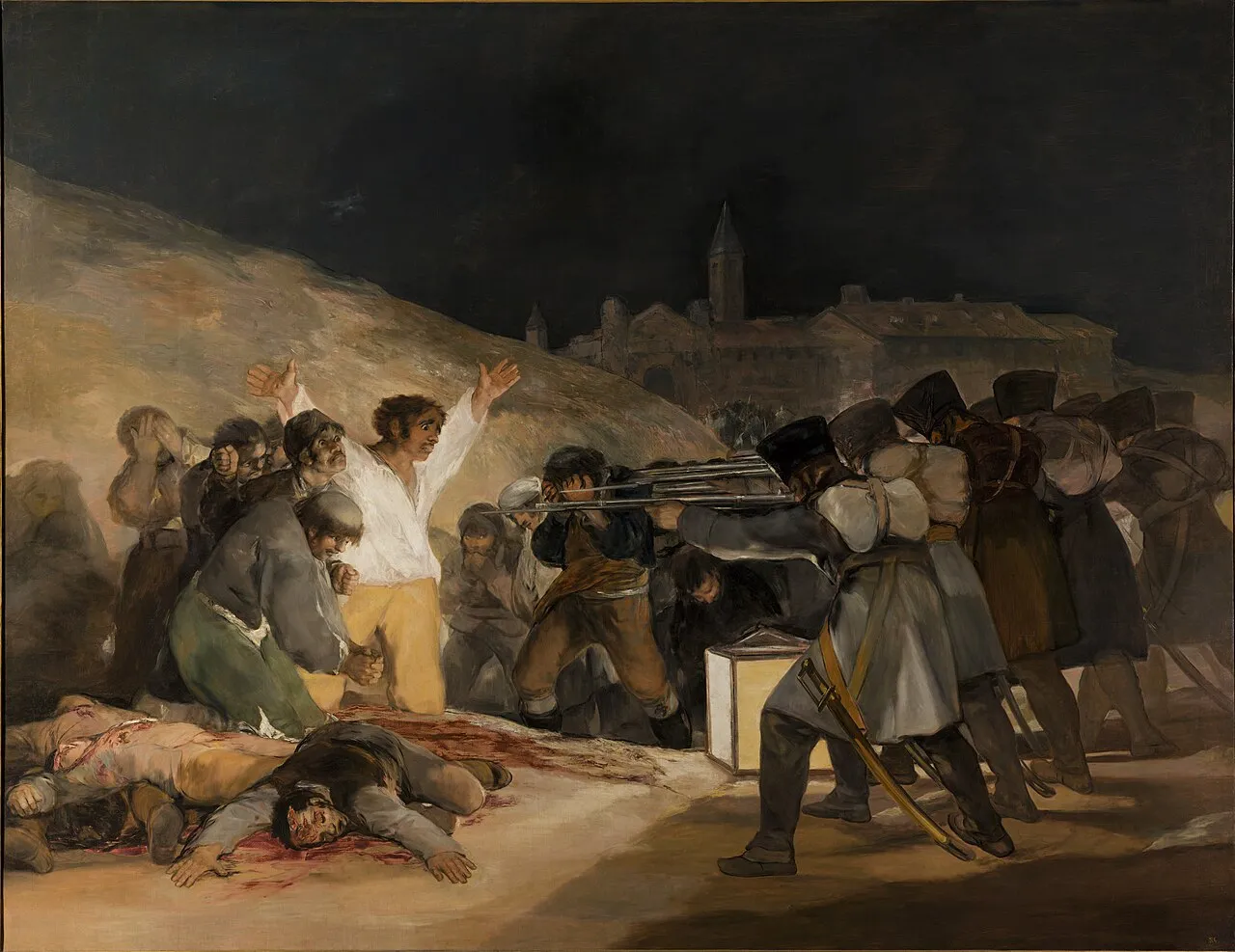
The 3rd of May 1808 in Madrid
1814
- Dimensions
- 268 cm × 347 cm
- Medium
- Oil on canvas
- Collection
- Museo del Prado
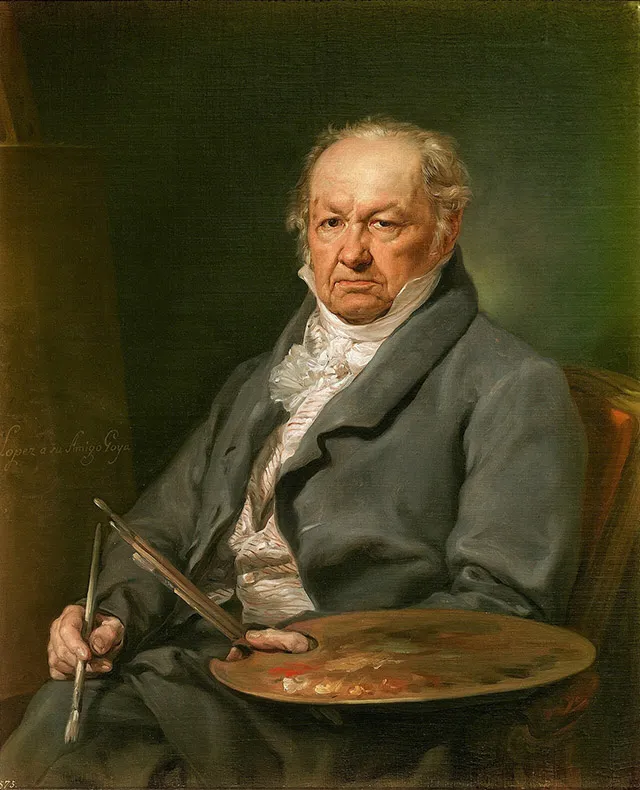
Active at the Spanish court from the late eighteenth to the early nineteenth cen…
A visceral indictment of senseless violence and anonymous sacrifice in a world devoid of heroes. A cry from the soul that mirrors the artist's own isolation and terror during the precarious restoration of absolute monarchy.
✦ Highlights (technique & color)
Capitalizing on a reddish-brown ground, the paint is applied roughly with broad brushes and palette knives. A large lantern in the center casts a blinding light, employing tenebrism to illuminate the victims against the darkness and creating an overwhelming sense of tension and tragedy.
✦ The setting of this painting
The setting is the slope outside the Vega Gate, near the Royal Palace of Madrid. In the early hours of May 3, 1808, indiscriminate summary executions were carried out in retaliation for the citizens' uprising against Napoleon's forces. While long believed to depict the hill of Príncipe Pío, recent research based on the arrangement of the background buildings has identified the location as outside the Vega Gate.
✦ Historical context
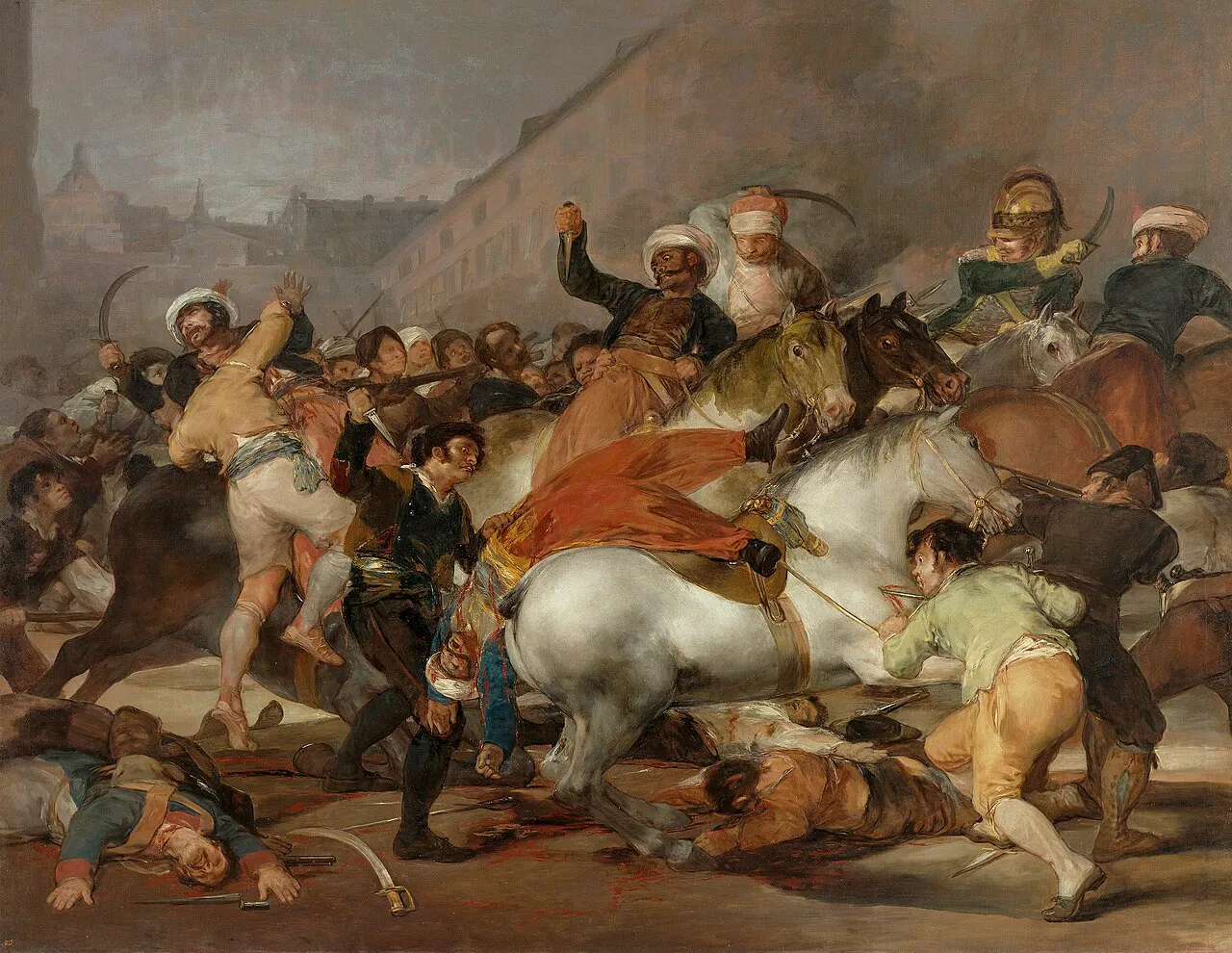
This work is set in the early 19th century during the Peninsular War. Napoleonic troops occupied Spain, imprisoned the king, and placed Napoleon's elder brother on the throne. Outraged, the citizens of Madrid rose in rebellion on May 2, 1808, triggering horrific retaliatory executions the following day. At the time, heroic Neoclassical painting dominated the art world.
Beneath a pitch-black sky, the light of an enormous lantern illuminates men on the verge of being shot.
Faceless soldiers level their rifles like a soulless execution machine.
At their feet, those already struck down lie in pools of blood.
A persistent legend has long surrounded this painting:
"On the night of the executions, the painter Goya went to the site with a servant.
Lantern and spyglass in hand, he sketched the scattered corpses and the bloodshed."
It is often said that such vivid authenticity could only have come from witnessing the horrific scene firsthand.
Yet in truth, there is no evidence whatsoever that Goya was there.
It is nothing more than a romantic myth conjured by a nineteenth-century novelist.
1814.
A studio in Madrid.
At sixty-eight, Francisco de Goya was entirely deaf.
A world of silence.
Having lost his wife of many years, Josefa, two years earlier, he was profoundly alone.
What is more, a perilous political crisis was closing in on him.
Having remained court painter under French occupation, Goya faced the danger of being branded a French collaborator and purged once the French troops withdrew.
He had to paint.
He took the initiative and wrote to the provisional government:
"To perpetuate with my brush the heroic actions or scenes of our glorious insurrection against the tyrant of Europe."
His proposal was accepted, and he turned to the canvas.
Not even a preliminary drawing survives.
He applied the paint directly onto a reddish-brown ground with bold, sweeping brushstrokes.
The scene is set on the slope outside the Vega Gate, near the Royal Palace.
It recalls the indiscriminate reprisal executions carried out before dawn on May 3, 1808.
Rather than working from sketches made on the spot, Goya reconstructed the event from his own deep terror and empathy.
The man in the white shirt at the center, flinging his arms wide.
He is no real-life hero.
He stands as an emblem of ordinary, nameless people resisting senseless brutality.
Only the monk kneeling beside him in prayer was a historical figure: Father Gallego y Dávila, who was indeed executed.
Goya utterly rejected the conventions of grand history painting that dominated his era.
No heroes—only slaughter.
Shed blood and the pallor of death.
Raw, merciless reality rendered with rough brushwork.
The masterpiece was complete.
Yet the restored monarch paid it no heed.
About 207 more words
Unlock this story's ending, and every article on MusicStory
- 42
Stories1–2 new every week
An archive of paintings paired with great music, made for a weekend night and a cup of coffee
- 319
Paintings with commentarygrowing daily
From simply looking to truly reading — the brushwork and the obsession of the masters
- 10
Music Librarygrowing daily
Know it first, and what reaches your ear changes — background music becomes art you keep for life
My Notes, unlimited
Every reading adds to a digital art notebook that is yours alone
Already have an account? Log in
Your Note
Write down what this painting made you feel in your art notebook.
Please sign up to write notes.
Sign up for freeRecommended Artworks
Sources & references
More artists
If you find an error in this content, please let us know here
This site is protected by reCAPTCHA, and the Google Privacy Policy and Terms of Service apply.