
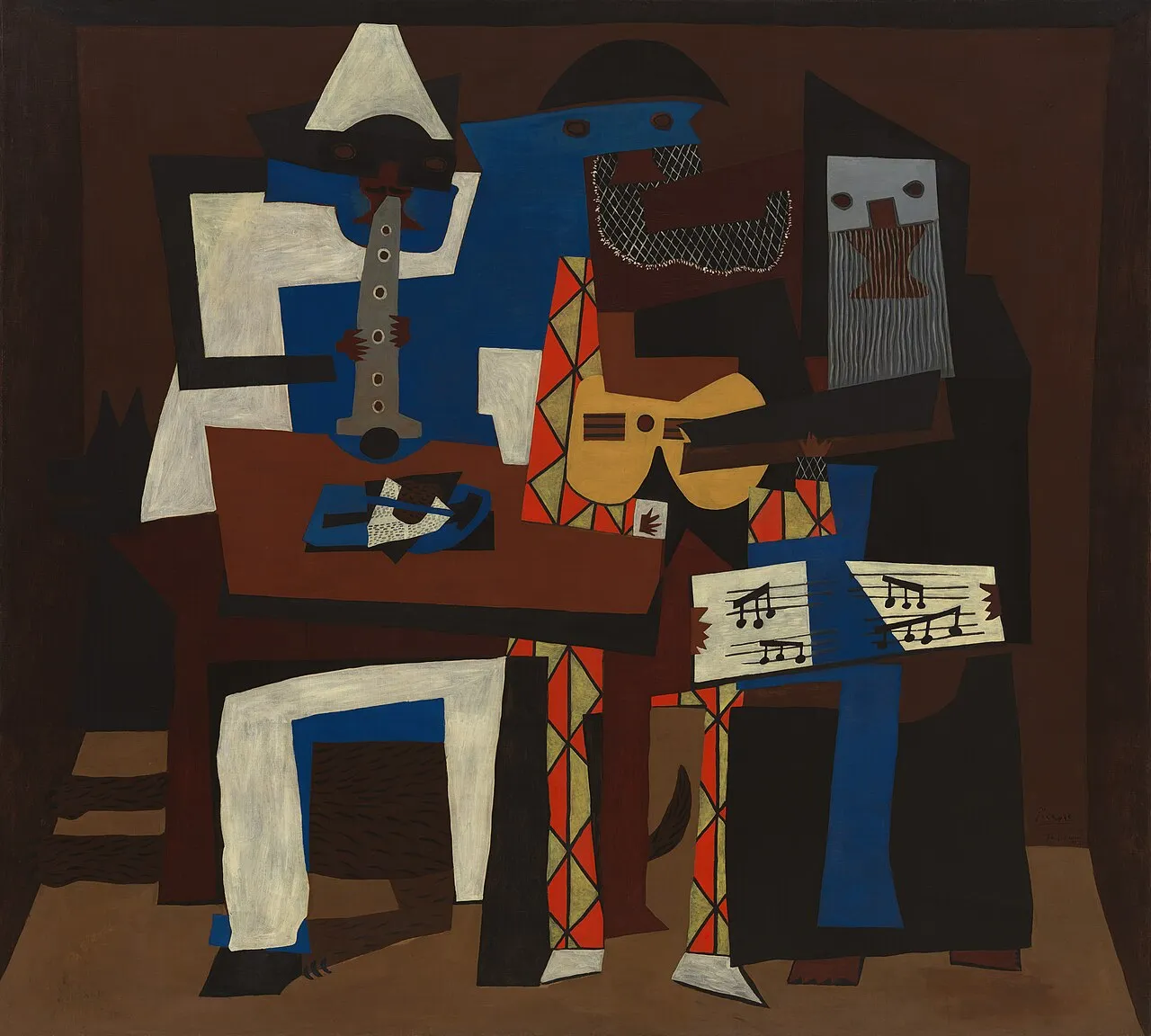
Three Musicians
1921
- Dimensions
- 200.7 × 222.9 cm
- Medium
- Oil on canvas
- Collection
- The Museum of Modern Art (MoMA)
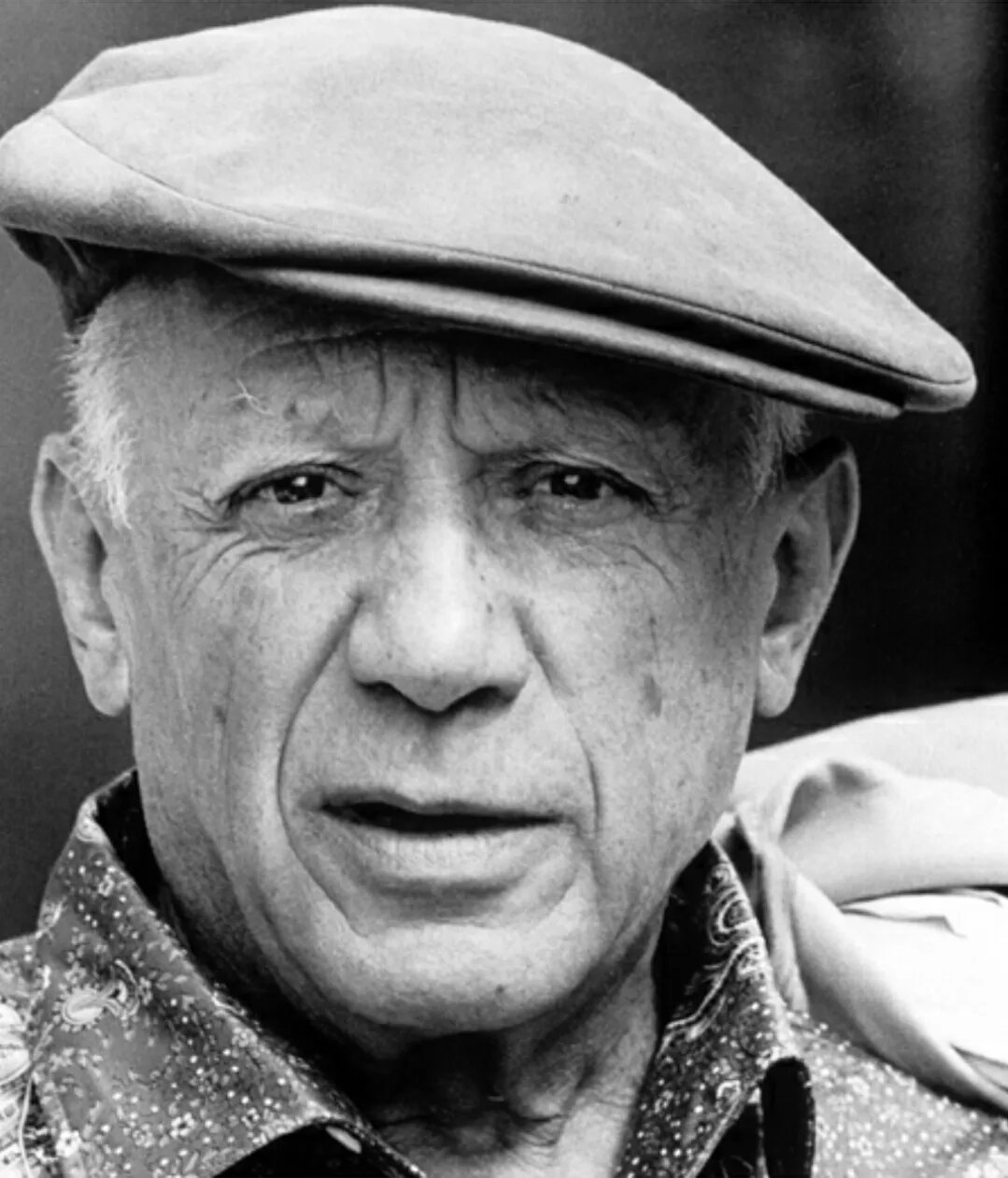
A Spanish-born painter who brought an end to the traditional practice of project…
A monumental canvas serving as a fierce defiance against claims that he had abandoned his past visual language. A quiet elegy in oil, preserving an eternal ensemble with departed friends.
✦ Highlights (technique & color)
This work is a "virtual collage," recreating the cut-and-paste paper technique solely through flat planes of oil paint. By precisely delineating the boundaries of each color field and layering the paint, Picasso achieved subtle variations in relief across the surface, conveying distinct tactile textures.
✦ The setting of this painting
In the summer of 1921, Picasso stayed with his family at a villa in Fontainebleau, an upscale resort town near Paris. The painting was created in a cramped, makeshift garage on the estate, with exposed walls and ceiling. The depicted setting is not a real room, but an abstract, conceptual space reminiscent of a theatrical stage set.
✦ Historical context
Post-World War I Europe. In reaction to the devastating ravages of war, the art world was dominated by the "Return to Order"—a movement that eschewed avant-garde disruption in favor of stability and classical harmony. During this period, Picasso was also actively exploring his own Neoclassical style.
In a room resembling a shallow stage,
three masked figures sit side by side behind a table.
From left to right: a clarinet, a guitar, and a singer.
On the table rest a pipe and a packet of tobacco, while at their feet, a dog lies like a shadow.
Shapes of colored paper, cut with scissors and assembled like a jigsaw puzzle—
that is how it might appear at first glance.
Indeed, this painting is often described
as a monumental collage of paper and newsprint.
Yet in truth, not a single piece of paper was used.
The entire work is rendered in oil paint alone.
The summer of 1921.
Picasso was staying in Fontainebleau, an elegant resort outside Paris.
Accompanied by his wife Olga, a former dancer with the Ballets Russes, and their newborn son,
he was enjoying a period of bourgeois stability and financial comfort.
His makeshift studio was a garage on the grounds of the rented villa.
In this cramped space with exposed walls and ceiling, he tacked the monumental canvas directly to the wall.
At the time, the art world was undergoing a profound transformation in the aftermath of World War I:
the "Return to Order," a movement that turned away from avant-garde disruption in favor of tradition and harmony.
Picasso himself had begun painting neoclassical figures inspired by antiquity.
The art world whispered:
Picasso has abandoned Cubism.
In defiance.
He pinned a classical composition side by side with this work on the garage wall,
working on two entirely antithetical paintings at the same time.
It was a bold challenge: to execute the visual language of paper collage purely in flat planes of oil paint on a grand scale.
It was his declaration that he had never forsaken the revolutionary method he had created.
Who, then, are these three musicians?
At the center, playing the guitar, is Harlequin in a diamond-patterned costume of red and yellow.
Evoking the colors of the Spanish flag, this figure is widely seen as Picasso himself.
On the left, the Pierrot in white is the poet Guillaume Apollinaire,
his dearest companion who succumbed to the Spanish flu in 1918.
Dressed as an ephemeral white clown, he appears as if mourned in silence.
On the right, the monk cloaked in black is the poet Max Jacob.
A close friend from their earliest days, in June 1921—just before this work was painted—
he had abandoned Parisian bohemian life to retreat into a monastery.
About 88 more words
Unlock this story's ending, and every article on MusicStory
- 42
Stories1–2 new every week
An archive of paintings paired with great music, made for a weekend night and a cup of coffee
- 282
Paintings with commentarygrowing daily
From simply looking to truly reading — the brushwork and the obsession of the masters
- 10
Music Librarygrowing daily
Know it first, and what reaches your ear changes — background music becomes art you keep for life
My Notes, unlimited
Every reading adds to a digital art notebook that is yours alone
Already have an account? Log in
Your Note
Write down what this painting made you feel in your art notebook.
Please sign up to write notes.
Sign up for freeRecommended Artworks
%2C_by_Diego_Vela%CC%81zquez.webp)
Sources & references
More artists
If you find an error in this content, please let us know here
This site is protected by reCAPTCHA, and the Google Privacy Policy and Terms of Service apply.