
Les Demoiselles d'Avignon
1907
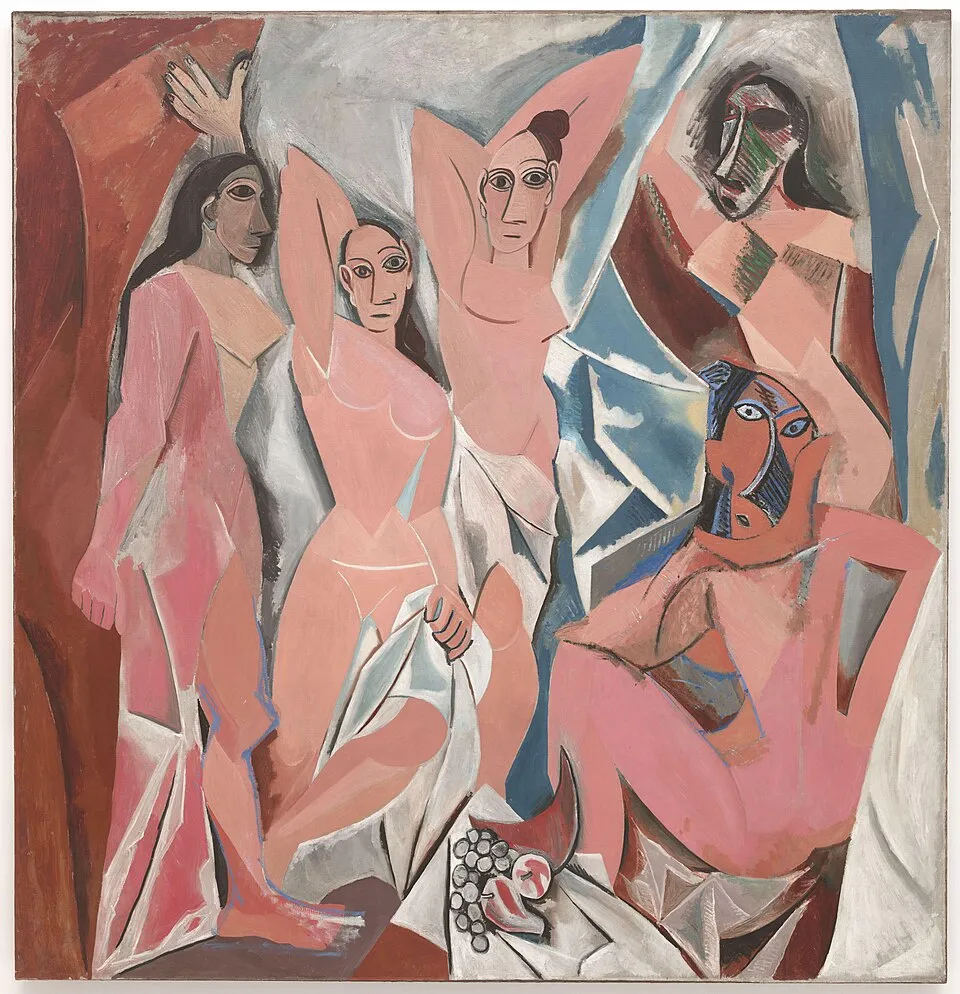
Image: By Pablo Picasso - Museum of Modern Art, New York, PD-US, https://en.wikipedia.org/w/index.php?curid=547064
- Dimensions
- 243.9 cm × 233.7 cm
- Medium
- Oil on canvas
- Collection
- The Museum of Modern Art (MoMA), New York
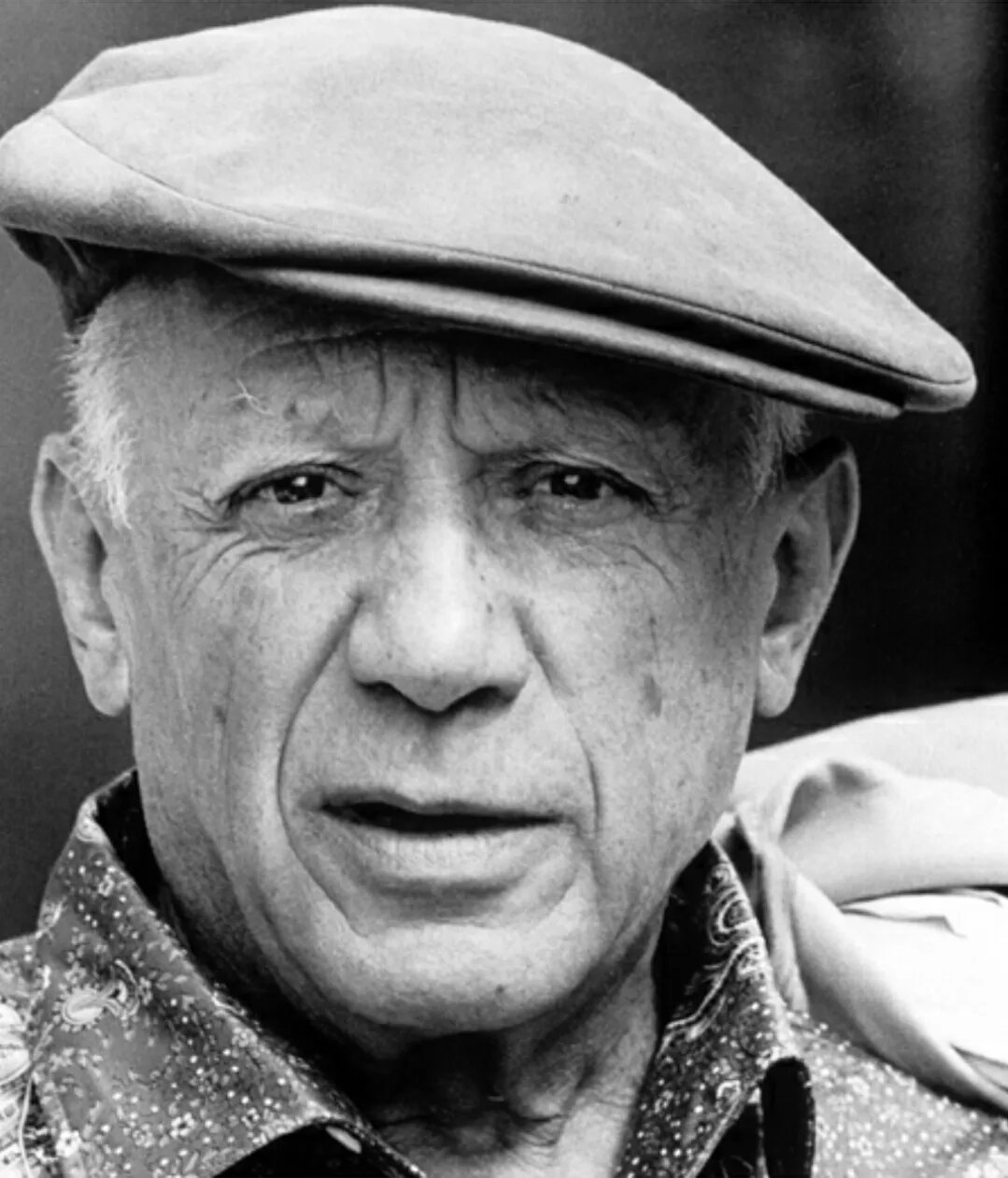
A Spanish-born painter who brought an end to the traditional practice of project…
Driven by a fierce rivalry with Matisse's success and an ambition to dismantle the conventions of Western painting, the artist channeled the raw desires from his memories of the brothel to create a geometric space that directly confronts and provokes the viewer.
✦ Highlights (technique & color)
The application of paint varies dramatically across different areas of the canvas. While the central figures are rendered with smooth, thin layers, the figures on the right and the background are heavily encrusted with rough, thick impasto, likely worked with a palette knife. In addition, parallel diagonal strokes of red and green are slashed across the face in the upper right, generating intense visual tension.
✦ The setting of this painting
The setting is a brothel on Carrer d'Avinyó (Avignon Street) in the old quarter of Barcelona, Spain. In the early 20th century, this was a bawdy red-light district frequented by sailors, young bohemians, and artists. The blue and brown fabrics depicted in the background represent interior drapery, yet the collapsed perspective flattens the scene, creating a claustrophobic, shallow stage-like space.
✦ Historical context
In early-1900s Paris, the expansion of Western imperialism brought a massive influx of colonial artifacts looted from Africa and Oceania. It was also a pivotal era of scientific upheaval, as breakthroughs such as the discovery of X-rays and the publication of the theory of special relativity began to dismantle the visible, Newtonian worldview.
Five larger-than-life female nudes crowd together in a shallow, confined space.
In the foreground lie pieces of fruit, including a slice of melon as sharp as a blade.
Les Demoiselles d'Avignon—an elegant title.
A painting depicting noblewomen from the beautiful French city of Avignon.
Or so one might assume.
Yet it does not refer to Avignon in France.
Rather, it depicts prostitutes from Carrer d'Avinyó, an actual street in Barcelona, Spain.
The word "demoiselles" was added later to soften the scandal.
The winter of 1906.
At the Bateau-Lavoir, a studio in Montmartre, Paris.
Twenty-five-year-old Pablo Picasso was just emerging from extreme poverty.
Yet his mind was far from at ease.
Henri Matisse's monumental Le Bonheur de Vivre was winning rapturous acclaim across the avant-garde art world.
A fierce sense of rivalry gripped him.
Picasso poured his heart and soul into conceiving a masterpiece that would overturn the traditions of Western painting.
It was not a commission from a patron.
It was conceived entirely on his own initiative.
For his subject, he chose a brothel in Barcelona he had frequented in his youth.
He created hundreds of preparatory studies.
In his initial composition, two men appeared alongside the five prostitutes.
One was a medical student carrying a book or a skull.
A figure of reason, mindful of the perils of venereal disease.
The other was a sailor drinking wine, surrounded by women.
A man indulging in physical desires.
An allegorical narrative.
Yet when working on the final canvas, Picasso completely removed both men.
He stripped away the storyline.
Then, in the summer of 1907, he drastically repainted the faces of the two figures on the right.
Resembling African tribal masks, they featured sharply angled noses and dark, hollow eye sockets.
These were faces forged as magical weapons against terrifying, unknown forces.
When the finished painting was unveiled in his studio,
the reaction from close friends and fellow artists was merciless.
There was intense outrage and bewilderment.
Matisse ridiculed it as a bad joke on modern art.
Georges Braque remarked, "It feels as though you want to make us drink gasoline and eat tow so that we can spit fire."
André Derain said:
"One day Picasso will hang himself behind this canvas."
About 195 more words
Unlock this story's ending, and every article on MusicStory
- 42
Stories1–2 new every week
An archive of paintings paired with great music, made for a weekend night and a cup of coffee
- 282
Paintings with commentarygrowing daily
From simply looking to truly reading — the brushwork and the obsession of the masters
- 10
Music Librarygrowing daily
Know it first, and what reaches your ear changes — background music becomes art you keep for life
My Notes, unlimited
Every reading adds to a digital art notebook that is yours alone
Already have an account? Log in
Your Note
Write down what this painting made you feel in your art notebook.
Please sign up to write notes.
Sign up for freeRecommended Artworks
%2C_by_Diego_Vela%CC%81zquez.webp)
Sources & references
More artists

If you find an error in this content, please let us know here
This site is protected by reCAPTCHA, and the Google Privacy Policy and Terms of Service apply.