
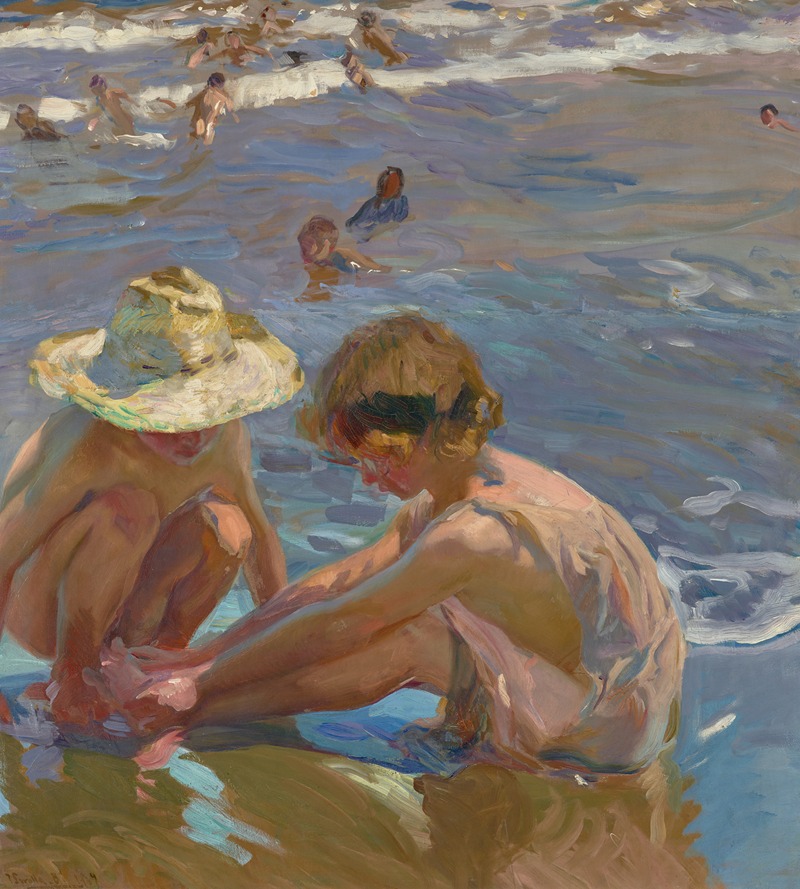
The Wounded Foot
1909
- Dimensions
- 109.2 × 99.7 cm
- Medium
- Oil on canvas
- Collection
- The J. Paul Getty Museum (Los Angeles, United States)
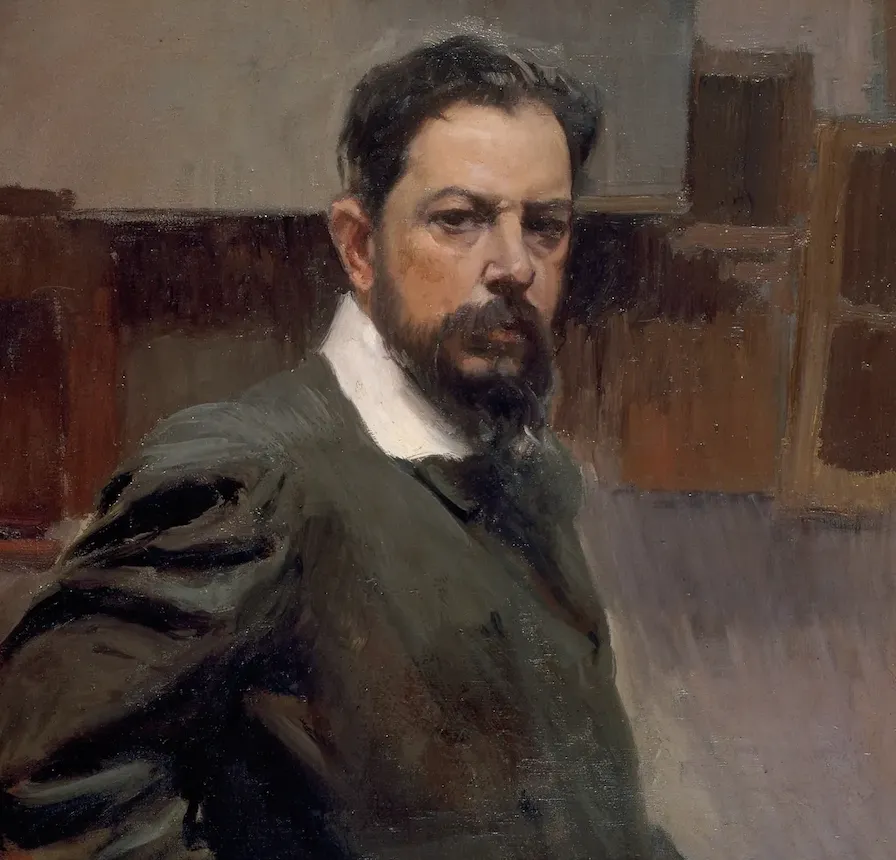
A defining figure of Spanish art who bridged the late nineteenth and early twent…
To present the pure vitality and tenderness of human beings free from social constraints. Although Sorolla achieved immense wealth and fame through his triumphant success in the United States, what he truly wished to depict was not figures in elegant attire, but nameless children of his homeland harmonizing with the sea. Without moral didacticism, he sought to immortalize the unvarnished radiance and fragility of life.
✦ Highlights (technique & color)
A key highlight is the rich interplay of reflected light cast by the low evening sun. Grounded in pink and blue shadows falling across the sand and skin, light is captured not as mere white, but as an accumulation of countless colors. By placing intense highlights on the girl's hand, the sand beneath their feet, and the boy's straw hat, Sorolla creates a meticulous visual pyramid that naturally guides the viewer's gaze toward the wounded foot.
✦ The setting of this painting
The setting is El Cabañal beach in Valencia, along the eastern coast of Spain. At the turn of the twentieth century, this was not a polished resort, but a rugged space steeped in the authentic rhythms of everyday life, where fishermen worked and local working-class children played naked by the water. Serving as a lifelong source of inspiration for Sorolla, it offered a scene where figures merged with nature under the radiant Mediterranean sun.
✦ Historical context
The year 1909 marked Sorolla's first solo exhibition in New York, a historic triumph that drew roughly 350,000 visitors. Against the backdrop of the Generation of '98, which sought national and spiritual renewal to dispel the gloom following Spain's defeat in the Spanish-American War of 1898, Sorolla cast aside the shadows of a fallen empire, presenting on canvas a vibrant Spain filled with vitality and the promise of a bright future.
A beach at dusk, shimmering with dazzling light.
A young girl looks down, nursing an injured foot,
while a boy peers with concern at her feet.
A humble, fleeting moment from the seaside lives
of nameless local children.
It seems a charming, yet ordinary scene.
Yet this painting was, in truth,
the single work that the global oil tycoon J. Paul Getty
pursued with the greatest obsession in his entire collection.
Let us turn back the clock a little.
In 1909, the painter Joaquín Sorolla
held his first solo exhibition in New York.
It was a historic triumph, drawing some 350,000 visitors.
Paintings sold for sums equivalent to millions of dollars today,
sparking an extraordinary fervor.
Having attained international renown and fortune,
Sorolla set off that summer
for El Cabañal beach in his native Valencia.
This was no polished resort where well-dressed vacationers gathered.
It was an untamed, earthy shore where fishermen labored
and working-class children played naked in the surf.
Sorolla employed no professional models,
choosing instead the local children he found there.
Unbound by social constraints and at one with nature, their vital energy
was captured onto his canvases with explosive speed.
When displayed during a traveling exhibition across the United States in 1911,
the painting was rapturously embraced by critics and the public alike
as "everybody's favorite."
That same year, it was purchased directly from the artist
by the financier Thomas Fortune Ryan.
Then, on November 24, 1933,
at an auction held in New York in the depths of the Great Depression,
the winning bidder was J. Paul Getty.
Getty gave Sorolla's painting pride of place in his California home,
taking pleasure in viewing it every day.
"There is no greater contrast than between the quiet of seventeenth-century Dutch painting
and Sorolla's brilliant depiction of sunlight."
"I simply bought what I liked,"
he later recalled.
Remarkably, out of his vast collection,
it was the provenance of this very painting that Getty spent the most time researching.
In 1973, he invited John Walsh, then director of the Getty Museum,
to his estate in Surrey, England.
Showing Walsh the painting in person,
Getty reportedly spoke with ardent passion about its authenticity
and the immense value of its flawless provenance.
About 142 more words
Read stories of masterpieces for free
Your Note
Write down what this painting made you feel in your art notebook.
Please sign up to write notes.
Sign up for freeRecommended Artworks
%2C_by_Diego_Vela%CC%81zquez.webp)
Sources & references
More artists
If you find an error in this content, please let us know here
This site is protected by reCAPTCHA, and the Google Privacy Policy and Terms of Service apply.