
Icarus, from Jazz
1947
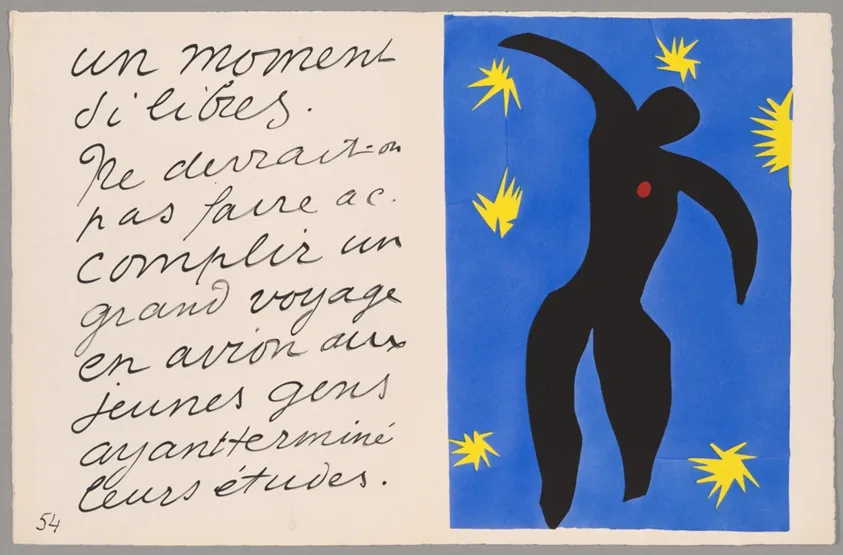
Image: Henri Matisse, Icarus, from Jazz, 1947Collection: The Art Institute of Chicago, Simeon B. Williams Fund© Succession H. Matisse / Artists Rights Society (ARS), New York
- Dimensions
- 42.2 × 65.3 cm(見開き展開時)
- Medium
- Pochoir (gouache stencil) on Arches wove paper, with lithographed text
- Collection
- Centre Pompidou, The Museum of Modern Art (MoMA), and others

A French visual artist of the early 20th century, he detached color from the imi…
A powerful hymn to indomitable human dignity and life in defiance of wartime darkness and the terror of death. A flight of the soul, capturing the radiance of a human figure soaring through a starry sky, sculpted with scissors and burning passion.
✦ Highlights (technique & color)
The groundbreaking technique of the cut-out (gouache découpée). Matisse wielded scissors to cut shapes directly from paper painted with gouache by his assistants. The deep ultramarine background and yellow stars create a striking complementary contrast, instantly drawing the viewer's gaze to the single vermilion point on the silhouette's chest.
✦ The setting of this painting
Within the composition, ancient Greek mythology converges with the artist's inner world across a cosmic expanse. Eschewing representational perspective, expanses of deep blue evoke an infinite celestial realm. In reality, the work was created at Villa Le Rêve in Vence, southern France—a rented home shrouded in the tensions of wartime occupation, with blackouts enforced and air-raid sirens piercing the night.
✦ Historical context
France under Nazi German occupation during World War II. Amid severe censorship of speech and art, Matisse's family joined the French Resistance. Against this harrowing backdrop, marked by his daughter's torture by the Gestapo, this work emerged as a vibrant blossoming of color symbolizing human freedom and the liberation of the spirit.
Yellow stars are scattered across a deep blue night sky.
Through it, a black silhouette of a figure drifts downward with arms outstretched.
The title is "Icarus," included in the art book "Jazz."
With its vivid colors and rhythmic composition, it is often assumed to have been created playfully while listening to cheerful music.
Others see it as a cautionary tale of human folly, drawing on the Greek myth of Icarus, who challenged the gods and plummeted to his death.
Yet in truth, what this artwork embodies is neither carefree gaiety nor the terror of death.
In 1943, as the flames of World War II intensified across France,
Henri Matisse sought refuge from the threat of air raids at the villa "Le Rêve" in Vence, southern France.
Tense days were filled with nighttime blackouts and wailing air-raid sirens.
For a time, the villa's basement was even requisitioned as a canteen for German soldiers.
Moreover, Matisse's own physical condition had reached its breaking point.
He suffered severe aftereffects from major surgery in 1941.
He could no longer stand for extended periods or paint in oils at an easel.
Plagued by insomnia, bound in an iron corset around his abdomen, he spent his days confined to a wheelchair or bed.
Tragedy also struck his family.
His estranged wife and children had thrown themselves into the French Resistance.
In 1944, his daughter Marguerite was arrested by the Gestapo.
She endured brutal torture before being put on a train bound for a concentration camp.
In the depths of despair and fear,
amidst the darkness, Matisse embarked on a new form of expression.
He used scissors to cut directly into paper colored with gouache by his assistants.
This marked the birth of his cut-outs—"cutting directly into color."
It was the only art left to him, an endeavor he could pursue entirely within the reach of his wheelchair.
About 199 more words
Unlock this story's ending, and every article on MusicStory
- 42
Stories1–2 new every week
An archive of paintings paired with great music, made for a weekend night and a cup of coffee
- 319
Paintings with commentarygrowing daily
From simply looking to truly reading — the brushwork and the obsession of the masters
- 10
Music Librarygrowing daily
Know it first, and what reaches your ear changes — background music becomes art you keep for life
My Notes, unlimited
Every reading adds to a digital art notebook that is yours alone
Already have an account? Log in
Your Note
Write down what this painting made you feel in your art notebook.
Please sign up to write notes.
Sign up for freeRecommended Artworks
Sources & references
More artists







If you find an error in this content, please let us know here
This site is protected by reCAPTCHA, and the Google Privacy Policy and Terms of Service apply.