
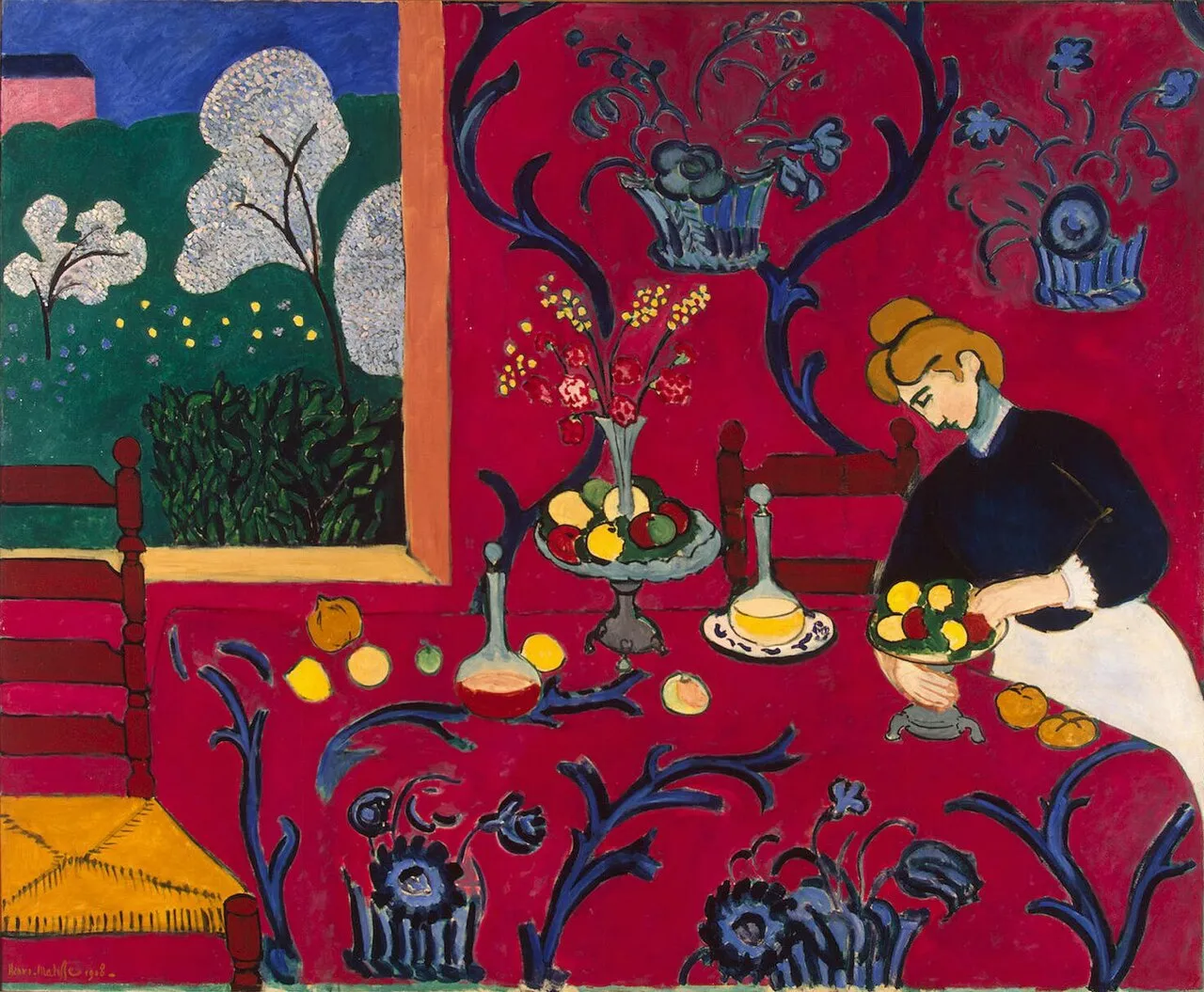
The Dessert: Harmony in Red (The Red Room)
1908
- Dimensions
- 180.5 × 221.0 cm
- Medium
- Oil on canvas
- Collection
- The State Hermitage Museum, St. Petersburg
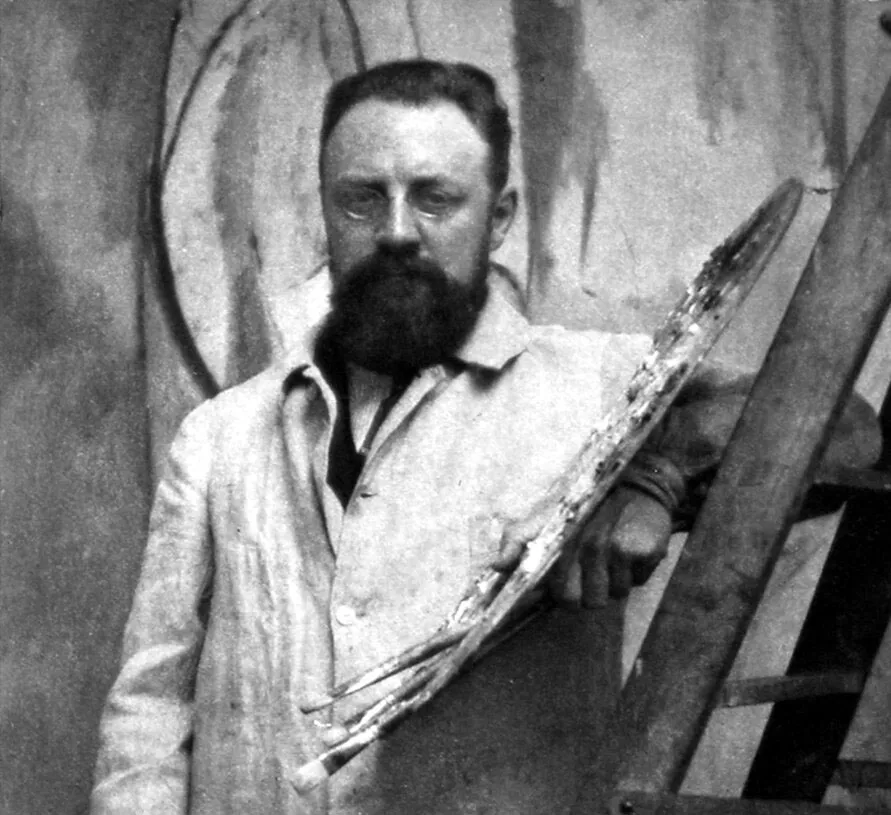
A French visual artist of the early 20th century, he detached color from the imi…
An uncompromising thirst for color and a fierce devotion to autonomous pictorial space. A solitary resolve that set aside even a patron's acclaim to pursue decorative harmony to its ultimate ideal.
✦ Highlights (technique & color)
The vivid red enveloping the canvas is far from a flat, uniform layer. Beneath the cadmium red lies an earlier layer of deep blue. At the top of the canvas and along the contours of the motifs, Matisse deliberately allowed subtle traces of this underlying blue to remain visible. This creates delicate modulations of tone across the red field, imbuing the composition with visual depth and vitality.
✦ The setting of this painting
The setting is Matisse's studio on the Rue de Sèvres or at the former Hôtel Biron in Paris. Rather than a depiction of an actual room, it is an imagined space conceived in the artist's mind, bringing together his own chair, a decanter, and a cherished blue arabesque printed cotton fabric. Outside the window, trees in white blossom evoke early spring in the Parisian suburbs.
✦ Historical context
The year 1908 marked a momentous turning point in twentieth-century art history. As the Fauvist movement lost its cohesion and Picasso and his circle began pioneering Cubism, Matisse was seeking a transition from stark contrasts of primary colors to decorative harmony on a grand scale. That same year, he famously declared his desire for an art that would offer mental relaxation, like a comfortable armchair.
An interior where vivid red walls merge seamlessly with the table.
A maid in blue work clothes quietly arranges fruit.
It is easy to assume that this masterpiece was conceived in this intense red from the very beginning—
or perhaps that the commissioner requested it to be painted red.
In truth, however, that was not the case.
This painting was originally a blue painting.
Without a word to his patron, the artist took it upon himself to paint over it entirely in red.
Paris, 1908.
Henri Matisse received a commission from the Russian collector Sergei Shchukin:
a large decorative panel for the dining room of his Moscow mansion.
The fee was 4,000 francs.
For Matisse at the time, it was a crucial lifeline to escape financial hardship.
Around this period, Matisse stood at a major turning point.
The Fauvist movement he had once led was already losing its cohesion.
As his rivals, including Picasso, began pioneering new forms of expression, Matisse was also seeking a transition toward decorative order and harmony.
An art that soothes mental fatigue, like a good armchair—
that was the new harmony Matisse aspired to create.
He arranged his own belongings around the studio and began constructing an ideal space:
a wooden chair, a glass decanter,
and a printed cotton fabric with a blue arabesque pattern that he had treasured for years.
At first, Matisse began painting the canvas in green.
Unsatisfied, however, he covered it in deep blue.
Thus, "Harmony in Blue" was completed.
Exhibited at the Salon d'Automne later that year, the blue painting won lavish praise from Shchukin.
The purchase was happily finalized.
All that remained was to ship it to Moscow.
Yet in the spring of 1909,
just before shipping, Matisse stood in his studio, gazing intently at the painting.
Outside the window, white blossoms were blooming in the Parisian suburbs.
Something was missing.
The decorative power and the overall harmony of the canvas were not yet enough.
The patron loved the blue painting and had already paid for it.
Under ordinary circumstances, one would simply send it as it was.
He painted over it.
Without consulting anyone, Matisse layered a vivid red over the blue canvas.
He chose his own artistic quest over financial security.
About 145 more words
Read stories of masterpieces for free
Your Note
Write down what this painting made you feel in your art notebook.
Please sign up to write notes.
Sign up for freeRecommended Artworks
Sources & references
More artists






If you find an error in this content, please let us know here
This site is protected by reCAPTCHA, and the Google Privacy Policy and Terms of Service apply.