
The Birth of Venus
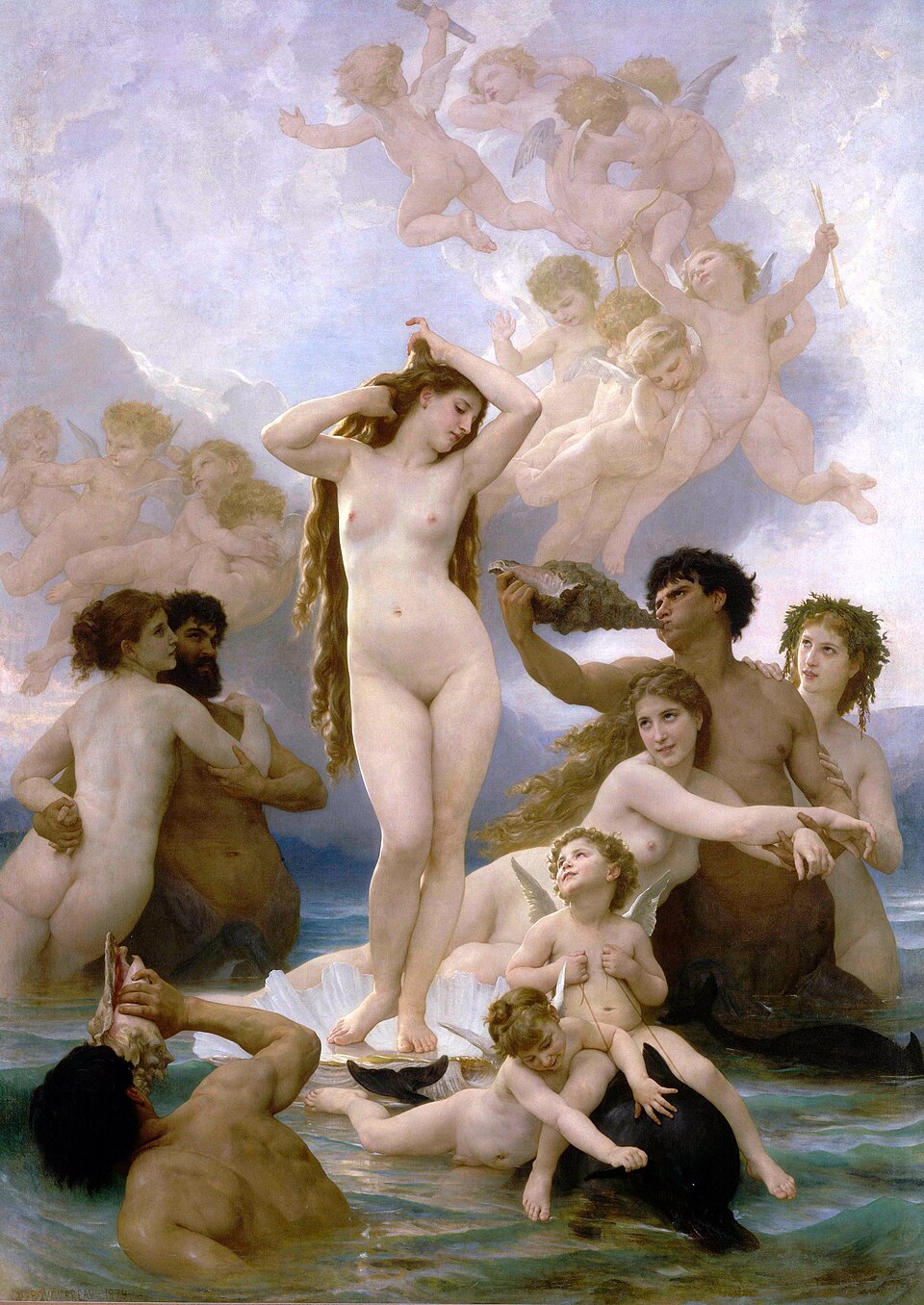
- Dimensions
- 300.0 × 218.0 cm
- Medium
- Oil on canvas
- Collection
- Musée d'Orsay, Paris

An unwavering pursuit of classical ideal beauty in the depths of despair following the loss of his beloved family. Like coaxing light from darkness, it was a work forged as a solace for the soul, filling an agonizing grief and a profound inner void.
✦ Highlights (technique & color)
The painting's crowning achievement is its impeccably smooth finish, entirely free of visible brushstrokes. Through the meticulous layering of whisper-thin, translucent glazes over opaque flesh tones, the artist achieved a pearlescent luminosity and skin that seems imbued with genuine warmth. The exquisite color contrast between the cool blue backdrop and the radiant, warm flesh tones is equally striking.
✦ The setting of this painting
The scene is set in the waters near Paphos on Cyprus, or off the sacred island of Cythera, drawn from classical Greek mythology. It is dawn; the sky catches the morning light, as soft pink and golden rays pierce through the clouds. The gentle west wind, Zephyrus, sweeps across the canvas, lightly stirring the goddess's golden tresses and the draperies of her attendants.
✦ Historical context
France in 1879, under the Third Republic. Emerging from the defeat and turmoil of the Franco-Prussian War, the state actively championed Academic art—celebrated for its moral dignity and technical mastery—to foster civic unity. At the same time, this was the year Monet, Degas, and the Impressionists held their Fourth Impressionist Exhibition, marking a period of sharp conflict between traditional and modern visions of art.
A calm, turquoise-blue expanse of sea.
Atop a pearlescent scallop shell stands a goddess, lifting her cascading golden hair.
She is surrounded by sea gods blowing into conch shells.
Supple, nude nymphs recline across the water's surface, gazing at her in adoration.
Putti soar through the sky casting down garlands, celebrating the birth of the goddess.
William-Adolphe Bouguereau, a leading master of 19th-century French academic art.
This was his crowning masterpiece, exhibited at the Salon of 1879 to immense acclaim.
Yet the critic Huysmans fiercely condemned the work,
dismissing it as little more than a poorly inflated rubber balloon—
a creature devoid of muscle and blood, resembling the soft flesh of an octopus.
His contemporary Degas also mocked the porcelain finish that left no trace of a brushstroke.
To champions of the Impressionists, the painting was hopelessly out of touch:
an empty, saccharine nude rendered by a conservative painter cloaked in the establishment's favor.
It was often spoken of in such terms.
Yet the truth is quite different.
This flawless ideal of beauty was born from the depths of profound despair.
In 1877,
Bouguereau was struck by the greatest tragedy of his life.
His beloved wife, Marie-Nelly Monchablon,
and their young son, Georges,
succumbed to tuberculosis in rapid succession.
What remained was deep anguish,
and an unbearable emptiness of the soul.
There was nowhere to turn.
The painter confined himself to his studio on the Rue Notre-Dame-des-Champs in Paris,
immersing himself in work with relentless intensity.
From the latter half of 1878 through the spring of the following year,
he stood continuously before this monumental canvas, measuring three meters tall.
It was not a commission from a patron,
but an endeavor undertaken entirely of his own volition.
Hiring several professional models, he drew precise studies of each individual feature—heads, arms, and legs.
His aim was not to depict living human flesh as it existed in reality, but a classical ideal that lived only in the mind.
He sought to reconstruct it geometrically, forging a state of perfect harmony.
About 145 more words
Unlock this story's ending, and every article on MusicStory
- 42
Stories1–2 new every week
An archive of paintings paired with great music, made for a weekend night and a cup of coffee
- 282
Paintings with commentarygrowing daily
From simply looking to truly reading — the brushwork and the obsession of the masters
- 10
Music Librarygrowing daily
Know it first, and what reaches your ear changes — background music becomes art you keep for life
My Notes, unlimited
Every reading adds to a digital art notebook that is yours alone
Already have an account? Log in
Your Note
Write down what this painting made you feel in your art notebook.
Please sign up to write notes.
Sign up for freeRecommended Artworks
_1893.webp)
Sources & references
More artists






If you find an error in this content, please let us know here
This site is protected by reCAPTCHA, and the Google Privacy Policy and Terms of Service apply.