
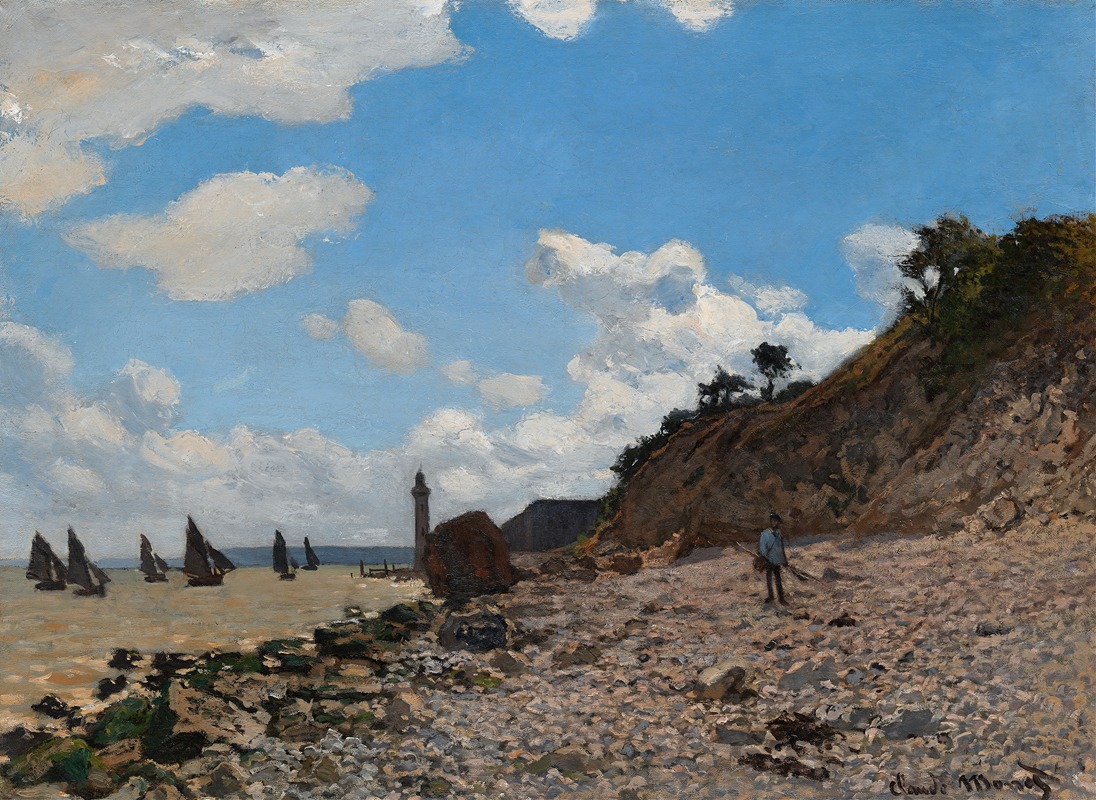
The Beach at Honfleur
1864
- Dimensions
- 59.69 × 81.28 cm
- Medium
- Oil on canvas
- Collection
- Los Angeles County Museum of Art
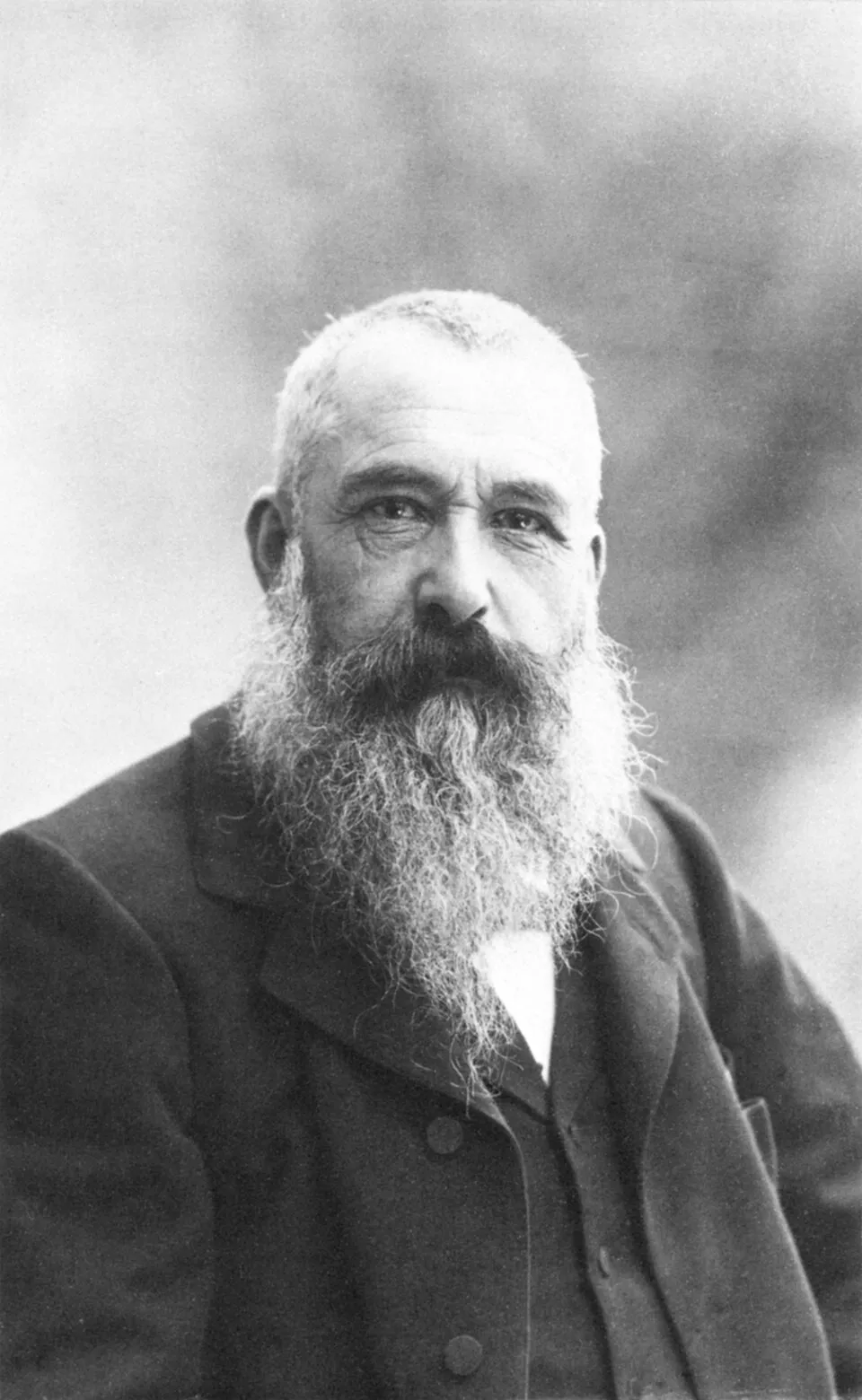
Celebrated as a founding figure of Impressionism, he is one of France’s most ren…
✦ Highlights (technique & color)
The composition is defined by the contrast between the sky, which occupies roughly two-thirds of the canvas, and the beach in the foreground. Earth tones are thickly layered along the shoreline, evoking the tactile texture of pebbles and wet sand through the density of the paint. The solitary fisherman in blue workwear serves as a visual scale, accentuating the sheer vastness of nature.
✦ The setting of this painting
The scene is set on the beach stretching beneath the cliffs known as the Côte de Grâce in Honfleur, a port town at the estuary on the left bank of the Seine in Normandy, northern France. Steep cliffs covered in wild vegetation jut out over a rugged shore scattered with pebbles and cobbles, while the delicate silhouettes of a traditional wooden lighthouse and a quarantine hospital appear along the distant horizon.
✦ Historical context
During the 1860s, the Normandy coast was rapidly transforming into a modern resort destination with the expansion of the railway from Paris. In the art world, while Realism was in its ascendancy, a burgeoning movement toward plein-air painting was gaining momentum among young artists who sought to capture the atmosphere and the motion of the waves directly under natural light.
Dynamic clouds drift across a vast, pale blue sky.
Beneath rugged cliffs, on a desolate shoreline scattered with boulders and pebbles, stands a solitary fisherman in blue workwear.
Summer, 1864.
Claude Monet, then a 23-year-old art student, was growing increasingly frustrated with the academic teachings in Paris.
He invited his fellow student Frédéric Bazille on a painting trip to Honfleur, a port town in Normandy.
Just across the estuary in Sainte-Adresse, his parents owned a summer villa, making the region a familiar second home to him.
At the time, Monet was facing severe financial hardship.
Extending a helping hand was the painter Johan Barthold Jongkind.
Monet received technical guidance from him, learning how to capture the atmosphere and the motion of waves directly under natural light.
In later years, Monet recalled:
"It was Jongkind who truly completed the education of my eye and taught me how to understand light."
Upon returning to Paris, Monet and Bazille rented a shared studio on Rue Furstenberg.
In a painting of the studio that Bazille made in 1866, an unfinished version of this seascape can be seen hanging on the wall.
It offers clear testament to the deep bond of artistic trust between them.
About 118 more words
Sign up free and enter Your Museum
Read the stories behind great paintings and music for free, in Your Museum
Your Note
Write down what this painting made you feel in your art notebook.
Please sign up to write notes.
Sign up for freeRecommended Artworks
_Claude_Monet_-_Muse%CC%81e_des_Beaux-Arts_de_Lyon_(W821)+(1).webp)
Sources & references
More artists
If you find an error in this content, please let us know here
This site is protected by reCAPTCHA, and the Google Privacy Policy and Terms of Service apply.