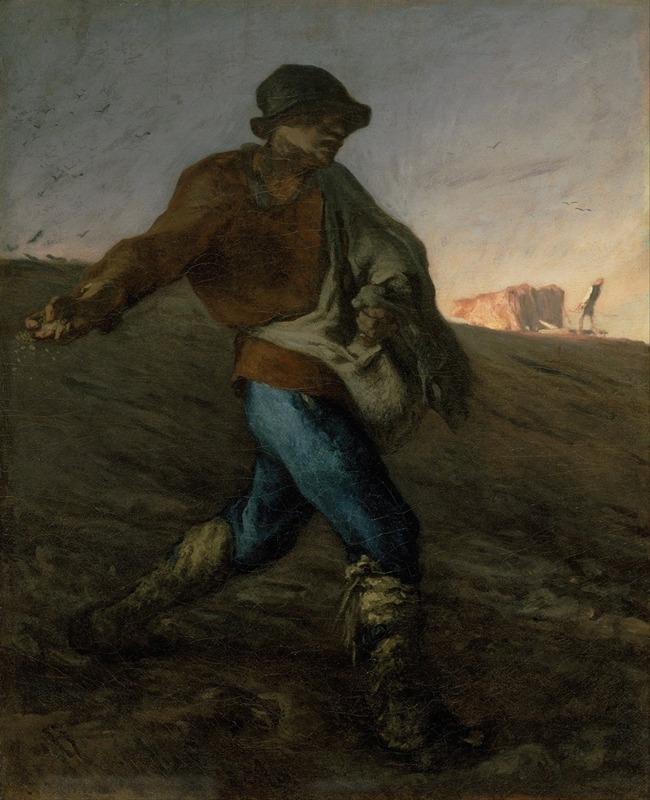
A nineteenth-century French painter who portrayed peasant labor through the rigorous compositions once reserved solely for history painting, elevating the physical gestures of the nameless into a universal human destiny.
LifeLife and works
Jean-François Millet was born in 1814 in the Norman village of Gruchy. His family were prosperous, landowning farmers, and under the tutelage of an uncle who was a priest, he studied Latin from an early age, cultivating the classical learning required to read authors such as Virgil in the original. Aspiring to become a painter, he began his formal artistic training in Cherbourg at nineteen, before moving to Paris at twenty-five on a scholarship. At the École des Beaux-Arts, he studied under the master of history painting Paul Delaroche; however, after failing to win the Prix de Rome, his scholarship was rescinded. Plunged into acute poverty, he supported himself by painting street portraits and shop signs for a few francs, as well as delicate, decorative works in the Rococo manner of François Boucher.
The Revolution of 1848 and an outbreak of cholera in Paris marked a turning point in his artistic trajectory. At the Salon that year, he exhibited The Winnower, depicting an anonymous laborer winnowing grain, which was promptly acquired by the French government. The following year, in 1849, Millet moved with his family to the village of Barbizon on the edge of the Forest of Fontainebleau. From that moment on, he made the rustic landscape and the everyday life of the peasantry his central subjects.
Presented at the Salon of 1850, The Sower filled the canvas with the monumental figure of a farmworker striding vigorously across the dark earth to cast his seeds. In the art world of the time, history and religious painting occupied the highest tier of the academic hierarchy, while peasant life was customarily confined to comic genre scenes or idealized pastoral idylls. Millet, however, applied traditional grand-manner principles—the rigorous compositions of Nicolas Poussin studied at the Louvre, the muscular forms of Michelangelo, and the dramatic chiaroscuro of Diego Velázquez—to the tangible realities of agricultural labor. Conservative critics fiercely denounced the work as an incitement to socialism, yet Millet himself remained aloof from political movements, viewing labor instead as a fundamental human destiny resonating with the Old Testament and classical poetry.
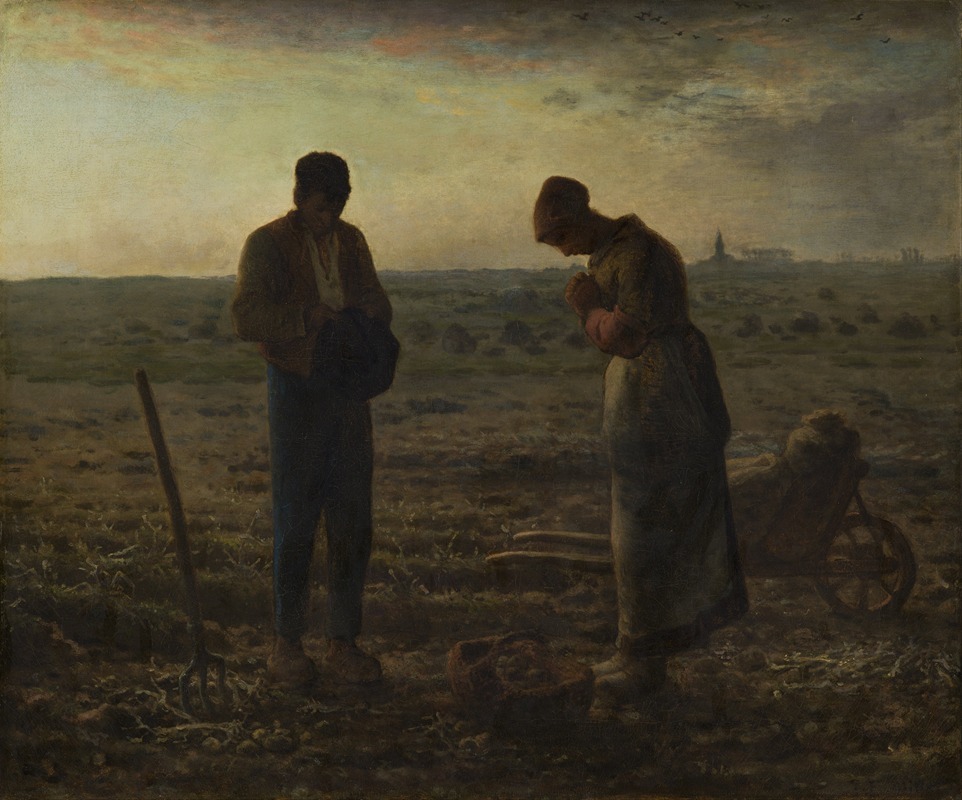
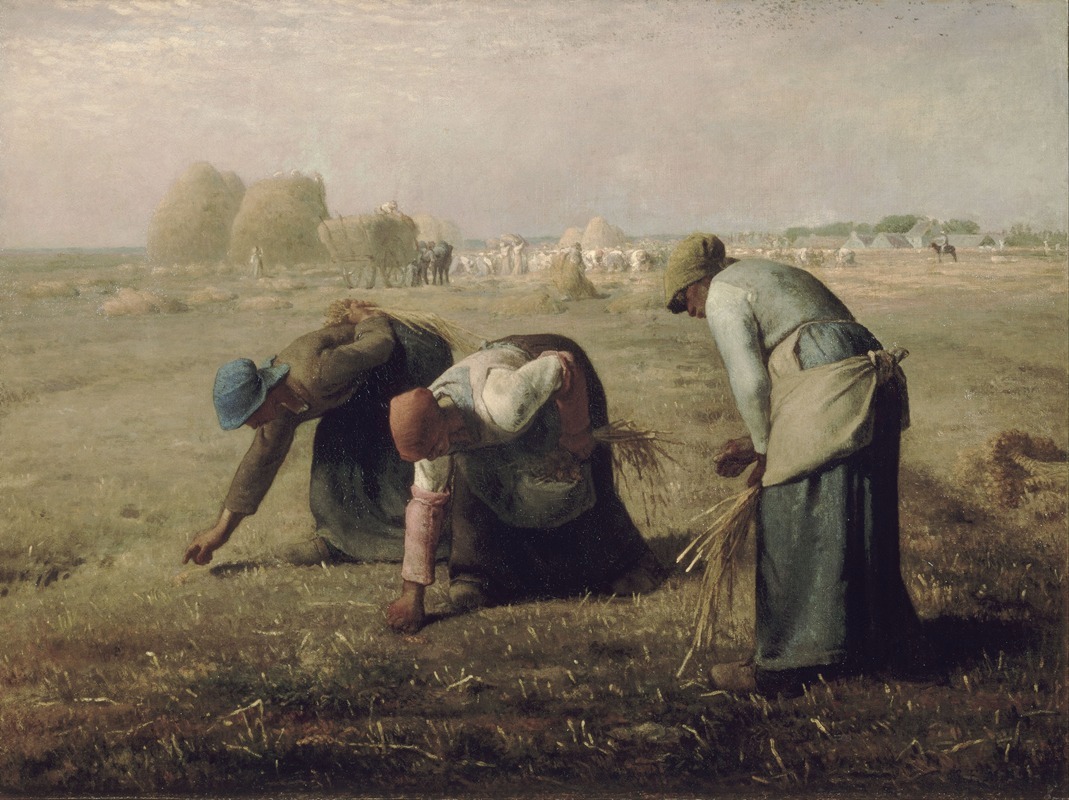
Life in Barbizon was far from easy, and Millet often struggled with debts, even to the local baker. In 1850, he reached an agreement with the art dealer Alfred Sensier, receiving a monthly stipend and painting materials in exchange for regular shipments of work. Among the creations of this period was The Gleaners, which brought to the foreground women from the poorest rural strata gathering leftover ears of wheat after the estate's harvest. During these years, he also conceived The Angelus, portraying a couple pausing at dusk to pray across the open plain at the distant sound of church bells.
In 1864, Millet won a first-class medal at the Salon for Shepherdess with Her Flock, a portrayal of a young girl tending her sheep against a glowing sunset. The painting earned acclaim from critics and the public alike, finally bringing stability to his finances. Major commissions from patrons followed, and in his later years, Millet's focus shifted from figure-dominated compositions toward the vital forces of nature itself—light, atmosphere, and the turn of the seasons. In Spring, part of a cycle commissioned by an industrialist, he captured the fresh vitality of rain-cleared skies, an arching rainbow, and budding trees.
Following his death in 1875 at the age of sixty, Millet's works soared in value on the art market. In an 1889 auction, The Angelus was purchased for 553,000 francs—at the time the highest price ever paid for a modern painting. The revelation that the artist's widow and children were living in penury while immense fortunes were being made from his work deeply unsettled French society, directly inspiring the 1920 establishment of the droit de suite, or resale royalty right, the first of its kind in the world. Today, The Angelus and The Gleaners reside in the Musée d'Orsay in Paris, while major versions of The Sower belong to the Museum of Fine Arts, Boston, and the Yamanashi Prefectural Museum in Japan. Millet's visions of rural life would be copied more than thirty times by Vincent van Gogh, passing directly into the canvases of the generation that followed.