
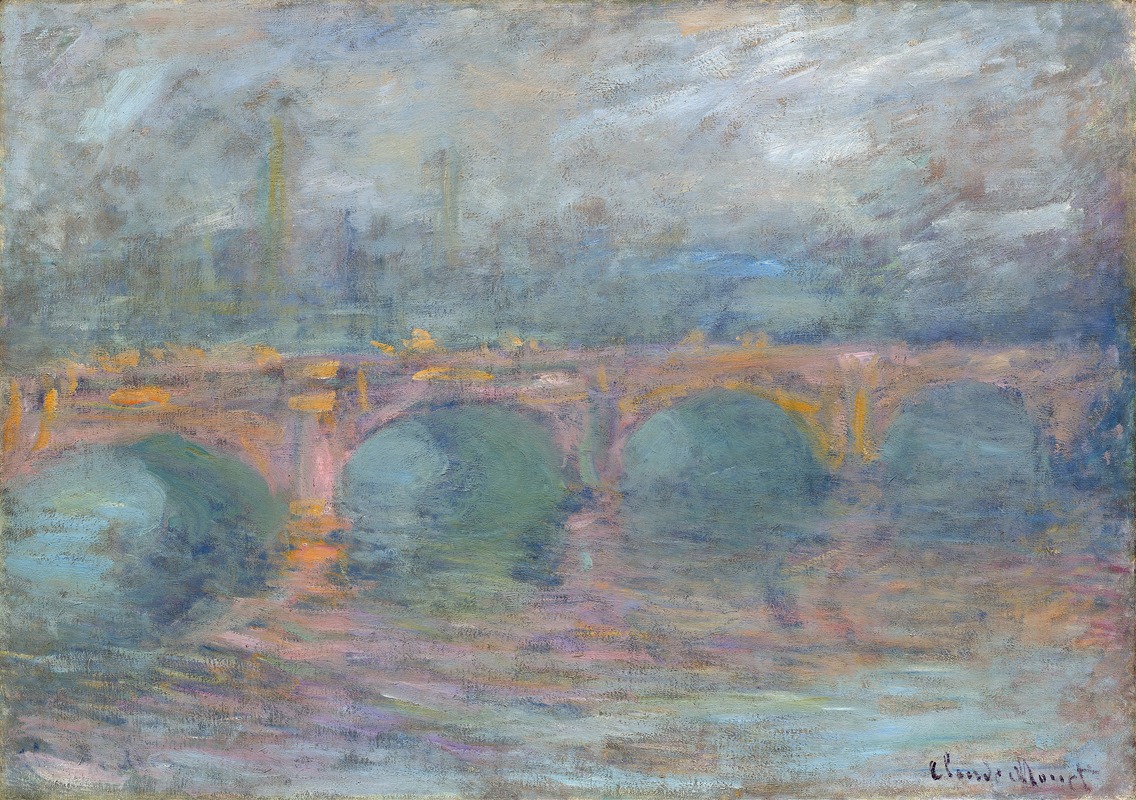
Waterloo Bridge, London at Sunset
1904
- Dimensions
- 65.5 × 92.7 cm
- Medium
- Oil on canvas
- Collection
- National Gallery of Art, Washington, D.C.
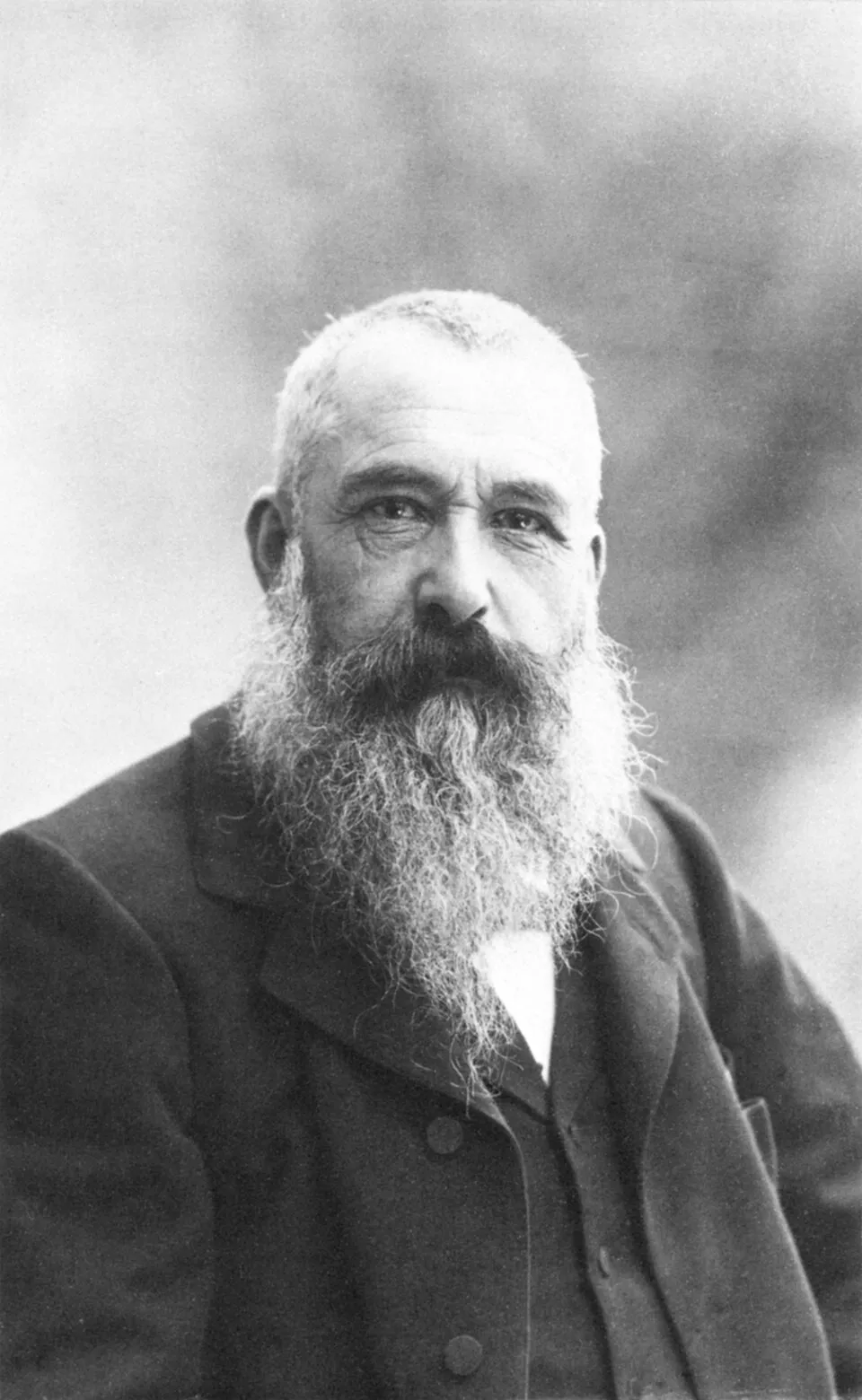
Celebrated as a founding figure of Impressionism, he is one of France’s most ren…
✦ Highlights (technique & color)
Dispensing with realistic detail, the artist conveys the impression of color and the palpable density of the mist. The upper sky is filled with cool tones like aquamarine blue, while the bridge's piers are rendered in warm shades such as cotton-candy pink. On the river's surface, these colors swirl together in intricate patterns, achieving an optical blend.
✦ The setting of this painting
The scene is set at the original Waterloo Bridge spanning the River Thames in central London. Looking eastward from the balcony of his sixth-floor room at the Savoy Hotel, Monet depicted the bridge alongside the cluster of industrial chimneys behind it. He captured the moment at dusk as the setting sun in the west bathes the bridge's piers in a warm crimson glow.
✦ Historical context
At the height of the Industrial Revolution, London was enveloped in thick soot generated from burning domestic coal and unrefined industrial fuel. This severe urban pollution, known as the "London fog" or smog, produced an opaque veil in the air and created extraordinary light-scattering effects.
A stone bridge quietly traverses the center of the canvas.
The sky and water are filled with shades of blue and green, while the arches of the bridge glow in pale pink.
Shrouded in a soft mist, it is an ethereal twilight scene.
At first glance, it appears to be a poetic work capturing a beautiful meteorological phenomenon woven by nature.
Yet in truth, this mist was not a creation of nature.
It was severe air pollution blanketing London at the height of the Industrial Revolution—
thick soot and smoke rising from domestic coal fires and raw coal burned in factories.
It was the infamous London smog.
In the autumn of 1899,
Claude Monet visited London.
He would return in the winters of 1900 and 1901.
He stayed in a sixth-floor room at the Savoy Hotel on the banks of the River Thames.
Looking east from his balcony, he could see the original Waterloo Bridge, opened in 1817.
Behind the stone bridge and its nine arches rose the smokestacks of an industrial district.
This urban pollution tormented residents and sullied the city.
Yet Monet was utterly captivated by this opaque atmospheric layer and the scattering of light it created.
"It is the winter fog that gives the city its true grandeur."
So he remarked in a later interview.
Without fog, London would not be a beautiful city;
it is the fog that gives London its magnificent scale.
To him, the smoke and smog were more than just a weather phenomenon.
It was a mysterious cloak that wrapped uniform structures,
transmuting man-made buildings and grimy factories into a fantasy of light.
For Monet, it became an indispensable artistic medium.
At dusk,
the sun sinks in the west, dyeing the bridge's piers in hues of red.
From his fixed viewpoint, Monet observed the scene and set to work on his canvas.
About 179 more words
Sign up free and enter Your Museum
Read the stories behind great paintings and music for free, in Your Museum
Your Note
Write down what this painting made you feel in your art notebook.
Please sign up to write notes.
Sign up for freeRecommended Artworks
Sources & references
More artists
If you find an error in this content, please let us know here
This site is protected by reCAPTCHA, and the Google Privacy Policy and Terms of Service apply.